

How Schools Can Evaluate a Teacher’s Demo Class in India – Complete Guide
Introduction
Hiring the right teacher is one of the most important decisions a school can make. A teacher may have excellent qualifications and a strong resume, but these alone cannot show how they perform in a real classroom. This is why a teacher's demo class has become an essential part of the recruitment process for many schools in India.
A demo class gives principals, academic coordinators, and hiring teams an opportunity to observe a candidate's teaching style, subject knowledge, communication skills, classroom management, and ability to engage students. It helps schools assess whether the teacher can create a positive learning environment and meet the needs of students.
However, many schools rely on personal opinions instead of a structured evaluation process during a demo class. This can lead to hiring mistakes and inconsistent decisions. Using a simple and standard evaluation method allows schools to compare candidates fairly and select the most suitable teacher for the role.
In this complete guide, we will discuss how schools can evaluate a teacher's demo class in India, the key factors to observe, common mistakes to avoid, and practical tips to improve the teacher hiring process. Whether you are a principal, school administrator, academic coordinator, or member of a hiring committee, this guide will help you make more informed and confident recruitment decisions.
How Schools Can Evaluate a Teacher's Demo Class in India
A teacher's demo class is one of the best ways for schools to assess a candidate before hiring. It helps principals and recruiters understand how a teacher explains concepts, manages the classroom, interacts with students, and creates a positive learning environment. Schools should evaluate a demo class based on subject knowledge, communication skills, classroom management, student engagement, lesson planning, confidence, and teaching methods. Using a simple evaluation checklist can help schools make better hiring decisions and reduce the risk of selecting the wrong candidate.
A Realistic School Scenario – Why a Demo Class Matters
A private school in India urgently needed a Mathematics teacher for Classes IX and X. The candidate had good qualifications and teaching experience, so the school hired them after an interview without conducting a demo class.
After a few months, students began struggling to understand the lessons. Although the teacher had strong subject knowledge, they found it difficult to explain concepts clearly and engage the class. The school's Mathematics results in the pre-board exams were lower than expected, and many parents raised concerns.
The management reviewed the situation and realised that a simple demo class could have revealed these teaching challenges before hiring. Since then, the school has made demo classes a mandatory part of its recruitment process.
The lesson is simple: A resume and interview can show a teacher's qualifications, but a demo class helps schools understand how effectively the candidate can teach and connect with students.
Why Is a Teacher Demo Class Important?
A teacher's demo class is one of the most important steps in the hiring process. A resume and interview can tell a school about a candidate's qualifications and experience, but they cannot show how the teacher performs in a real classroom.
During a demo class, schools can see how the teacher explains concepts, interacts with students, manages the classroom, and keeps learners engaged. It also helps assess the teacher's subject knowledge, communication skills, confidence, and teaching style.
A demo class gives schools a better understanding of whether the candidate is the right fit for their students and teaching environment. At the same time, it allows the teacher to experience the school's culture and classroom setting.
Simply put, a well-planned demo class helps schools make better hiring decisions, reduce the chances of a wrong selection, and build a stronger teaching team.
Read Also-Teacher Qualification for CBSE Schools in India – NCTE Norms & PRT TGT PGT Eligibility Guide
How Should Schools Conduct a Teacher Demo Class?
A teacher's demo class should be planned and organised. A proper process helps schools evaluate every candidate fairly and choose the best teacher for their students. Here are some simple steps schools can follow.
Step 1 – Inform the Candidate in Advance
Before the demo class, schools should clearly share:
Subject to be taught.
Class or grade level.
Topic for the lesson.
Duration of the demo class.
Teaching aids available, such as a whiteboard, smart board, projector, or charts.
Giving the candidate enough preparation time is important. The goal is to assess how well the teacher plans and delivers a lesson, not to test their ability to handle unexpected surprises.
Step 2 – Form an Evaluation Panel
A demo class should ideally be observed by more than one person. The evaluation panel may include:
Principal.
Vice Principal.
Academic Coordinator.
Subject Head.
Senior or experienced teacher.
Having multiple evaluators provides different perspectives and helps reduce personal bias in the hiring process.
Step 3 – Use a Standard Evaluation Form
Schools should prepare a simple evaluation sheet before the demo class begins. Every evaluator should use the same checklist and scoring system to assess important areas such as subject knowledge, communication skills, classroom management, student engagement, and teaching methods.
A standard evaluation form makes it easier to compare candidates fairly.
Step 4 – Observe the Class Carefully
During the demo class, evaluators should allow the candidate to teach naturally without unnecessary interruptions. They should observe how the teacher explains concepts, interacts with students, manages the classroom, answers questions, and maintains student interest throughout the lesson.
Taking notes during the class can help evaluators discuss the candidate's performance and make an informed hiring decision later.
A well-planned demo class not only helps schools identify the right teacher but also creates a fair and professional recruitment process for every candidate.
Read Also-How to Hire a Vice Principal in India (2026 Guide) – Skills, Salary, Interview & Hiring Tips
What Should Schools Evaluate During a Teacher Demo Class?
A teacher's demo class is more than just a sample lesson. It gives schools a chance to understand whether the candidate can teach effectively and connect with students. Here are some important areas to observe during a demo class.
1. Subject Knowledge
A teacher should have a good understanding of the subject and explain concepts correctly. The lesson should be easy for students to follow, and the teacher should be able to answer questions confidently.
Schools can observe:
Is the information accurate?
Can the teacher explain difficult topics in a simple way?
Does the teacher use practical examples?
Can the teacher connect the topic with previous learning?
2. Communication Skills
Good communication is not about speaking only in fluent English. The most important thing is whether students can understand the lesson.
Look for:
Clear and simple explanations.
Good voice and confidence.
Easy-to-understand language.
Positive interaction with students.
A good teacher makes even complex topics simple.
3. Lesson Planning
A well-prepared teacher usually follows a proper structure during the class.
The lesson should include:
A short introduction.
Clear learning objectives.
Topic explanation.
Student participation.
Questions or activities.
A quick summary at the end.
A planned lesson shows preparation and professionalism.
4. Classroom Management
A teacher should be able to maintain discipline while creating a friendly learning environment.
Observe whether the teacher:
Keeps students attentive.
Handles distractions calmly.
Encourages participation.
Manages the class confidently.
5. Student Engagement
A good demo class is interactive rather than a one-way lecture.
The teacher should:
Ask questions.
Encourage students to answer.
Involve everyone in the lesson.
Check whether students have understood the topic.
6. Confidence and Professional Behaviour
Schools should also observe the teacher's overall attitude.
Look for:
Confidence.
Positive body language.
Patience.
Respectful behaviour.
Professional appearance.
A confident and approachable teacher can create a better learning environment.
Simple Teacher Demo Class Evaluation Checklist
Schools can use a simple rating system from 1 to 5 for each area.
| Evaluation Area | Score |
|---|---|
| Subject Knowledge | 1–5 |
| Communication Skills | 1–5 |
| Lesson Planning | 1–5 |
| Classroom Management | 1–5 |
| Student Engagement | 1–5 |
| Teaching Methods | 1–5 |
| Confidence | 1–5 |
| Time Management | 1–5 |
| Question Handling | 1–5 |
| Professional Behaviour | 1–5 |
This checklist helps schools compare candidates fairly and make better hiring decisions.
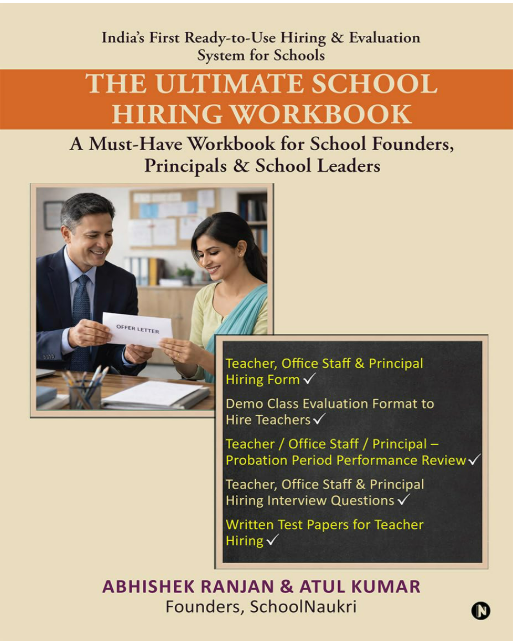
A Practical Resource for Schools
Schools looking to make their teacher hiring process more structured may find The Ultimate School Hiring Workbook helpful. The workbook includes ready-to-use resources such as:
✓ Teacher demo class evaluation format.
✓ Teacher, Principal, and School Office Staff hiring forms.
✓ Interview questions for different school positions.
✓ Written test papers for teacher recruitment.
✓ Probation period performance review sheets.
✓ Practical checklists to standardise the hiring process.
These ready-to-use templates can help schools save time, evaluate candidates fairly, and make more informed hiring decisions.
Buy this on Amazon- https://www.amazon.in/Ultimate-School-Hiring-Workbook-Principals/dp/B0GPR4MQ1F?s=bazaar
Common Mistakes Schools Should Avoid During a Teacher Demo Class
A teacher's demo class is an important part of the hiring process, but it can lose its value if schools do not evaluate candidates properly. Small mistakes during the assessment can lead to hiring the wrong teacher, which may affect student learning and overall academic performance.
Here are some common mistakes schools should avoid.
Focusing Only on English Speaking Skills
Many schools give too much importance to fluent English. While communication is important, a good teacher is someone who can explain concepts clearly and ensure that students understand the lesson. Subject knowledge and teaching ability are equally important.
Giving Unrealistic or Very Difficult Topics
Sometimes schools ask candidates to teach an unexpected or highly complex topic with very little preparation time. This may create unnecessary pressure and may not reflect the teacher's actual classroom abilities. Choosing a practical topic gives a fair assessment of teaching skills.
Conducting a Very Short Demo Class
A 5 or 10-minute demo may not be enough to evaluate a teacher properly. Schools should allow enough time to observe how the teacher introduces the topic, explains concepts, interacts with students, and concludes the lesson.
Ignoring Student Participation
A demo class should not be a one-way lecture. Schools should observe whether the teacher encourages students to ask questions, participate in discussions, and stay engaged throughout the class.
Not Using a Standard Evaluation Form
Without a proper evaluation checklist, different interview panel members may judge candidates based on personal opinions. A standard score sheet helps schools compare candidates fairly and make objective decisions.
Making Decisions Based on Personal Preferences
Sometimes a candidate is selected simply because they have a confident personality or make a good first impression. Hiring decisions should be based on teaching ability, classroom management, subject knowledge, and overall suitability for the role.
Selecting a Teacher Only Because of Qualifications or Experience
A teacher may have excellent degrees and many years of experience, but that does not always guarantee effective classroom teaching. A demo class helps schools understand whether the candidate can apply their knowledge in a real learning environment.
Read Also-CBSE Affiliation Process in India – Step-by-Step Application, Inspection & Approval Guide
General Questions Schools Can Ask After a Teacher's Demo Class
After the demo class, schools should ask a few simple questions to understand the teacher's planning, teaching approach, and classroom management skills. Here are some commonly asked questions.
About the Lesson
Why did you choose this teaching method for the lesson?
What was the main learning objective of today's class?
How would you know if students understood the topic?
If you had more time, what additional activities would you include?
Which part of the lesson do you think students found most challenging?
About Classroom Management
How would you handle a student who keeps disturbing the class?
What would you do if some students did not understand the topic?
How do you encourage shy students to participate?
How would you manage a class with students of different learning abilities?
What steps would you take to maintain discipline without being too strict?
About Teaching Style
How do you make your classes interesting and interactive?
How do you connect lessons with real-life examples?
What teaching aids or technology do you like to use?
How do you motivate students who are not interested in the subject?
How do you encourage critical thinking and problem-solving?
About Assessment
How do you check whether students have understood the lesson?
What types of assessments do you prefer?
How would you help weak students improve their performance?
How do you provide feedback to students?
How do you prepare students for examinations?
About Professional Growth
How do you update your subject knowledge?
How do you handle feedback from school management?
What would you do if a parent complained about your teaching?
Why do you want to join our school?
What qualities make you a good teacher?
Tip for Schools
The purpose of these questions is not to confuse the candidate but to understand their teaching philosophy, classroom approach, and problem-solving skills. Combining these answers with the demo class performance can help schools make better and more confident hiring decisions.
Frequently Asked Questions (FAQs)
1. How long should a teacher demo class be?
A teacher demo class should ideally last between 20 and 40 minutes. This gives the candidate enough time to introduce the topic, explain key concepts, interact with students, and assess their understanding. Very short demo classes may not provide a complete picture of the teacher's classroom abilities.
2. Should schools inform the teacher about the demo class topic in advance?
Yes, schools should usually provide the topic, class level, and duration in advance. This helps the candidate prepare a proper lesson plan and allows the school to evaluate planning, organisation, and teaching skills rather than testing the candidate's ability to handle surprises.
3. Who should be present during a teacher demo class evaluation?
A teacher demo class should ideally be evaluated by a small panel that may include the Principal, Vice Principal, Academic Coordinator, Subject Head, and experienced teachers. Having multiple evaluators helps ensure a fair and balanced assessment.
4. What should schools look for during a teacher demo class?
Schools should observe more than just subject knowledge. Important factors include communication skills, lesson planning, classroom management, student engagement, confidence, teaching methods, time management, and the teacher's ability to simplify complex topics.
5. Can a demo class help schools hire better teachers?
Yes. A well-conducted demo class allows schools to see how a teacher performs in a real classroom setting. It can reveal teaching strengths and areas for improvement that may not be visible through a resume or interview alone, helping schools make better hiring decisions.
6. Is a demo class necessary for experienced teachers?
Yes. Teaching experience is important, but every school has different students and teaching expectations. A demo class helps schools evaluate whether an experienced teacher's classroom approach matches the school's academic standards and culture.
7. Should schools use an evaluation form during a demo class?
Using a standard evaluation form is highly recommended. It helps schools assess every candidate using the same criteria, such as subject knowledge, communication skills, classroom management, and student engagement, making the selection process more transparent and fair.
8. What are the common mistakes schools should avoid during a teacher demo class?
Schools should avoid judging candidates only by their English fluency or qualifications. Other common mistakes include conducting very short demo classes, giving unrealistic topics, ignoring student interaction, and not using a standard evaluation checklist.
9. Can schools ask questions after the demo class?
Yes. A short discussion after the demo class helps schools understand the candidate's lesson planning, classroom management strategies, assessment methods, and approach to handling different learning needs.
10. Why is a teacher demo class important in the school hiring process?
A teacher demo class gives schools an opportunity to observe a candidate's actual teaching skills before making a hiring decision. It helps evaluate classroom performance, communication, student engagement, and overall teaching effectiveness, reducing the chances of making a poor hiring choice.
Conclusion
Hiring the right teacher is one of the most important decisions a school can make because it directly affects student learning and academic results. While resumes and interviews provide useful information about a candidate's qualifications and experience, they cannot fully show how the teacher performs in a real classroom.
A well-planned demo class gives schools an opportunity to observe a teacher's subject knowledge, communication skills, classroom management, and ability to engage students. It also helps identify whether the candidate is the right fit for the school's teaching style and culture.
By following a standard demo class process, using a simple evaluation checklist, and involving experienced educators in the assessment, schools can make more confident and fair hiring decisions. This not only reduces the chances of a poor recruitment decision but also helps build a strong and effective teaching team.
Schools should remember that a good teacher can positively influence students for many years, while a poor hiring decision can affect academic performance and parent satisfaction. Spending a little extra time on a structured demo class can save schools significant time, effort, and resources in the future.