

How Schools Can Use Activities to Improve Student Learning | Activity-Based Learning
1. Introduction
Across India, many schools face a common classroom issue. Students attend classes regularly, teachers complete the syllabus, and exams are conducted on time. Still, actual understanding and interest in learning remain low. This situation is seen in CBSE schools, ICSE schools, and state board schools, whether in metros or smaller cities.
Teachers explain concepts clearly, but students often struggle to apply them in exams or daily life. This is where using activities to improve learning in students becomes essential. Activities are not meant to replace teaching. When planned properly, they support teaching by making learning active, practical, and engaging.
Table of Contents
- Introduction
- Understanding the Problem in Indian Classrooms
- How Schools Can Use Activities to Improve Learning in Students
- Link Activities with the Syllabus
- Use Short & Time-Bound Activities
- Encourage Group-Based Learning
- Use Activities for Concept Reinforcement
- Match Activities with Student Level
- Support Teachers Through Training
- Common Mistakes Schools Should Avoid
- How SchoolNaukri Helps Schools Hire Better Teachers
- Frequently Asked Questions (FAQs)
- Conclusion
- About the Authors
Case Study: How Activity-Based Learning Changed One Student's Learning Journey
During a conversation with a school founder in Chennai, they shared an experience that perfectly illustrates the impact of activity-based learning.
One of their Class 7 students had been struggling in Science for months. Despite attending every class, the student found it difficult to understand concepts and rarely participated in discussions.
The school decided to introduce activity-based learning. Teachers replaced long lectures with simple experiments, group activities, classroom models, and hands-on projects. Over the next few months, the student became more confident, started asking questions, participated actively in class, and showed a noticeable improvement in academic performance.
2. Understanding the Problem / Current Situation
In many Indian classrooms, teaching is still lecture-based and exam-oriented. Teachers, especially TGT and PGT teachers, are under pressure to complete the syllabus for board classes. As a result, classrooms become one-sided, with limited student interaction.
Common challenges faced by schools include:
Rote learning instead of concept clarity
Low attention span, especially in primary and middle classes
Fear of subjects like Math's, Science, and English
Limited student participation
Exam pressure reducing curiosity and creativity
In government and budget private schools, large class sizes make personalized learning difficult. In smaller private schools, teachers want to use activities but lack planning support or confidence. Some principals also feel that activities may waste time or affect exam results.
However, CBSE and NCERT guidelines clearly promote experiential and activity-based learning. The real challenge is how schools can use activities in a structured and syllabus-linked way.
Read Also-How to Get CBSE Affiliation for School in India – Complete Step-by-Step Guide
3. Practical Solutions / Step-by-Step Guide
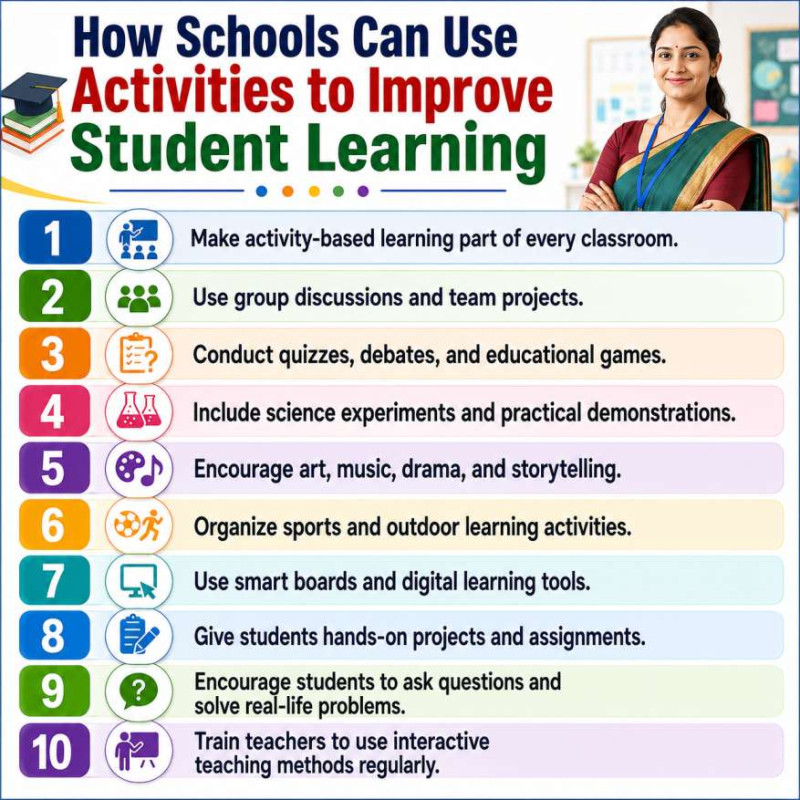
Below are simple and realistic ways schools can use activities to improve learning in students.
1. Link Activities Directly to the Syllabus
Activities must always be chapter-specific and goal-oriented.
- PRT classes: picture stories, object-based EVS activities
- TGT Science: simple experiments using classroom materials
- PGT subjects: case studies and real-life problem-solving
When students see that activities help them understand exam topics, engagement increases naturally.
2. Use Short, Time-Bound Activities
Activities do not need a full period. Even 10–15 minutes can be effective.
Examples include:
- Mental math's rounds
- English role-play for speaking practice
- Social Science map or chart activities
Short activities maintain discipline and do not slow syllabus completion.
3. Encourage Group-Based Learning
Group activities help students learn collaboratively and build confidence.
Good practices include:
- Small groups of 4–5 students
- Clear roles such as reader, writer, and presenter
- Role rotation to ensure equal participation
This method works well even in large CBSE and state board classrooms.
Read Also-How to Hire a School Principal in India (2026 Guide) – Interview Questions, Salary, Skills, Process & Hiring Tips
4. Use Activities for Concept Reinforcement
Activities are very effective after teaching a concept, not just at the start.
Examples:
Chapter-end quizzes
Worksheet-based discussions
Peer teaching, where students explain topics to classmates
This helps teachers assess real understanding, not just memorization.
5. Match Activities with Student Level
Activities must be age-appropriate and level-specific.
PRT: drawing, matching, storytelling
TGT: debates, charts, short projects
PGT: presentations, subject discussions, analysis tasks
This ensures activities support learning instead of confusing students.
6. Support Teachers Through Training
Many teachers hesitate to use activities due to lack of confidence.
Schools can support teachers by:
Conducting internal training sessions
Sharing best classroom practices
Observing demo classes focused on activity-based teaching
This is especially useful for new teachers during the probation period.
Read Also- How to Hire Teachers in India (2026 Guide) – Interview Questions, Salary, Skills & Hiring Tips
4. Common Mistakes to Avoid
Schools should avoid these common mistakes:
No clear learning objective behind activities
Too many projects, causing student stress
No connection with exams or assessment
Same activity style for all subjects
No reflection or discussion after activities
Activities work best when they are simple, relevant, and well-planned.
SchoolNaukri Insight
As the founders of SchoolNaukri, we've spoken with many principals and school leaders across India. One thing we hear repeatedly is that students learn better when they actively participate, not just listen.
Schools that regularly use activity-based learning often see students becoming more confident, curious, and involved in the classroom. Activities encourage teamwork, critical thinking, communication, and problem-solving—skills that go far beyond textbooks.
Our advice: Don't use activities just to make classes fun. Every activity should have a clear learning objective. Even a simple classroom activity can help students understand concepts better, remember lessons longer, and enjoy coming to school. When learning becomes engaging, better academic outcomes naturally follow.
Hire Qualified Teachers Faster with SchoolNaukri
- Hire Qualified Teachers Faster Across India
- Trusted by 20,000+ Schools Across India
- Access 10 Lakh+ Active Teacher Resumes
- Register Your School in Just 2 Minutes
- Post Teacher Vacancies & Start Hiring for Free
- SchoolNaukri – India's No.1 School Hiring & Teacher Recruitment Platform
- Visit: www.schoolnaukri.com
Read Also-CBSE vs ICSE vs IB: Which School Board Is Best for Your School? Complete Comparison Guide
Frequently Asked Questions (FAQs)
1. Are activities useful for Classes 10 and 12 students?
Yes. Activity-based learning helps Class 10 and 12 students understand concepts better, improve problem-solving skills, and perform well in board exams. Group discussions, case studies, quizzes, and practical activities make learning more effective and less stressful.
2. Do classroom activities slow down syllabus completion?
No. Well-planned classroom activities actually improve student understanding and reduce the need for repeated teaching. Interactive learning helps teachers complete the syllabus more efficiently.
3. Can activity-based learning work in large classrooms?
Yes. Schools can easily use group activities, quizzes, peer learning, and interactive tasks even in classrooms with 40–50 students. Proper planning and teamwork make large classroom learning more engaging.
4. Should schools give marks for activities?
Schools can include selected activities in internal assessment and skill evaluation. Some activities can be graded, while others can be used to improve participation, creativity, confidence, and learning outcomes.
5. Does CBSE support activity-based learning in schools?
Yes. CBSE and NCERT strongly encourage experiential and activity-based learning methods. Modern teaching strategies like practical learning, classroom interaction, projects, sports, and arts help improve student engagement and overall development.
About the Authors
- Abhishek Ranjan and Atul Kumar are the founders of SchoolNaukri, actively working with schools across India to improve teacher hiring and recruitment processes.
- Atul Kumar, an IIT Bombay graduate, focuses on helping schools solve one of their biggest challenges — hiring the right teachers through simple, practical, and effective recruitment systems.
- Abhishek Ranjan is an edupreneur working closely with school founders, principals, and academic leaders to improve teacher recruitment, leadership hiring, and school staffing strategies.
- They regularly collaborate with schools to support:
- Better teacher hiring
- Principal & leadership recruitment
- School staffing solutions
- Recruitment process improvement
- Academic team building
- They are also the authors of “The Ultimate School Hiring Workbook” — a practical guide designed to help schools streamline recruitment and build stronger academic teams.