

How to Become a School Chemistry Teacher in India – Complete Guide
How to Become a School Chemistry Teacher in India
Becoming a school Chemistry teacher in India is a rewarding career for students who enjoy science and have a passion for teaching. To become a Chemistry teacher, candidates generally need a Bachelor's or Master's degree in Chemistry, along with a B.Ed. qualification for most schools. Depending on the type of school, candidates may also need to clear eligibility exams such as CTET or State TET. Chemistry teachers can work in CBSE, ICSE, State Board, and private schools across India. In this complete guide, you will learn about the required qualifications, eligibility criteria, teaching skills, salary, career opportunities, and the step-by-step process to build a successful career as a school Chemistry teacher in India.
Introduction
A Chemistry teacher plays an important role in helping students understand the science behind everyday life, from the food we eat to the medicines we use and the environment around us. Good Chemistry teachers make complex concepts simple and encourage students to develop curiosity and practical thinking.
If you are interested in science and enjoy explaining concepts to others, a career as a school Chemistry teacher can be a good choice. Chemistry teachers are in demand in CBSE, ICSE, State Board, and private schools across India, especially for middle, secondary, and senior secondary classes.
To become a school Chemistry teacher, candidates need the right educational qualifications, teaching skills, and subject knowledge. Schools also look for teachers who can conduct practical activities, manage classrooms, and help students prepare for board examinations.
In this guide, we will explain how to become a school Chemistry teacher in India, including the qualifications required, B.Ed., CTET, career opportunities, salary, important skills, and practical tips to help you start and grow your teaching career.
What Does a School Chemistry Teacher Do?
A school Chemistry teacher is responsible for--
- Teaching Chemistry concepts clearly using examples
- Conducting lab experiments safely
- Preparing lesson plans and question papers
- Helping students with board exam preparation
- Managing classroom discipline and student understanding
Chemistry teachers are mainly required for Classes IX to XII in CBSE, ICSE, and State Board schools.
Educational Qualification Required
| Teaching Level | Required Qualification |
| Secondary Level (Class IX–X) | B.Sc. with Chemistry as a main subject B.Ed. (Bachelor of Education) |
| Senior Secondary Level (Class XI–XII) | M.Sc. in Chemistry B.Ed. (mandatory for most schools) |
Some private schools may appoint teachers without B.Ed initially, but completing B.Ed is important for career stability.
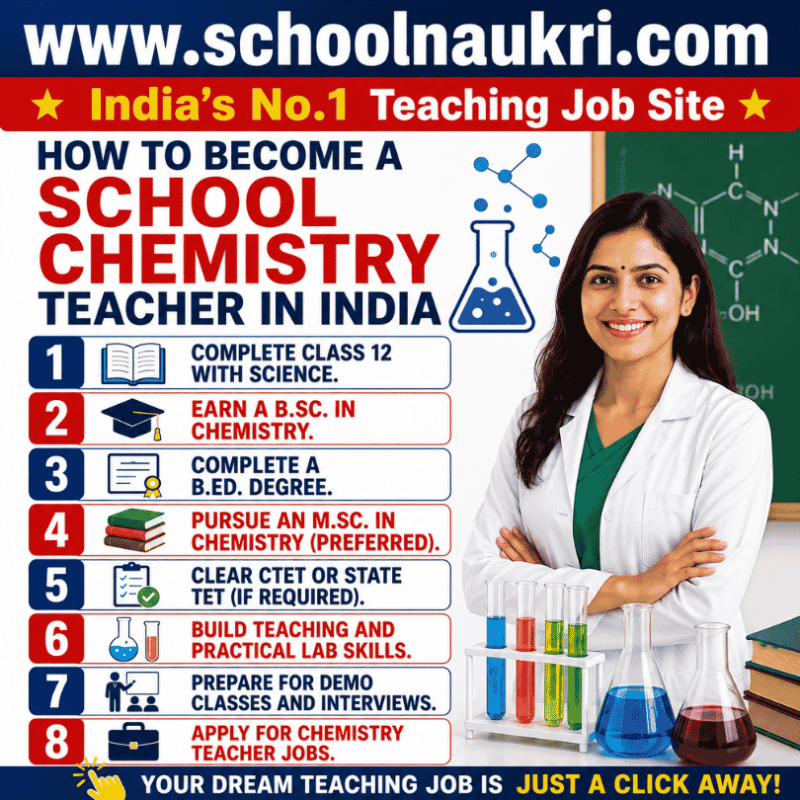
Step-by-Step Process to Become a School Chemistry Teacher in India
Step 1 – Complete Class 12 with Science
Start by choosing the Science stream in Class 11 and 12 with Chemistry as one of your core subjects. Pay attention to the fundamentals, as they will form the foundation for your future studies and teaching career.
Step 2 – Earn a Bachelor's Degree
After Class 12, complete a B.Sc. in Chemistry or a related field from a recognised university. During your graduation, focus on understanding concepts rather than just passing exams, as strong subject knowledge is essential for becoming a good teacher.
Step 3 – Complete a B.Ed. Degree
A Bachelor of Education (B.Ed.) is required for teaching in most CBSE, ICSE, and government schools. This course helps you learn classroom management, lesson planning, teaching methods, and student assessment.
Step 4 – Pursue an M.Sc. in Chemistry (Recommended)
If you want to teach Classes XI and XII, an M.Sc. in Chemistry is highly recommended. Many senior secondary schools prefer postgraduate candidates, and it can also improve your career growth and salary prospects.
Step 5 – Clear CTET or State TET (If Required)
If you're aiming for a government school job, you'll usually need to qualify for the Central Teacher Eligibility Test (CTET) or your state's Teacher Eligibility Test (TET), depending on the recruitment requirements.
Step 6 – Build Strong Teaching Skills
Being good at Chemistry isn't enough—you also need to explain it in a way that students can easily understand. Work on:
- Explaining concepts clearly
- Conducting laboratory experiments safely
- Using practical and real-life examples
- Managing the classroom confidently
- Keeping students engaged throughout the lesson
Step 7 – Prepare a Professional Teacher Resume
Create a clear and professional resume that highlights your education, teaching skills, certifications, internships, achievements, and any classroom or laboratory experience. A well-written resume increases your chances of getting shortlisted.
Step 8 – Practise Demo Classes and Interviews
Most schools ask candidates to conduct a demo class before hiring. Practise explaining common Chemistry topics with confidence, improve your communication skills, and prepare for frequently asked teacher interview questions.
Read Also:How to Prepare for School Demo Class – Complete Guide for Teachers in India
Step 9 – Apply for Chemistry Teacher Jobs
Once you're ready, start applying to schools that match your qualifications and experience. You can apply to:
- CBSE schools
- ICSE schools
- State Board schools
- Private schools
- Coaching institutes
Step 10 – Keep Learning and Growing
Great teachers never stop learning. Stay updated with the latest Chemistry syllabus, teaching techniques, educational technology, and classroom practices. The more you improve your knowledge and teaching skills, the better your career opportunities will be.
SchoolNaukri Insight
As the founders of SchoolNaukri, we've had the privilege of meeting many outstanding and award-winning Chemistry teachers from schools across India. One thing they all had in common was that they didn't just teach Chemistry—they made students curious about it.
The best Chemistry teachers teach with passion. They connect formulas to real life, encourage students to ask questions, and make every experiment a learning experience. Their goal isn't just to finish the syllabus but to help students truly understand and enjoy the subject.
Our advice: If you want to become a great Chemistry teacher, never stop learning, keep improving your teaching skills, and teach from your heart. Schools always remember teachers who inspire students to love learning, and those are the teachers every school wants to hire.
Salary of a School Chemistry Teacher in India
| School Type | Average Monthly Salary |
| Private Schools (District level) | ₹ 15,000 – ₹ 30,000 |
| CBSE / ICSE Schools (Cities) | ₹ 25,000 – ₹ 45,000 |
| Government Schools | As per pay scale ( ₹40,000+) |
Teachers planning to teach senior secondary classes can explore the CBSE Chemistry Learning Framework to understand learning outcomes and effective teaching practices. CBSE Chemistry Learning Framework
Top 5 Books Every Chemistry Teacher Should Read
A good Chemistry teacher never stops learning. Reading the right books can improve subject knowledge, teaching methods, and classroom confidence. Here are five books that can help Chemistry teachers become better educators.
1. NCERT Chemistry Textbooks (Class XI & XII)
NCERT Chemistry books provide a strong foundation for teaching important concepts. Many CBSE and other schools follow these textbooks, making them an essential resource for Chemistry teachers.
2. Foundations for Teaching Chemistry
This book focuses on effective Chemistry teaching strategies. It helps teachers simplify difficult topics and improve classroom learning.
3. Professional Development of Chemistry Teachers
This book discusses modern teaching methods and practical approaches to Chemistry education. It is useful for teachers who want to improve their professional skills.
4. Modern Teaching of Chemistry
The book covers innovative teaching techniques, laboratory activities, and ways to make Chemistry more interesting and engaging for students.
5. Chemistry in Daily Life
This book connects Chemistry with everyday situations and practical applications. It helps teachers explain scientific concepts using simple real-life examples that students can easily understand.
Chemistry Teacher Interview Questions Schools Commonly Ask
Schools assess not only your Chemistry knowledge but also your teaching skills, classroom management, and ability to make the subject interesting for students. Here are some common interview questions asked by private, CBSE, ICSE, and State Board schools in India.
General Questions
Tell us about yourself.
Why do you want to become a Chemistry teacher?
Why do you want to join our school?
What are your strengths as a teacher?
How do you keep your Chemistry knowledge up to date?
Subject Knowledge Questions
How would you explain the periodic table to Class IX students?
What is the difference between physical and chemical changes?
How do you explain acids, bases, and salts using everyday examples?
How would you teach chemical bonding to senior classes?
Why is practical learning important in Chemistry?
Teaching Methodology Questions
How do you make Chemistry interesting for students?
How do you simplify difficult topics?
What teaching aids or technology do you use?
How do you encourage students to participate in class?
How do you handle students who find Chemistry difficult?
Laboratory Questions
How do you ensure safety during practical experiments?
What would you do if laboratory resources are limited?
How do you teach practical concepts without a laboratory?
Which Chemistry experiments are your favourite to teach?
How do you maintain discipline during lab activities?
Classroom Management Questions
How do you maintain discipline in the classroom?
How would you handle a disruptive student?
How do you motivate weak students?
How do you manage students with different learning abilities?
How do you create a positive learning environment?
Assessment Questions
How do you check whether students have understood a topic?
How do you prepare students for board examinations?
What type of questions do you ask during assessments?
How do you help students improve their marks?
How do you provide feedback to students?
Situational Questions
What would you do if students were afraid of Chemistry?
How would you explain a difficult concept to a struggling student?
How would you deal with a parent who is worried about their child's performance?
What would you do if students showed little interest in practical work?
How would you handle a large classroom with mixed-ability learners?
Demo Class Questions
What is the learning objective of your lesson?
Why did you choose this teaching method?
How will you involve students during the lesson?
How will you assess student understanding?
What would you improve if you taught this lesson again?
Step-by-Step Process to Get a Chemistry Teaching Job in 7 Days
Getting a Chemistry teaching job in a week requires proper planning and consistent effort. Here is a practical 7-day action plan.
Day 1 – Prepare Your Resume
Create a professional Chemistry teacher resume.
Highlight your qualifications, B.Ed., teaching experience, and skills.
Include laboratory and practical teaching experience.
Read Also-Free Chemistry Teacher Resume & CV for School Jobs in India | Sample, Format & Free CV Guide
Day 2 – Prepare for Demo Classes
Practise common Chemistry topics.
Prepare simple experiments and real-life examples.
Improve your classroom presentation and communication skills.
Day 3 – Gather Important Documents
Keep these documents ready:
Educational certificates.
B.Ed. certificate.
Experience letters.
Identity proof.
Passport-size photographs.
Updated resume.
Day 4 – Apply on Online Teaching Job Portals
Register on trusted online teaching job portals.
Complete your teacher profile with accurate details.
Upload your updated Chemistry teacher resume.
Apply for CBSE, ICSE, State Board, and private school vacancies.
Apply for multiple jobs every day instead of waiting for one response.
Keep your profile and resume updated.
Check for new vacancies regularly.
Respond quickly to interview calls and school messages.
Apply for jobs in nearby cities to increase opportunities.
Register on SchoolNaukri.com – India's No.1 Teacher Hiring Job Site to connect with schools across India.
Day 5 – Prepare for Interviews
Practise:
General teacher interview questions.
Chemistry subject questions.
Classroom management scenarios.
Demo class discussions.
Day 6 – Attend Interviews and Demo Classes
Arrive on time.
Dress professionally.
Teach with confidence.
Use practical examples to explain concepts.
Day 7 – Follow Up and Continue Applying
Contact schools after the interview.
Send a polite follow-up message.
Keep applying for new vacancies until you receive an offer.
Frequently Asked Questions (FAQs) – Chemistry Teacher Career in India
1. What qualifications are required to become a Chemistry teacher in India?
To become a school Chemistry teacher, you generally need a B.Sc. in Chemistry or a related subject. A B.Ed. degree is required for government schools and most CBSE-affiliated private schools. An M.Sc. in Chemistry is preferred for teaching senior secondary classes.
2. Can I become a Chemistry teacher without a B.Ed.?
Yes, some private schools may hire candidates without a B.Ed. initially. However, a B.Ed. qualification is important for long-term career growth and is required for many teaching positions.
3. Is there a demand for Chemistry teachers in India?
Yes. Chemistry teachers are in demand in CBSE, ICSE, State Board, and private schools, especially for Classes IX to XII and board examination preparation.
4. Can freshers get Chemistry teacher jobs?
Yes. Fresh graduates can apply for Chemistry teacher vacancies in private schools and coaching institutes. Strong subject knowledge and good teaching skills can improve job opportunities.
5. Is an M.Sc. in Chemistry necessary for school teaching?
An M.Sc. is generally preferred for teaching Classes XI and XII and can improve career prospects, but many schools also hire B.Sc. graduates for lower classes.
6. What is the salary of a Chemistry teacher in India?
The salary depends on qualifications, experience, school type, and location. Experienced Chemistry teachers in reputed CBSE and private schools often receive higher salaries than freshers.
7. How can I get a Chemistry teacher job quickly?
Keep your resume updated, practise demo classes, prepare for interviews, and apply regularly through trusted teacher hiring platforms and school websites.
8. What skills do schools look for in a Chemistry teacher?
Schools look for strong subject knowledge, practical laboratory skills, good communication, classroom management, lesson planning, and the ability to make Chemistry simple and interesting for students.
9. Do Chemistry teachers need to conduct laboratory experiments?
Yes. Many schools expect Chemistry teachers to conduct practical activities safely and help students understand scientific concepts through experiments.
10. Where can I apply for Chemistry teacher jobs in India?
Chemistry teachers can apply for vacancies in CBSE, ICSE, State Board, and private schools through school websites and trusted teacher hiring platforms such as SchoolNaukri.com – India's No.1 Teacher Hiring Job Site.
Find Chemistry Teacher Jobs Across India
If you are planning to start your career as a Chemistry teacher or looking for better teaching opportunities, SchoolNaukri can help you connect with schools hiring qualified Chemistry teachers across India.
What You Can Do on SchoolNaukri
Apply for Chemistry Teacher jobs in CBSE, ICSE, State Board, private, and international schools.
Create a professional Teacher Resume/CV in just a few minutes.
Explore PRT, TGT, PGT, and other school teaching vacancies.
Find Chemistry teaching opportunities in different cities and states across India.
Connect with schools looking for skilled and passionate Chemistry teachers.
Create Your Free Teacher Resume
https://schoolnaukri.com/teacher-resume-maker
Explore School Teaching Jobs
Download the SchoolNaukri App
https://play.google.com/store/apps/details?id=com.schoolnaukri.app
Whether you are a fresher or an experienced Chemistry teacher, SchoolNaukri can help you discover teaching opportunities and take the next step in your teaching career.
SchoolNaukri – India's No.1 Teacher Hiring Job Site.
Conclusion
Becoming a school Chemistry teacher in India is a rewarding career for those who enjoy science and teaching. The right qualifications, good subject knowledge, and strong teaching skills can help you build a successful career in CBSE, ICSE, State Board, and private schools.
While degrees and certifications are important, schools also value teachers who can explain concepts clearly, conduct practical activities confidently, and make Chemistry interesting for students. Continuous learning and regular teaching practice can help you grow as an educator.
If you are planning to become a Chemistry teacher, focus on improving your subject knowledge, communication skills, and classroom confidence. With the right preparation and dedication, you can build a successful teaching career and make a positive difference in the lives of your students.