
How to Become a School Physics Teacher in India – Complete Guide
Introduction
Physics is one of the most important subjects taught in schools, helping students understand how the world works through concepts like motion, energy, electricity, and matter. If you enjoy Physics and have a passion for teaching, becoming a school Physics teacher can be a rewarding career choice.
In India, schools regularly hire qualified Physics teachers for secondary and senior secondary classes. To become a Physics teacher, you typically need a degree in Physics, a teaching qualification such as B.Ed., and strong subject knowledge. In this guide, we'll explain the complete step-by-step process, eligibility requirements, qualifications, skills, and career opportunities to help you start your journey as a school Physics teacher in India.
How to Become a School Physics Teacher in India
Becoming a school Physics teacher in India requires the right educational qualifications, teaching skills, and a passion for helping students understand scientific concepts. Generally, candidates need a Bachelor's degree in Physics or a related subject, followed by a teaching qualification such as B.Ed. Depending on the school and the teaching level, additional qualifications or eligibility tests may also be required. Physics teachers can work in CBSE, ICSE, State Board, and private schools across India. In this complete guide, we will explain the eligibility criteria, qualifications, skills, career opportunities, salary, and step-by-step process to become a successful school Physics teacher in India.
Becoming a school Physics teacher in India is a respected and stable career option for students who enjoy science and explaining concepts clearly. Physics teachers play an important role in building student's understanding of the world, from basic motion to electricity and modern science.
This guide explains how to become a school Physics teacher in India, step by step, in simple language and with real school-level clarity.
If you want to become a Physics teacher in India, it is important to have the right qualifications and teacher training. The National Council for Teacher Education (NCTE) sets the standards for teacher education in the country. Checking the latest NCTE guidelines can help you understand the qualifications and requirements needed to build a successful career as a school Physics teacher.
Why Become a Physics Teacher?
Becoming a Physics teacher is a great career choice for people who enjoy science and want to make a difference in students' lives. Physics teachers help students understand important concepts that are used in everyday life, engineering, technology, and many other fields. The profession offers job stability, good career growth, respect in society, and the opportunity to inspire young minds. With the growing demand for qualified science teachers in schools across India, Physics teachers can find rewarding opportunities while enjoying a meaningful and fulfilling career.
SchoolNaukri Insight
As the founders of SchoolNaukri, we've interacted with thousands of Physics teachers across India. One thing we've learned is that the best Physics teachers don't just teach formulas—they make students understand why those formulas work.
If you want to become a successful Physics teacher:
- Build strong conceptual knowledge.
- Practice numerical problems regularly.
- Use real-life examples to explain concepts.
- Keep learning new teaching methods and technology.
- Encourage students to ask questions and think logically.
Our advice: Schools hire teachers who can make Physics simple, interesting, and enjoyable. Focus on becoming that teacher, and job opportunities will follow.
What Does a School Physics Teacher Do?
A school Physics teacher is responsible for-
- Teaching Physics concepts clearly and practically
- Conducting experiments and lab activities
- Preparing lesson plans and assessments
- Helping students prepare for board exams
- Maintaining discipline and classroom engagement
Physics teachers are required in CBSE, ICSE, and State Board schools, especially for Classes IX to XII.
Educational Qualification Required
The qualification depends on the level you want to teach-
| Teaching Level | Required Qualification |
| Secondary Level (Class IX–X) | B.Sc. with Physics as a main subject B.Ed. (Bachelor of Education) |
| Senior Secondary Level (Class XI–XII) | M.Sc. in Physics B.Ed. (mandatory for most schools) |
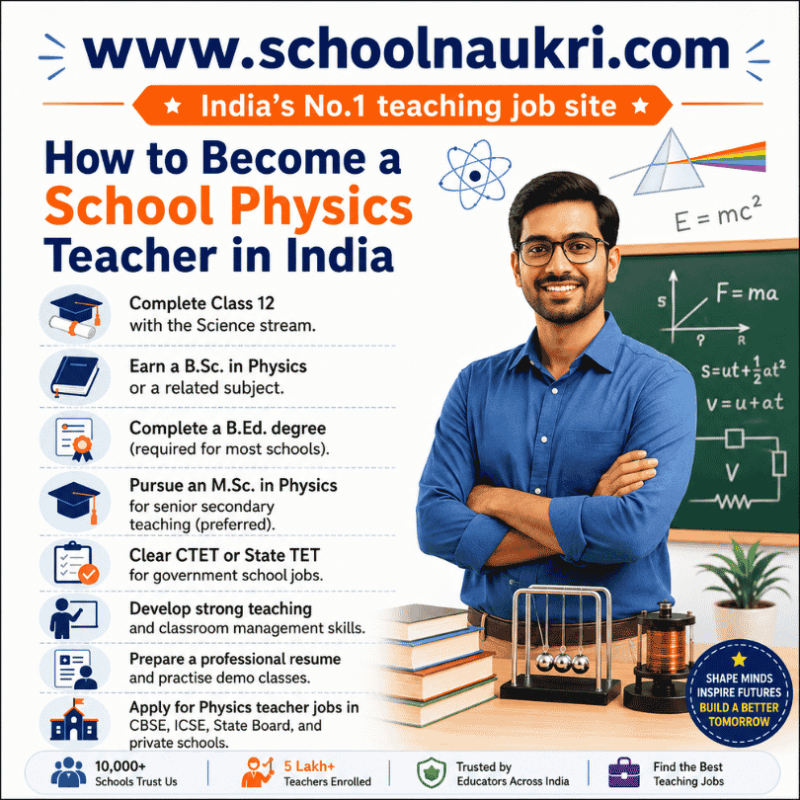
Step-by-Step Process to Become a School Physics Teacher in India
Step 1: Complete Class 12 with Science Stream
Choose Physics, Chemistry, and Mathematics (PCM) in Class 11 and 12 from a recognized board. A strong foundation in science subjects will help you pursue higher studies in Physics and prepare for a teaching career.
Step 2: Earn a Bachelor's Degree in Physics
Complete a B.Sc. in Physics or a related science degree from a recognized university. This degree provides the subject knowledge required to teach Physics effectively in schools.
Step 3: Complete a B.Ed. Degree
Pursue a Bachelor of Education (B.Ed.) degree to gain professional teaching skills. Most CBSE, ICSE, government, and reputed private schools prefer or require this qualification.
Step 4: Consider a Master's Degree (Optional but Recommended)
Complete an M.Sc. in Physics if you want to teach senior secondary classes (XI–XII). Most schools prefer a postgraduate qualification for PGT Physics teacher positions.
Step 5: Qualify CTET or State TET (If Required)
Many government schools and reputed private schools prefer candidates who have cleared CTET or State Teacher Eligibility Tests (TET). These certifications can improve your job prospects.
Step 6: Develop Teaching and Communication Skills
Work on classroom management, lesson planning, student engagement, communication, and presentation skills. Good teachers can explain complex Physics concepts in a simple and easy-to-understand way.
Step 7: Gain Teaching Experience
Apply for internships, teaching practice programs, coaching institutes, tuition centers, or entry-level teaching positions to gain practical classroom experience.
Step 8: Prepare a Professional Teacher Resume
Create a well-structured resume highlighting your educational qualifications, teaching certifications, subject expertise, skills, achievements, and teaching experience.
Step 9: Attend Interviews and Demo Classes
Most schools conduct interviews and demo teaching sessions to evaluate subject knowledge, communication skills, classroom management ability, and teaching methodology.
Step 10: Apply for Physics Teacher Jobs
Apply for Physics teacher vacancies in CBSE, ICSE, State Board, international schools, coaching institutes, and residential schools across India. Opportunities are available for PRT, TGT, and PGT Physics teachers depending on your qualifications and experience.
Read Also-Where to Create a Free Physics Teacher Resume Online for School Jobs in India (Best Resume Builders)
Required Skills for a Good Physics Teacher
Apart from degrees, schools look for these skills-
- Strong subject clarity
- Ability to explain concepts with real-life examples
- Basic lab handling skills
- Classroom control and student engagement
- Clear communication in English or bilingual format
Teacher Eligibility Tests (CTET / STET)
To teach in government schools, clearing eligibility exams is important--
CTET – Central Teacher Eligibility Test
State TET (STET) – For state government schools
Private schools do not always require TET, but having it increases credibility.
Salary of a School Physics Teacher in India
| School Type | Average Monthly Salary |
| Private Schools (District level) | ₹ 15,000 – ₹ 30,000 |
| CBSE / ICSE Schools (Cities) | ₹ 25,000 – ₹ 45,000 |
| Government Schools | As per pay scale (₹ 40,000+) |
Read Also-How to Get a Teaching Job in 7 Days – Complete Guide for Teachers in India
How You Can Get a Physics Teacher Job
Getting a Physics teacher job starts with having the right qualifications, such as a degree in Physics and a B.Ed. After completing your education, prepare a professional resume that highlights your subject knowledge, teaching skills, certifications, and any teaching experience. Apply for Physics teacher vacancies in CBSE, ICSE, State Board, and international schools through school websites, job portals, and teacher recruitment platforms. During interviews and demo classes, focus on explaining Physics concepts clearly and confidently. Regularly applying to multiple schools, improving your communication skills, and staying updated with modern teaching methods can help you secure a Physics teacher job faster and build a successful teaching career.
Find Physics Teacher Jobs Across India
If you are planning to start your career as a Sanskrit teacher or looking for better teaching opportunities, SchoolNaukri can help you connect with schools hiring qualified Sanskrit teachers across India.
What You Can Do on SchoolNaukri
• Apply for Sanskrit Teacher jobs in CBSE, ICSE, state board, private, and international schools.
• Create a professional Teacher Resume/CV in just a few minutes.
• Explore PRT, TGT, PGT, and other school teaching vacancies.
• Find teaching opportunities across different cities and states in India.
• Connect with schools looking for skilled and passionate teachers.Create Your Free Teacher Resume
https://schoolnaukri.com/teacher-resume-maker
Explore School Teaching Jobs
Download the SchoolNaukri App
https://play.google.com/store/apps/details?id=com.schoolnaukri.app
Whether you are a fresher or an experienced Sanskrit teacher, SchoolNaukri can help you discover teaching opportunities and take the next step in your career.
SchoolNaukri – India's No.1 Teaching Job Platform for Schools and Teachers.
Physics Teacher Interview Questions
Whether you are applying for a Physics teacher job in a CBSE, ICSE, State Board, or private school, you should be prepared for both subject-related and classroom management questions. Here are some common Physics teacher interview questions asked by schools in India.
General Questions
- Tell us about yourself.
- Why do you want to become a Physics teacher?
- Why do you want to join our school?
- What are your strengths as a teacher?
- How do you keep yourself updated with new developments in Physics?
Subject Knowledge Questions
- How would you explain Newton's Laws of Motion to Class IX students?
- What methods do you use to make Physics interesting for students?
- How do you teach difficult topics like Electricity or Magnetism?
- Can you explain the difference between speed and velocity with an example?
- How do you connect Physics concepts with real-life situations?
Classroom Management Questions
- How would you handle a class where students are not interested in Physics?
- What would you do if a student repeatedly disrupted the class?
- How do you encourage weak students to participate?
- How do you manage students with different learning abilities?
- How do you maintain discipline while keeping the classroom interactive?
Teaching Methodology Questions
- How do you plan a Physics lesson?
- What teaching aids do you use in your classroom?
- How do you conduct practical experiments safely?
- How do you encourage critical thinking among students?
- How would you use technology to improve Physics teaching?
Assessment Questions
- How do you check whether students have understood a topic?
- How do you prepare students for board examinations?
- What type of questions do you include in class tests?
- How do you provide feedback to students?
- What steps would you take if a student's performance suddenly declined?
Practical and Situational Questions
- How would you teach a chapter if laboratory facilities were limited?
- What would you do if students were afraid of numerical problems?
- How would you explain a difficult concept to a struggling student?
- How would you handle questions when you do not know the immediate answer?
- What would you do if a parent complained that their child was not understanding Physics?
Demo Class Questions
- How would you introduce today's topic to students?
- Why did you choose this teaching method?
- How would you engage students during the lesson?
- How would you assess student understanding at the end of the class?
- If given another chance, what would you improve in your demo class?
School and Professional Questions
- How do you work as part of a teaching team?
- How do you handle feedback from the Principal or Academic Coordinator?
- How do you balance academic performance with student well-being?
- What are your long-term career goals?
- Why should our school hire you as a Physics teacher?
FAQs – Physics Teacher Career in India
1. Can I become a Physics teacher without a B.Ed. degree?
Yes, some private schools may hire Physics teachers without a B.Ed., especially if they have strong subject knowledge. However, a B.Ed. qualification is highly recommended and is often required by CBSE, ICSE, government, and reputed private schools. Having a B.Ed. can improve your job opportunities, salary prospects, and long-term career growth.
2. Is an M.Sc. in Physics necessary to become a Physics teacher?
It depends on the classes you want to teach. A B.Sc. in Physics is usually sufficient for teaching middle and secondary classes in many schools. However, most CBSE, ICSE, and senior secondary schools prefer or require an M.Sc. Physics qualification for PGT Physics teachers who teach Classes XI and XII.
3. Is there a good demand for Physics teachers in India?
Yes, Physics teachers are in high demand across India. Schools regularly recruit qualified Physics teachers for secondary and senior secondary classes. The demand is particularly strong in CBSE, ICSE, international schools, coaching institutes, and schools preparing students for board exams and competitive exams.
4. Can freshers get Physics teacher jobs?
Absolutely. Many schools hire fresh graduates who have a Physics degree and good communication skills. Freshers can start as assistant teachers, junior Physics teachers, or teachers for middle school classes and gain valuable classroom experience before moving to higher-level teaching positions.
5. What qualifications are required to become a Physics teacher in India?
Most schools prefer candidates who have completed Class 12 with Science, earned a B.Sc. or M.Sc. in Physics, and completed a B.Ed. degree. Some schools may also prefer candidates who have qualified CTET or State TET examinations.
6. What is the salary of a Physics teacher in India?
The salary of a Physics teacher depends on qualifications, experience, school type, and location. Freshers may start with a modest salary, while experienced Physics teachers, especially PGT Physics teachers, can earn significantly higher salaries in reputed schools and institutions.
7. How can I find Physics teacher jobs in India?
You can apply through school websites, education job portals, teacher recruitment drives, and specialized teaching job platforms. Keeping an updated resume and regularly applying for vacancies can increase your chances of getting hired quickly.
8. Which schools hire Physics teachers?
Physics teachers are hired by CBSE schools, ICSE schools, State Board schools, international schools, residential schools, coaching institutes, and higher secondary schools across India.
9. What skills make a successful Physics teacher?
A successful Physics teacher should have strong subject knowledge, good communication skills, classroom management abilities, lesson planning skills, patience, and the ability to explain complex concepts in a simple and engaging way.
10. Is Physics teaching a good career option in India?
Yes, Physics teaching is a respected and rewarding profession. It offers job stability, career growth, competitive salaries, and the opportunity to help students build strong foundations in science and technology while making a positive impact on their future.
Conclusion
Becoming a school Physics teacher in India is more than just earning degrees and certificates. It is about helping students understand the world around them, building their confidence in science, and inspiring them to think logically and creatively.
The right qualifications can help you get a teaching job, but your ability to explain concepts clearly, connect with students, and make learning interesting is what truly makes you a successful teacher. Schools are always looking for Physics teachers who have strong subject knowledge, good communication skills, and a genuine passion for teaching.
If you are dedicated, willing to keep learning, and committed to helping students succeed, a career as a Physics teacher can offer job stability, professional growth, respect in society, and the satisfaction of making a real difference in young lives.