
How to Become a School Sanskrit Teacher in India – Step-by-Step Guide
Introduction
A career as a school Sanskrit teacher in India is much more than just teaching a language—it is an opportunity to preserve India's rich cultural heritage while shaping young minds. From CBSE and State Board schools to traditional educational institutions, qualified Sanskrit teachers continue to be in demand across the country.
Sanskrit is often called the foundation of many Indian languages and is deeply connected to our history, literature, philosophy, and values. A great Sanskrit teacher doesn't just explain grammar and shlokas—they make the subject interesting, relatable, and easy for students who may initially find it challenging.
If you are passionate about teaching and have an interest in Sanskrit, this profession offers respect, career stability, and the chance to make a lasting impact on students' lives.
In this complete guide, you'll learn who can become a Sanskrit teacher, the required qualifications, eligibility criteria, step-by-step career path, essential skills, salary expectations, job opportunities, and the real challenges faced by school Sanskrit teachers in India—all explained in simple, easy-to-understand language.
How to Become a School Sanskrit Teacher in India
Becoming a school Sanskrit teacher in India typically requires completing Class 12, earning a bachelor's degree with Sanskrit as a subject, obtaining a B.Ed. degree for most school teaching positions, and qualifying for relevant teacher eligibility exams such as CTET, State TET, or school-specific recruitment processes. Candidates can then apply for Sanskrit teacher vacancies in CBSE, ICSE, state board, and private schools across India.
Table of Contents
- Introduction
- How to Become a School Sanskrit Teacher in India
- Who Can Become a School Sanskrit Teacher in India?
- Required Qualifications to Become a Sanskrit Teacher
- Primary Level (PRT)
- Middle & Secondary Level (TGT)
- Senior Secondary Level (PGT)
- Step-by-Step Career Path to Become a Sanskrit Teacher
- Salary of a School Sanskrit Teacher in India
- Private School Salary
- Government School Salary
- Skills Needed to Become a Good Sanskrit Teacher
- Job Opportunities for Sanskrit Teachers in India
- 10 Sanskrit Teacher Interview Questions and Sample Answers in Sanskrit
- Find Sanskrit Teacher Jobs Across India
- FAQs – School Sanskrit Teacher Career in India
- Conclusion
- About the Authors
Who Can Become a School Sanskrit Teacher in India?
If you have a passion for the Sanskrit language and enjoy teaching, you can build a rewarding career as a school Sanskrit teacher. While the eligibility requirements vary by school and education board, most schools look for candidates with the following qualities:
- Strong knowledge of Sanskrit – You should have a good understanding of Sanskrit grammar, vocabulary, sentence formation, and pronunciation.
- Educational qualification – You should have studied Sanskrit at the school, graduation, or post-graduation level, along with the required teaching qualifications.
- Good communication skills – You should be able to explain Sanskrit lessons, shlokas, and stories in simple Hindi or English so that students can understand them easily.
- Passion for teaching – A genuine interest in helping students learn and grow is one of the most important qualities of a successful teacher.
- Patience and supportive nature – Many students find Sanskrit difficult in the beginning, so a teacher should be patient, encouraging, and approachable.
- Classroom management skills – You should be able to maintain discipline while creating a positive, interactive, and student-friendly classroom environment.
- Interest in Indian culture and literature – Since Sanskrit is closely connected to Indian history, philosophy, and ancient texts, an interest in these subjects is a valuable advantage.
- Willingness to learn – Good teachers continuously improve their teaching methods and use modern classroom techniques to make learning more engaging.
- Confidence and professionalism – Schools prefer teachers who are confident, responsible, and committed to their students' academic success.
Whether you are a fresher starting your teaching career or an experienced educator looking for new opportunities, becoming a Sanskrit teacher is a respected profession that allows you to inspire students while preserving one of the world's oldest and most influential languages.
Required Qualification to Become a Sanskrit Teacher
The qualifications required to become a School Sanskrit Teacher depend on the class level you want to teach. The table below provides a simple overview.
| Teaching Level | Classes | Minimum Qualification | Additional Requirements |
|---|---|---|---|
| Primary Teacher (PRT) | Class 1–5 | Graduation in any stream (studying Sanskrit earlier is an added advantage) | D.El.Ed, BTC, or NTT is preferred. Some private schools may hire without a B.Ed. |
| Trained Graduate Teacher (TGT) | Class 6–10 | BA in Sanskrit | A B.Ed degree is generally required by most schools. |
| Post Graduate Teacher (PGT) | Class 11–12 | MA in Sanskrit | A B.Ed degree along with strong knowledge of Sanskrit grammar, literature, shlokas, and classical texts is usually required. |
Note: Qualification requirements may vary depending on the school, education board (CBSE, ICSE, State Board, or International Schools), and the school's recruitment policy. Some private schools may also consider experienced candidates with equivalent qualifications.
Step-by-Step Career Path to Become a Sanskrit Teacher
- Study Sanskrit in graduation (BA Sanskrit)
- Decide the level – Primary, TGT, or PGT
- Complete B.Ed for better job options
- Start teaching in a private school or local school
- Improve explanation skills and pronunciation
- Gain experience and move to better schools
- Many Sanskrit teachers start in small private schools and slowly grow with experience.
Salary of a School Sanskrit Teacher in India
Private School Salary (Monthly)
| Primary Level | ₹7,000 to ₹12,000 |
|---|---|
| TGT Level | ₹10,000 to ₹22,000 |
| PGT Level | ₹18,000 to ₹35,000 |
Government School Salary
| For ( PRT, TGT,PGT) | ₹35,000 to ₹60,000 |
As per central or state pay scale
Read Also-How to Get a Teaching Job in 7 Days – Complete Guide for Teachers in India
Skills Needed to Become a Good Sanskrit Teacher
Becoming a good Sanskrit teacher is about much more than knowing the language. Schools look for teachers who can make Sanskrit simple, interesting, and enjoyable for students. A teacher who can build students' confidence and remove their fear of the subject is often highly valued.
Some of the most important skills include--
- Clear pronunciation: A good Sanskrit teacher should be able to pronounce shlokas, verses, and Sanskrit words correctly so that students learn the right way from the beginning.
- Strong grammar knowledge: Understanding Sanskrit grammar and explaining it in a simple, step-by-step manner helps students grasp even difficult topics with ease.
- Simple teaching style: The ability to explain complex concepts using easy Hindi or English and everyday examples makes learning more interesting and practical.
- Connecting lessons to daily life: Relating Sanskrit stories, values, and shlokas to real-life situations helps students appreciate the importance of the language and Indian culture.
- Patience and encouragement: Many students find Sanskrit difficult at first. A good teacher supports slow learners, answers questions calmly, and motivates every student to improve.
- Classroom management: Maintaining a disciplined yet friendly classroom creates a positive learning environment where students feel comfortable participating.
- Good communication skills: Explaining ideas clearly and interacting well with students, parents, and colleagues is an essential part of being an effective teacher.
- Passion for learning: A successful Sanskrit teacher continues to learn new teaching methods, explore Sanskrit literature, and stay updated with changes in school education.
A great Sanskrit teacher not only teaches a subject but also inspires students to appreciate India's rich language, culture, and heritage.
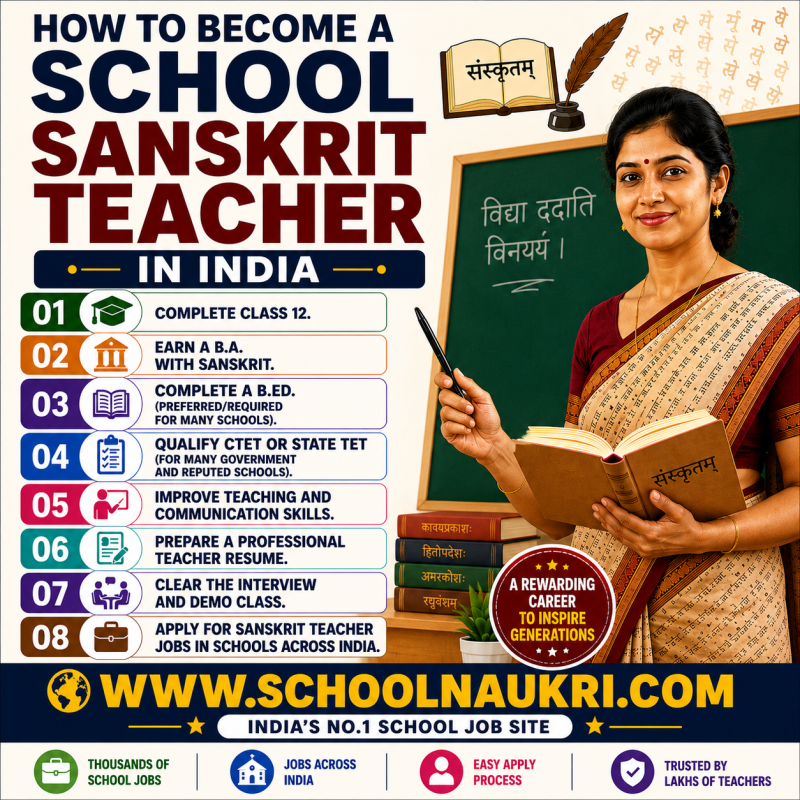
“A good Sanskrit teacher makes even a difficult shloka feel simple and meaningful for students.”
Job Opportunities for Sanskrit Teachers in India
Sanskrit teachers have a wide range of career opportunities in India. Since Sanskrit is an important subject in many school curricula, qualified teachers are regularly hired by government, private, and traditional educational institutions. The demand for skilled Sanskrit teachers remains steady, especially in schools that promote Indian culture, values, and classical education.
Some of the common places where Sanskrit teachers can find jobs include:
- CBSE Schools: Many CBSE-affiliated schools offer Sanskrit as a subject from middle to secondary classes and regularly recruit qualified Sanskrit teachers.
- State Board Schools: Most state education boards include Sanskrit in their curriculum, creating teaching opportunities across different states.
- Kendriya Vidyalayas (KVs): These central government schools recruit Sanskrit teachers through official recruitment processes and offer stable career opportunities.
- Private Schools: English-medium and private schools often hire Sanskrit teachers to strengthen language education and cultural studies.
- Traditional and Residential Schools: Many residential schools and institutions with a focus on Indian heritage include Sanskrit as an important part of their education system.
- Gurukuls and Value-Based Schools: Gurukuls and schools that promote Indian traditions and moral education frequently look for qualified Sanskrit teachers.
- Coaching Centres and Online Teaching Platforms: With the growth of digital learning, Sanskrit teachers can also teach students online, provide exam preparation classes, and offer private tuition.
The demand for Sanskrit teachers is expected to continue as schools increasingly recognise the importance of preserving India's linguistic and cultural heritage. Candidates with good subject knowledge, teaching skills, and the required qualifications can find rewarding career opportunities across the country.
10 Sanskrit Teacher Interview Questions and Sample Answers in Sanskrit
Many schools, especially CBSE, state board, traditional schools, and Gurukuls, may ask basic Sanskrit conversation or subject-related questions during a Sanskrit teacher interview. Here are 10 simple and commonly asked questions with sample answers.
1. भवतः (भवत्याः) नाम किम्?
उत्तरम्: मम नाम __________ अस्ति।
2. भवान्/भवती संस्कृतभाषां किमर्थं पठयितुम् इच्छति?
उत्तरम्: अहं संस्कृतभाषायाः प्रचारं प्रसारं च कर्तुम् इच्छामि। छात्राणां कृते संस्कृतं सरलरुचिकरं च कर्तुम् इच्छामि।
3. संस्कृतभाषायाः महत्त्वं किम्?
उत्तरम्: संस्कृतम् भारतस्य प्राचीनभाषा अस्ति। अस्माकं संस्कृति, साहित्यं, दर्शनं च संस्कृते निहितम् अस्ति।
4. संस्कृतशिक्षकस्य मुख्यं कर्तव्यं किम्?
उत्तरम्: छात्रान् संस्कृतभाषायां निपुणान् कर्तुं, सदाचारं शिक्षयितुं, संस्कृतिसंरक्षणं च कर्तुम्।
5. कथं संस्कृतपाठं रोचकं करिष्यथ?
उत्तरम्: कथाभिः, श्लोकैः, गीतैः, क्रीडाभिः, सरलसंवादैः च पाठं रोचकं करिष्यामि।
6. यदि छात्राः संस्कृतं कठिनं मन्यन्ते तर्हि किं करिष्यथ?
उत्तरम्: अहं सरलरीत्या पाठयिष्यामि, उदाहरणानि दास्यामि, पुनः पुनः अभ्यासं कारयिष्यामि च।
7. भवान्/भवती कस्य संस्कृतकवेश्च ग्रन्थस्य वा प्रियः अस्ति?
उत्तरम्: मम कालिदासस्य काव्यानि अतीव प्रियाणि सन्ति।
8. कः भवतः (भवत्याः) प्रियः श्लोकः?
उत्तरम्:
विद्या ददाति विनयं विनयाद् याति पात्रताम्।
पात्रत्वात् धनमाप्नोति धनात् धर्मं ततः सुखम्॥
9. कक्षायां अनुशासनं कथं स्थापयिष्यथ?
उत्तरम्: प्रेम्णा, धैर्येण, स्पष्टनियमैः, छात्राणां सहभागेन च अनुशासनं स्थापयिष्यामि।
10. संस्कृतशिक्षकत्वे भवतः (भवत्याः) लक्ष्यं किम्?
उत्तरम्: छात्रेषु संस्कृतभाषायाः प्रेम उत्पद्येत, ते संस्कृतसंस्कृतेः महत्त्वं च अवगच्छेयुः इति मम लक्ष्यं अस्ति।
These basic Sanskrit interview questions help candidates prepare for interviews in CBSE schools, state board schools, private schools, Gurukuls, and other educational institutions across India.
Find Sanskrit Teacher Jobs Across India
If you are planning to start your career as a Sanskrit teacher or looking for better teaching opportunities, SchoolNaukri can help you connect with schools hiring qualified Sanskrit teachers across India.
What You Can Do on SchoolNaukri
• Apply for Sanskrit Teacher jobs in CBSE, ICSE, state board, private, and international schools.
• Create a professional Teacher Resume/CV in just a few minutes.
• Explore PRT, TGT, PGT, and other school teaching vacancies.
• Find teaching opportunities across different cities and states in India.
• Connect with schools looking for skilled and passionate teachers.Create Your Free Teacher Resume
https://schoolnaukri.com/teacher-resume-maker
Explore School Teaching Jobs
Download the SchoolNaukri App
https://play.google.com/store/apps/details?id=com.schoolnaukri.app
FAQs – School Sanskrit Teacher Career in India
1. What qualifications are required to become a school Sanskrit teacher in India?
To become a school Sanskrit teacher, candidates generally need a bachelor's degree with Sanskrit as a subject. For many TGT and PGT positions, a B.Ed. degree is also preferred or required. Some schools may also ask for CTET or State TET qualifications.
2. Is B.Ed. compulsory to become a Sanskrit teacher?
The requirement depends on the school and teaching level. While some private schools may hire primary-level teachers without a B.Ed., most reputed schools prefer candidates with a B.Ed. for TGT and PGT positions.
3. Is there a good demand for Sanskrit teachers in India?
Yes. Sanskrit teachers are regularly recruited by CBSE, ICSE, state board, private schools, Kendriya Vidyalayas, Gurukuls, and other educational institutions. The demand remains steady across many parts of India.
4. What is the salary of a Sanskrit teacher in India?
The salary varies based on qualifications, experience, location, and the school. Freshers in private schools may earn around ₹7,000–₹30,000 per month, while experienced teachers and government school teachers can earn significantly higher salaries.
5. Can I become a Sanskrit teacher without an M.A. in Sanskrit?
Yes. An M.A. is mainly required for senior secondary or PGT-level teaching positions. For many primary and secondary school jobs, a B.A. with Sanskrit and the required teaching qualifications may be sufficient.
6. Can freshers apply for Sanskrit teacher jobs?
Yes. Many schools hire fresh graduates with good subject knowledge, communication skills, and a passion for teaching. A strong resume and a good demo class can improve your chances of selection.
7. Which schools hire Sanskrit teachers in India?
Sanskrit teachers can work in CBSE schools, ICSE schools, state board schools, private schools, international schools, Kendriya Vidyalayas, Gurukuls, residential schools, and value-based educational institutions.
8. How can I apply for Sanskrit teacher jobs across India?
You can apply through school websites, recruitment notifications, education job portals, and dedicated teaching platforms like SchoolNaukri, where schools regularly post Sanskrit teacher vacancies across India.
Read Also-How Teachers Can Create a Resume or CV for Free – Online Teacher Resume Maker
Conclusion
A career as a school Sanskrit teacher in India offers the opportunity to combine a passion for teaching with the responsibility of preserving one of the world's oldest and most respected languages. As schools continue to recognise the importance of Sanskrit and Indian culture, qualified and dedicated Sanskrit teachers remain in demand across CBSE, state board, private, and traditional educational institutions.
If you aspire to become a Sanskrit teacher, focus on building strong subject knowledge, earning the required qualifications, improving your teaching and communication skills, and gaining practical classroom experience. Even if you start your career in a small school, consistent learning and dedication can open doors to better opportunities and professional growth.
With the right preparation, patience, and passion for education, you can build a rewarding and long-term career as a Sanskrit teacher while making a meaningful contribution to the lives of students and the preservation of India's rich cultural heritage.
About the Authors
Abhishek Ranjan and Atul Kumar are the founders of SchoolNaukri, India's No.1 School Hiring & Teacher Recruitment Platform. Having worked closely with thousands of schools, principals, and teachers across India, they have extensive experience in understanding teacher qualifications, school recruitment processes, and education hiring trends.
Through this guide on How to Become a School Sanskrit Teacher in India, they aim to help aspiring teachers understand the required qualifications, career path, essential skills, salary expectations, and job opportunities in simple and practical language.
They are also the authors of " The Ultimate School Hiring Workbook " a practical resource that helps schools improve teacher recruitment through structured hiring processes and proven best practices.