

School Teacher Salary Expectations in India – What Schools Need to Know
Teacher salary expectations have become one of the most sensitive and confusing topics for schools in India. Many schools struggle not because they cannot find teachers, but because there is a gap between what teachers expect and what schools can offer. This gap often leads to failed interviews, delayed hiring, or early resignations.
In private schools across India — especially in Bihar, Jharkhand, Uttar Pradesh, and other district-level regions — salary discussions are often uncomfortable. Schools fear losing candidates, while teachers feel unsure about whether their expectations are reasonable. The result is mistrust on both sides.
This blog explains school teacher salary expectations in India, what factors influence them, what schools should realistically offer, and how schools can handle salary discussions professionally without losing good teachers.
Real School Problem & Practical Solution
The Real Problem
A private school in a district town shortlisted a qualified English teacher with 6 years of experience. During the interview, everything went well. However, at the final stage, the teacher asked for ₹35,000 per month, while the school’s budget was ₹22,000. The school hesitated, the teacher felt undervalued, and the discussion ended without clarity. Two weeks later, the school hired a less experienced teacher at a lower salary, but the teacher resigned within three months, forcing the school to restart hiring mid-session.
The Practical Solution
This situation could have been handled better with early and transparent salary discussion. If schools clearly communicate salary range, workload, and benefits at the start, and teachers understand realistic local salary structures, many hiring failures can be avoided. Salary alignment is not about paying more, but about setting clear expectations.
What Influences Teacher Salary Expectations in India?
Teacher salary expectations are not random. They are shaped by several factors.
1.Location of the School
Salary expectations differ widely based on location.
Metro cities → higher expectations
Tier-2 cities → moderate expectations
District towns → practical, flexible expectations
Schools should always align salaries with local market reality, not online salary figures.
2.Type of School
The school board and reputation matter.
CBSE / ICSE schools → higher salary expectations
State board / budget private schools → moderate salaries
Teachers adjust expectations based on school type.
3.Teaching Experience
Experience directly affects salary demands.
0–2 years → entry-level expectations
3–7 years → mid-level expectations
8+ years → senior teacher expectations
However, experience should be evaluated along with actual teaching ability, not just years.
4.Subject Demand
Some subjects command higher salaries.
High-demand subjects:
Maths
Science
English
Lower-demand subjects usually have flexible salary ranges.
5.Qualification vs Classroom Skill
Teachers often expect higher salaries due to degrees like B.Ed, M.Ed, or CTET.
Schools should balance qualifications with demo class performance and subject clarity.
Average School Teacher Salary Expectations in India (Private Schools)
(Indicative ranges – may vary by region)
PRT (Primary Teacher): ₹8,000 – ₹18,000
TGT (Middle School): ₹12,000 – ₹25,000
PGT (Senior Classes): ₹18,000 – ₹40,000
These figures are realistic for most non-metro private schools.
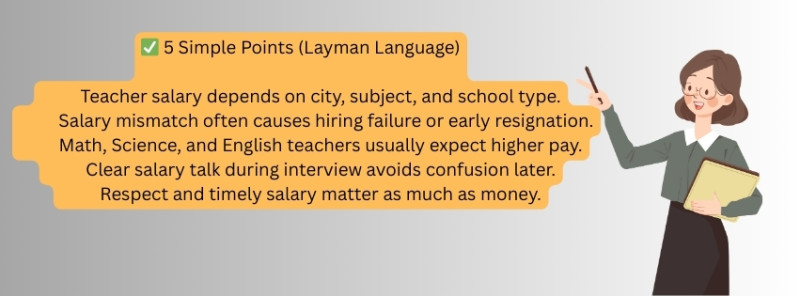
Common Mistakes Schools Make During Salary Discussions
Delaying Salary Discussion
Waiting till the final round wastes time if expectations do not match.
Overpromising Salary Increments
Verbal promises create future conflict.
Ignoring Workload While Fixing Salary
Salary must match:
- Number of classes
- Extra duties
- Administrative work
How Schools Should Handle Salary Discussions Professionally
Discuss Salary Range Early
Mention the salary range during the first interview or phone call.
Link Salary to Role and Responsibility
Explain why the salary is fixed at a certain level.
Be Transparent About Growth
If increments are possible, explain:
- When
- On what basis
- Honesty builds trust.
Balancing Budget and Teacher Expectations
Not every school can pay high salaries. That is acceptable. Schools can balance expectations by offering-
- Job stability
- Respectful work environment
- Timely salary
- Clear roles
Many teachers value stability and dignity as much as salary.
Many schools worry that limited budgets will affect hiring, but there are proven ways to attract better teachers without high salaries by offering stability, respect, and clear working conditions.
How Correct Hiring Reduces Salary Pressure
When schools hire teachers carefully through:
Structured interviews
Written tests
Demo class evaluation
They reduce early resignations and repeated hiring, which indirectly saves money and salary stress.
Practical Checklist for Schools (Salary Discussion)
Before finalising salary, ensure-
- Teacher understands workload clearly
- Salary discussed openly
- Payment cycle explained
- Growth possibilities clarified
- Commitment discussed
This avoids confusion later.
FAQs – Teacher Salary Expectations in India
- Do teachers expect the same salary everywhere in India?
No. Salary expectations vary by location, school type, and subject demand. - Is higher salary the only way to retain teachers?
No. Respect, clarity, and timely payment are equally important. - Should schools negotiate salary?
Yes, but respectfully and transparently. - Can small schools attract good teachers?
Yes, with clear communication and a supportive environment.
Finding Teachers Who Match Your Salary Budget
Platforms like SchoolNaukri.com help schools reach beyond their local circle by providing access to 5 lakh+ teacher resumes, trusted by 10,000+ schools across India. This makes it easier to find subject-wise teachers without depending only on references.
www.schoolnaukri.com – India’s fastest-growing teacher hiring website.
Conclusion
Teacher salary expectations in India are shaped by many factors, not just money. Schools that understand local salary realities, communicate clearly, and link salary with workload make better hiring decisions. Salary alignment is not about paying more, but about avoiding confusion and building long-term stability.