

Teacher Recruitment in India – Common Hiring Mistakes Schools Should Avoid
Teacher recruitment is one of the biggest challenges faced by schools in India today. Whether it is a small private school in a district town or a growing CBSE school in a city, hiring the right teacher at the right time is never easy. Many schools struggle not because teachers are unavailable, but because the recruitment process itself has gaps.
In many Indian schools, teacher hiring is done in urgency. Vacancies appear suddenly due to resignations, new sections, or academic expansion. Under pressure, schools often compromise on process, which leads to wrong hiring decisions. These mistakes later show up as classroom problems, parent complaints, poor results, or frequent teacher turnover.
This blog explains the most common teacher recruitment mistakes schools make in India, why they happen, and how schools can avoid them with simple, practical steps.
Real School Problem & Practical Solution
The Real Problem
A common situation in district-level private schools is this- a Maths teacher resigns mid-session. The school urgently needs a replacement. A candidate is referred by another teacher or relative. The interview is short, focusing mainly on qualifications and salary discussion. No written test is conducted, and the demo class is rushed or skipped. The teacher joins quickly.
Within two months, students start complaining that concepts are not clear. Classroom discipline becomes an issue, and parents raise concerns. The teacher feels stressed and leaves. The school now has to restart recruitment during the academic year, damaging its reputation and learning continuity.
The Practical Solution
This problem can be avoided by following a basic, structured teacher recruitment process, even during urgent hiring. Schools should never skip demo classes, should ask situation-based interview questions, and must clearly discuss expectations before finalising a teacher. A simple process followed consistently reduces wrong hiring significantly.
Mistake 1: Hiring in Urgency Without a Process
One of the biggest mistakes schools make is hiring teachers in panic.
- Vacancies are filled quickly
- Interviews are rushed
- Decisions are based on first impressions
Urgent hiring leads to emotional decisions instead of practical ones.
What schools should do instead-
- Written test (if applicable)
- 20–30 minute demo class
- Clear discussion on workload and salary
A delay of one or two days is better than hiring the wrong teacher.
Mistake 2: Depending Only on Qualifications and Experience
Many schools believe that degrees like B.Ed or years of experience guarantee good teaching. In reality, teaching ability depends more on classroom performance than certificates.
A teacher may be highly qualified but still struggle with:
Explaining concepts simply
Handling students
Managing time
What schools should do instead:
Use qualifications only as a shortlisting filter, not as the final decision factor. Always judge:
Subject clarity
Communication skills
Classroom confidence
Mistake 3: Skipping or Poorly Evaluating Demo Classes
Skipping demo classes is one of the most damaging recruitment mistakes.
Some schools:
Skip demos due to time pressure
Allow demos without proper observation
Judge demos only on confidence
This leads to wrong hiring.
What schools should do instead:
Treat the demo class as the most important evaluation stage. During a demo, observe:
How the teacher explains
How students respond
How discipline is handled
A structured demo evaluation saves schools from long-term problems.
Mistake 4: Asking Wrong Interview Questions
Many teacher interviews focus on generic questions like:
Why do you want to join our school?
What are your qualifications?
These questions do not test real classroom ability.
What schools should do instead:
Ask situation-based interview questions, such as:
How will you handle a noisy class?
How do you teach weak students?
What will you do if parents complain?
Such questions reveal practical thinking and maturity.
Mistake 5: Not Checking Teacher Stability and Commitment
High teacher turnover is a serious problem in Indian schools.
Common reasons include:
Teachers preparing for government exams
Salary mismatch
Workload misunderstanding
Schools often avoid asking direct questions about commitment.
What schools should do instead:
Clearly discuss:
Long-term plans
Exam preparation
Expected workload
Salary structure
Honest discussion reduces early resignations.
Mistake 6: No Written Tests for Academic Subjects
Many schools skip written tests, especially for primary and middle classes. This can hide weak subject knowledge.
What schools should do instead:
For core subjects like Maths, English, and Science:
Conduct a short written test
Check basic concept clarity
Avoid overcomplicated papers
Written tests help validate subject understanding.
Mistake 7: No Clear Hiring Criteria
Some schools hire based on:
Personal liking
Recommendation pressure
Emotional judgement
This creates inconsistency and internal conflict.
What schools should do instead:
Set clear criteria:
Interview performance
Demo class score
Written test result
Behaviour and communication
Objective criteria make hiring fair and professional.
Mistake 8: Not Documenting the Hiring Process
Many schools do not keep records of interviews, demos, or decisions. When problems arise, there is no reference.
- What schools should do instead:
Maintain simple records: - Interview notes
- Demo class feedback
- Salary and expectation discussion
This improves accountability and future decisions.
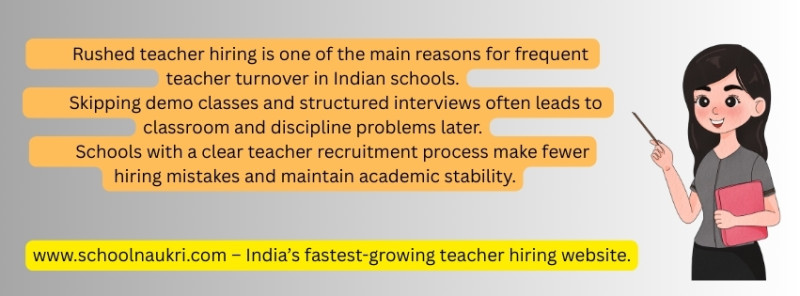
How a Structured Recruitment Process Helps Schools
Schools that follow a clear recruitment process:
- Make fewer hiring mistakes
- Reduce teacher turnover
- Improve classroom quality
- Gain parent trust
Teacher recruitment is not about speed, but about clarity and consistency.
To understand the complete recruitment journey in detail, schools can also refer to this guide:
How to Hire Teachers in India – Full Guide for School Owners
This helps school owners see teacher recruitment as a step-by-step system rather than a one-day activity.
Practical Checklist for Schools
Before finalising a teacher, ensure you have checked:
- Qualifications verified
- Interview conducted with situation-based questions
- Written test completed (if required)
- Demo class evaluated properly
- Salary and workload discussed clearly
- Commitment and availability confirmed
This checklist prevents most common hiring mistakes.
FAQs – Teacher Recruitment in India
- Why do schools make repeated hiring mistakes?
Due to urgency, lack of structure, and dependency on references. - Is demo class compulsory for all teachers?
Yes. Demo classes reveal real teaching ability. - How long should the teacher recruitment process take?
Ideally 2–4 days, depending on urgency. - Should schools hire teachers on trial basis?
Yes, probation periods help assess long-term suitability.
Finding Teachers Beyond Local References
Platforms like SchoolNaukri.com help schools reach beyond their local circle by providing access to 5 lakh+ teacher resumes, trusted by 10,000+ schools across India. This makes it easier to find subject-wise teachers without depending only on references.
www.schoolnaukri.com – India’s fastest-growing teacher hiring website.
Conclusion
Teacher recruitment mistakes cost schools time, money, and academic stability. Most of these mistakes happen due to urgency and lack of structure, not because schools are careless. Indian schools that follow a simple, clear recruitment process make better hiring decisions and build stronger teaching teams over time.
Recommendation
From my experience, schools that avoid rushed hiring and follow a structured teacher recruitment process make fewer mistakes and create a more stable learning environment for students.