
Who Can Apply for CBSE Affiliation? Society, Trust, Company & Government School Rules
Introduction
Schools can get CBSE affiliation only if they are run by a registered Society, Trust, Section 8 Company, Government body or approved public organization. A single person cannot apply in their own name. Before applying, the school must also have proper land, building, teachers, state recognition and safety certificates.
Many people think that if they have land, a school building and teachers, they can directly apply for CBSE affiliation. But this is not true.
CBSE gives affiliation only to schools that are run by approved legal bodies like a Society, Trust, Section 8 Company or Government organization.
If you are a school owner, principal, director, chairman or trustee, it is important to first understand whether your school is legally eligible for CBSE affiliation.
One common mistake many schools make is spending money on land, classrooms and furniture before checking whether their school is being run under the correct legal structure. Even a good school can face rejection if it is not registered properly.
So before spending money on infrastructure, schools should first check whether they are legally ready for CBSE affiliation.
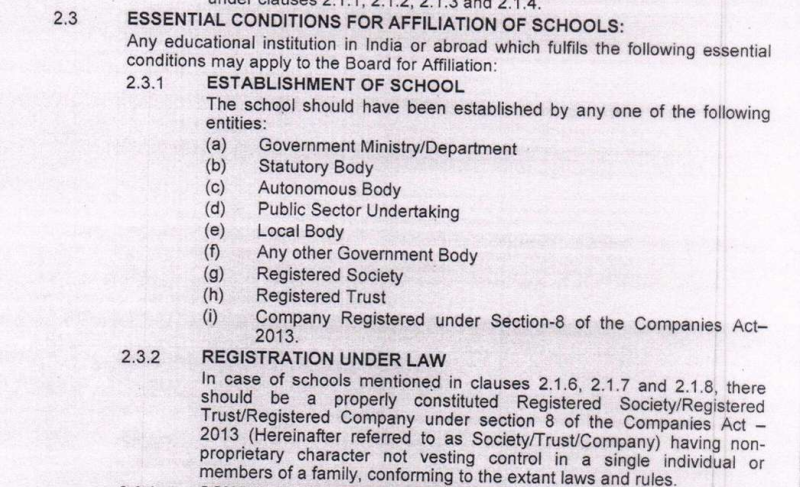
According to the CBSE Affiliation Bye-Laws 2018, schools can apply only if they are run by approved bodies such as a Society, Trust, Section 8 Company, Government body or certain public organizations.
Who Can Apply for CBSE Affiliation? Society, Trust, Company & Government School Rules
CBSE affiliation can generally be applied for by schools managed by a registered Society, Public Trust, Section 8 Company, or Government body, provided they meet the eligibility criteria and follow CBSE Affiliation Bye-Laws. The school must have the required approvals, infrastructure, qualified staff, and necessary documents before applying for CBSE affiliation. Understanding the type of management eligible for affiliation is the first step in planning a CBSE school.
Table of Contents
Introduction
Who Can Apply for CBSE Affiliation?
Can a Society Apply for CBSE Affiliation?
Can a Trust Apply for CBSE Affiliation?
Can a Company Apply for CBSE Affiliation?
Can Government Schools Apply for CBSE Affiliation?
Can an Individual Apply for CBSE Affiliation?
Who Can Apply for CBSE Affiliation? – Simple Eligibility Table
Essential Rules Before Applying for CBSE Affiliation
Legal Registration
State Recognition & NOC
Land Requirements
Infrastructure Norms
Teacher Qualifications
Non-Profit Requirement
Real School Problem & Practical Solution
Common Documents Needed Before Applying
FAQs – Who Can Apply for CBSE Affiliation?
Build a Strong School Team with SchoolNaukri
Conclusion
About the Authors
Can a Society Apply for CBSE Affiliation?
Yes. A registered society can apply for CBSE affiliation.
This is one of the most common structures used by private schools in India. Many schools are run by educational societies registered under the Societies Registration Act.
However, the society should meet certain conditions-
- The society must be properly registered
- It should have a non-proprietary character
- The school should not run for personal profit
- The society should have its own management committee
- The society should own or legally possess the school land
- The school should have state recognition and NOC before applying
CBSE clearly says that schools run by societies are eligible if they are registered and work as non-profit educational institutions.
Can a Trust Apply for CBSE Affiliation?
Yes. A school run by a registered trust can apply for CBSE affiliation.
Many schools in India are operated through public charitable trusts. This is another accepted structure for CBSE.
The trust must be legally registered and should be formed only for educational and charitable purposes. A family trust created for personal profit is not suitable.
Before applying, the trust should make sure--
- Trust deed is complete and valid
- Trustees are clearly mentioned
- School land is owned or leased in the name of the trust
- School has proper infrastructure and staff
- School is being run as a community service, not a business
CBSE also requires the trust to submit an affidavit stating that the school is not being run for commercial profit and no income is being diverted to individuals.
Read Also-How to Hire Teachers in India (2026 Guide) – Interview Questions, Salary, Skills & Hiring Tips
Can a Company Apply for CBSE Affiliation?
Yes. A Section 8 Company can apply for CBSE affiliation.
A normal private limited company or business company cannot apply. CBSE only allows companies registered under Section 8 of the Companies Act, 2013.
A Section 8 Company is a non-profit company created for education, social work or charitable activities.
This means-
- The company should not distribute profit to directors or owners
- Income should be used only for school development
- The company should be properly registered under Section 8
- Proper board members and school management committee should exist
- Land and school documents should be in the company’s name
This rule is important because many school owners wrongly think they can run a CBSE school through a normal business company. That is not allowed.
CBSE clearly states that only Section 8 Companies can apply under the company structure.
Can Government Schools Apply for CBSE Affiliation?
Yes. Government schools can also apply for CBSE affiliation.
This includes--
- State Government schools
- Central Government schools
- Municipal schools
- Government aided schools
Schools run by public sector undertakings
Schools run by autonomous government bodies
Many government schools apply for CBSE affiliation to improve academic quality, student opportunities and national recognition.
Government schools may get some flexibility in land and infrastructure norms depending on their category, but they still need to meet major CBSE requirements related to teachers, safety, classrooms, laboratories and school records.
Can an Individual Apply for CBSE Affiliation?
No. An individual person cannot apply directly for CBSE affiliation.
For example, if a person owns land and wants to start a CBSE school, they cannot apply in their own personal name.
They must first create one of these--
- Registered Society
- Registered Trust
- Section 8 Company
Only after creating a proper legal entity can they start the CBSE process.
This is one of the biggest mistakes made by new school founders in India.
Who Can Apply for CBSE Affiliation? – Simple Eligibility Table
| Organisation Type | Eligible for CBSE Affiliation? | Simple Explanation |
|---|---|---|
| Government School | Yes | Government-run schools can apply if they meet CBSE requirements. |
| Government-Aided School | Yes | Aided schools are eligible after fulfilling CBSE norms. |
| Registered Society | Yes | Many CBSE schools in India are managed by registered societies. |
| Registered Trust | Yes | Trust-run schools can apply after meeting CBSE guidelines. |
| Section 8 Company | Yes | Non-profit Section 8 companies can establish and manage CBSE schools. |
| Individual School Owner | No | An individual cannot usually apply directly. A Society, Trust, or Section 8 Company is generally required. |
| Private Limited Company | No | A regular private limited company is generally not eligible for CBSE affiliation. |
| Partnership Firm | No | Partnership firms are generally not eligible under CBSE rules. |
| Proprietorship Firm | No | A sole proprietorship cannot usually apply for CBSE affiliation. |
Simple Tip: Before applying for CBSE affiliation, ensure that your school is managed by an eligible organisation and meets the latest CBSE requirements.
Essential Rules Before Applying for CBSE Affiliation
Even if your school is run by a society, trust or company, CBSE will not approve the school unless some basic conditions are met.
1. The School Must Be Registered Properly
The society, trust or company should be legally registered with the appropriate authority.
2. The School Must Have Recognition from the State Government
CBSE does not directly approve a completely new school without state approval.
The school must first get--
- State recognition
- NOC from the State Government if required
- UDISE number
CBSE requires Recognition Certificate and No Objection Certificate before considering the application.
3. The School Must Have Proper Land
The school should have land in the name of the society, trust or company.
Generally, CBSE expects around 1.5 acres land for schools in normal areas, though the requirement may be lower in metro cities, hilly areas, North Eastern states and municipal areas. Some city schools can apply with 4000 square meters land depending on location.
4. The School Must Have Proper Infrastructure
CBSE checks whether the school has--
- Safe classrooms
- Science labs
- Computer lab
- Library
- Toilets
- Drinking water
- Playground
- Staff room
- Safety measures
- Boundary wall
For example, CBSE says classrooms should generally be around 8m x 6m, science labs around 9m x 6m and libraries around 14m x 8m.
For complete details about CBSE affiliation rules, land requirement, infrastructure norms, teacher qualifications, safety certificates and school eligibility, schools should read the official CBSE Affiliation Bye-Laws PDF issued by Central Board of Secondary Education. This document explains all major requirements in detail and helps schools avoid mistakes during the CBSE affiliation process.
5. Teachers Must Be Qualified
The school should appoint qualified teachers as per CBSE and state government rules.
CBSE also requires--
- Principal qualification
- Teacher-student ratio
- Trained teachers
- Physical education teacher
- Special educator
- Wellness teacher or counsellor
The pupil-teacher ratio should normally not exceed 30:1.
6. The School Should Not Run for Profit
This is one of the most important CBSE rules.
The school should not operate like a private business where profit is distributed to family members, directors or trustees.
CBSE clearly says that--
- No income should go to any individual
- Income should be used only for school development
- No capitation fee should be charged
- No donation should be taken for admission
Schools must submit an affidavit confirming that the school is run as a community service and not for business profit.
You can visit the official website of Central Board of Secondary Education to understand the latest CBSE rules, affiliation bye-laws and complete application process. https://www.cbse.gov.in
You can also visit the official SARAS portal of Central Board of Secondary Education to understand the CBSE affiliation application process step by step.
Real School Problem & Practical Solution
A common situation in Jharkhand schools – A school owner purchases land, builds classrooms and hires teachers, but starts the school in his own personal name without creating a society, trust or Section 8 company.
After spending lakhs of rupees, the owner realizes that CBSE will not accept the application because the school is not run by an approved legal body.
The practical solution is simple – before buying land or starting construction, first create the correct legal structure.
In most cases, a registered society or trust is the easiest and most practical option for school owners.
Read Also-How Schools Can Hire French & German Language Teachers in India
Common Documents Needed Before Applying
Schools should usually keep these documents ready:
- Society registration certificate / Trust deed / Section 8 certificate
- School recognition certificate
- NOC from state government
- Land ownership papers or lease deed
- Building safety certificate
- Fire safety certificate
- Health and sanitation certificate
- Staff list and qualifications
- Salary payment proof through bank
- School management committee details
- Photographs of infrastructure
- Affidavit on non-profit status
CBSE also requires the school to maintain proper records, website details and financial transparency.
FAQs – Who Can Apply for CBSE Affiliation?
1. Can a private school owner apply directly for CBSE affiliation?
No. CBSE generally does not grant affiliation to schools owned by an individual in a personal capacity. The school should be managed by an eligible entity such as a registered Society, Registered Trust, Section 8 Company, or a Government body, as per the applicable CBSE rules.
2. Can a trust-run school get CBSE affiliation?
Yes. A school managed by a registered trust can apply for CBSE affiliation if it fulfils the required conditions related to infrastructure, qualified teachers, recognition, safety certificates, and other CBSE norms.
3. Can a private limited company apply for CBSE affiliation?
A regular private limited company is generally not eligible for CBSE affiliation. Schools seeking CBSE affiliation should be managed by a Section 8 Company or another eligible entity recognised under the CBSE Affiliation Bye-Laws.
4. Is State Government recognition required for CBSE affiliation?
Yes. State recognition is an important requirement for CBSE affiliation. Depending on the applicable rules, schools may also need a No Objection Certificate (NOC) or other approvals from the competent authority before applying.
5. Can government schools apply for CBSE affiliation?
Yes. Government schools, aided schools, and schools established by Government departments or other eligible Government bodies can apply for CBSE affiliation, provided they meet the prescribed CBSE requirements.
6. What type of organisation is best for starting a CBSE school?
Many CBSE schools in India are managed by registered Societies, Public Trusts, or Section 8 Companies. The choice depends on the school's long-term goals, management structure, and compliance with applicable laws and CBSE guidelines.
7. What are the basic conditions for an organisation to apply for CBSE affiliation?
Apart from being managed by an eligible entity, the school should have the required land, infrastructure, qualified staff, statutory approvals, safety certificates, and other documents specified under the CBSE Affiliation Bye-Laws.
8. Where can schools check the latest CBSE affiliation eligibility rules?
Schools should always refer to the latest CBSE Affiliation Bye-Laws and official CBSE notifications for updated eligibility conditions, required documents, and application procedures before starting the affiliation process.
Build a Strong School Team with SchoolNaukri
Planning to start a CBSE school or apply for CBSE affiliation? Building a team of qualified teachers and school leaders is an important step towards creating a successful school.
What SchoolNaukri Can Help You With
• Access 5 lakh+ teacher resumes from across India.
• Hire Teachers, Principals, Vice Principals, and School Office Staff.
• Find subject-wise and role-specific candidates quickly.
• Connect with nearby and PAN India talent.
• Strengthen your school's academic and administrative team.
• Save time and simplify the teacher hiring process.
• Free registration for schools.
• Start hiring in just a few minutes.Visit:
SchoolNaukri – India's No.1 Teacher Hiring Job Site.
Conclusion
Getting CBSE affiliation becomes much easier when the school is built on the right legal structure from the beginning.
The most common and safest options are:
- Registered Society
- Registered Trust
- Section 8 Company
- Government body
A school cannot apply for CBSE affiliation in a personal name, even if the owner has land, building and money.
Before applying, schools should complete all the basic requirements step by step:
- Proper legal registration
- State recognition and NOC
- School land and building
- Qualified teachers
- Labs, library and classrooms
- Fire safety and health certificates
- School management committee
- Financial records and salary payment proof
Many schools face delay or rejection because they start construction and spend money before checking the legal structure.
The smartest way is to first create the correct legal body, then complete land, infrastructure and documents, and only after that apply for CBSE affiliation.
For detailed rules on land, infrastructure, safety certificates, teacher qualifications, school management, staff records and other mandatory documents, schools can read the official CBSE Affiliation Bye-Laws PDF. It is one of the most important reference documents for understanding the complete CBSE affiliation process in India.
https://www.cbse.gov.in/cbsenew/documents/affiliation-Bye-Laws.pdf
About the Authors
Abhishek Ranjan and Atul Kumar are the founders of SchoolNaukri and actively work with schools across India to support school growth, teacher recruitment, and educational leadership.
By working closely with school founders, principals, and management teams, they gain practical insights into the challenges involved in establishing and managing schools, including staffing, compliance, and institutional development. Their goal is to simplify complex school-related topics and provide practical guidance for educators and school leaders.
They are also the authors of "The Ultimate School Hiring Workbook," a practical resource designed to help schools build effective hiring systems and strengthen their academic teams.