

How to Hire GK / Social Studies Teachers in India – Simple Guide
How to Hire GK / Social Studies Teachers in India
Hiring the right GK (General Knowledge) or Social Studies teacher is essential for building students' understanding of history, geography, civics, economics, and current affairs. Schools should look beyond qualifications and evaluate communication skills, classroom management, subject knowledge, and teaching ability through structured interviews, subject tests, and demo classes. This guide explains the complete recruitment process for hiring qualified PRT, TGT, and PGT Social Studies teachers in India.
Introduction
Hiring a good GK or Social Studies teacher is one of the most important recruitment decisions for any school. A great teacher does much more than complete the syllabus. They help students understand history, geography, civics, economics, and current affairs in a way that makes learning interesting and meaningful.
Whether your school follows the CBSE, ICSE, State Board, or any other curriculum, students need teachers who can explain concepts clearly, encourage discussions, and connect classroom lessons with real-life examples.
However, finding the right teacher is not always easy. Many candidates meet the required qualifications, but only a few can keep students engaged, simplify complex topics, and create an interactive classroom environment.
As founders of SchoolNaukri, we've interacted with thousands of schools across India. One challenge we hear repeatedly is that schools receive many applications but struggle to identify candidates who can genuinely inspire students. The best Social Studies teachers are not simply subject experts—they are storytellers who make history come alive, explain geography through everyday examples, and encourage students to think critically about society.
This guide will help schools hire qualified GK and Social Studies teachers through a structured recruitment process. Whether you're hiring a PRT, TGT, or PGT teacher, these practical tips will help you make better hiring decisions.
Why Hiring the Right GK / Social Studies Teacher Matters
A good GK or Social Studies teacher does much more than teach History, Geography, Civics, or Economics. They help students understand the world, think critically, stay informed about current events, and become responsible citizens.
The best teachers make learning enjoyable by using stories, maps, real-life examples, classroom discussions, and activities. Instead of asking students to simply memorize facts, they help students understand the reasons behind important events and how those lessons relate to everyday life.
Hiring the right teacher can help your school:
- Improve students' understanding of Social Studies and General Knowledge.
- Increase performance in school and board examinations.
- Develop critical thinking and decision-making skills.
- Encourage classroom discussions and student participation.
- Build students' awareness of current affairs and society.
- Improve parent satisfaction through better learning outcomes.
- Strengthen your school's academic reputation.
- Reduce teacher turnover by hiring the right candidate from the beginning.
A great GK or Social Studies teacher can inspire hundreds of students and leave a lasting impact on their learning journey.
What Qualifications Should a GK / Social Studies Teacher Have?
The qualification depends on the classes the teacher will handle.
| Position | Typical Qualification |
|---|---|
| PRT | Graduate with B.Ed. (Social Science background preferred) |
| TGT | B.A./B.Sc. in Social Science, History, Geography, Political Science, Economics or related subject + B.Ed. |
| PGT | Master's Degree in the relevant subject + B.Ed. |
Schools may also prefer:
- CTET or State TET qualification (where applicable)
- CBSE or ICSE teaching experience
- Good English and Hindi communication skills
- Computer literacy
- Smart classroom teaching experience
Remember, qualifications are important—but they should never be the only factor when selecting a teacher.
Qualities of an Excellent GK / Social Studies Teacher
A great GK or Social Studies teacher is not selected only based on qualifications. They should be able to make learning simple, interesting, and enjoyable for students.
Look for teachers who:
- Have strong knowledge of History, Geography, Civics, and General Knowledge.
- Explain difficult topics in a simple and easy-to-understand way.
- Use stories, maps, and real-life examples while teaching.
- Encourage students to ask questions and participate in class.
- Have good communication skills.
- Manage the classroom confidently.
- Keep students interested throughout the lesson.
- Use smart boards and other teaching tools when needed.
- Stay updated with current affairs and general knowledge.
- Have a positive attitude and enjoy teaching.
Teachers with these qualities create a better classroom experience and help students develop a genuine interest in Social Studies.
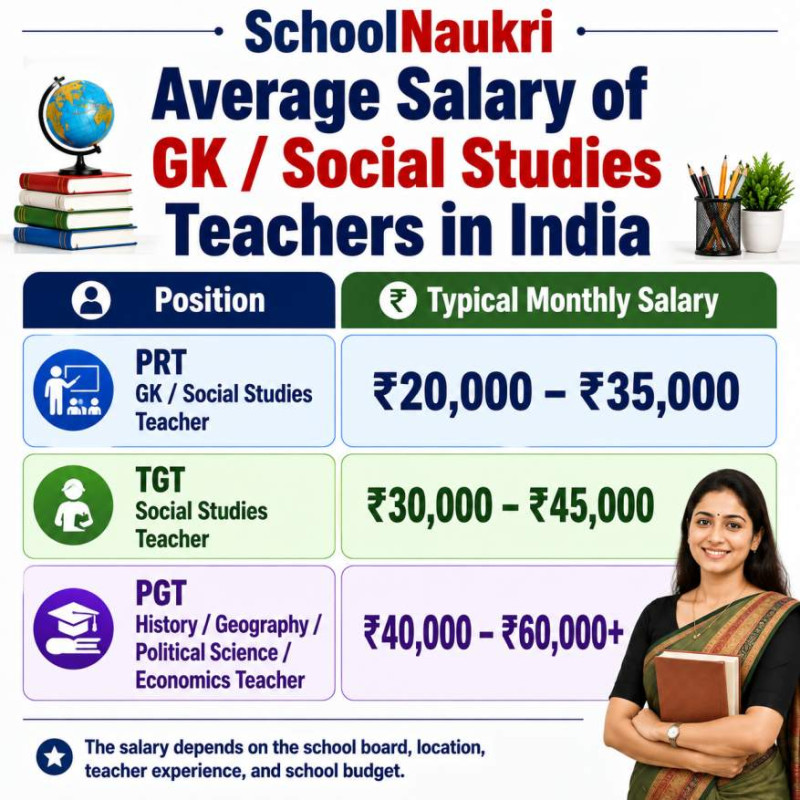
Average Salary of GK / Social Studies Teachers in India
The salary depends on the school board, location, teacher experience, and school budget.
| Position | Typical Monthly Salary |
|---|---|
| PRT GK / Social Studies Teacher | ₹20,000 – ₹35,000 |
| TGT Social Studies Teacher | ₹30,000 – ₹45,000 |
| PGT History / Geography / Political Science / Economics Teacher | ₹40,000 – ₹60,000+ |
Large metropolitan schools and well-established private schools may offer higher salaries based on experience and qualifications.
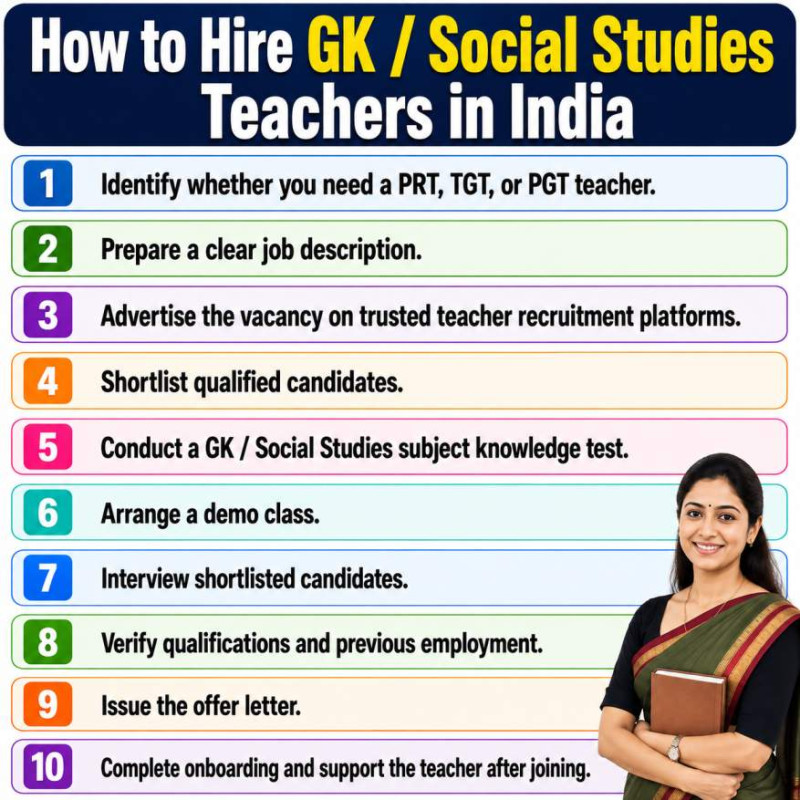
Step-by-Step Process to Hire GK / Social Studies Teachers
Hiring the right teacher becomes much easier when schools follow a structured recruitment process.
Step 1: Identify Your Hiring Requirement
Before you start hiring, be clear about what your school needs.
Ask yourself:
- Are you hiring a PRT, TGT, or PGT teacher?
- Which classes will the teacher teach?
- Which board does your school follow (CBSE, ICSE, or State Board)?
- Is the position full-time or part-time?
- What salary can your school offer?
- When do you want the teacher to join?
A clear hiring plan helps you attract the right candidates from the beginning.
Step 2: Prepare a Clear Job Description
A good job description helps teachers understand your requirements before they apply.
Include:
- Job title
- School name and location
- Classes and subjects to be taught
- Required qualification
- Experience (if required)
- Main responsibilities
- Salary (optional)
- Joining date
- How to apply
The clearer your job description, the better the applications you will receive.
Step 3: Advertise the Vacancy
Now it's time to let teachers know that your school is hiring.
You can post your vacancy on:
- SchoolNaukri
- Your school website
- WhatsApp groups
- Teacher training colleges
- Employee referrals
Posting on trusted teacher recruitment platforms helps you reach more qualified teachers.
Step 4: Shortlist the Right Candidates
After receiving applications, don't invite everyone for an interview.
Carefully review each resume and check:
- Educational qualifications
- B.Ed. qualification
- Teaching experience
- Board experience
- Communication skills
- Previous work history
- Certifications (if any)
A good shortlist saves time and helps you focus on the best candidates.
Step 5: Conduct a Subject Knowledge Test
A resume cannot always tell you how strong a teacher's subject knowledge is.
A short written or online test can help you assess the candidate's understanding of:
- History
- Geography
- Civics
- Economics
- General Knowledge
- Current Affairs
- Environmental Studies
- Map-based questions
A simple 20–30 minute test can make your hiring decision much easier.
Step 6: Arrange a Demo Class
A demo class is one of the best ways to evaluate a teacher.
During the demo, observe whether the teacher:
- Explains topics clearly.
- Uses simple language.
- Keeps students interested.
- Encourages students to participate.
- Uses stories and real-life examples.
- Answers questions confidently.
- Maintains classroom discipline.
- Completes the lesson on time.
Many principals say a demo class reveals more than a resume or interview.
Step 7: Conduct the Interview
The interview helps you understand the teacher's personality, confidence, and teaching approach.
Ask questions about:
Teaching experience
Classroom management
Lesson planning
Parent communication
Use of technology
Current affairs
Why they want to join your school
Choose candidates who are confident, positive, and genuinely interested in teaching.
Step 8: Verify Documents and References
Before offering the job, verify the candidate's documents.
Check:
Educational certificates
B.Ed. certificate
Experience certificates
Identity proof
Previous employment
Professional references
A few simple checks can help you avoid future problems.
Step 9: Issue the Offer Letter
After selecting the right candidate, send a clear offer letter.
It should mention:
Job title
Salary
Joining date
Working hours
Probation period
School policies
Other employment terms
A clear offer letter avoids confusion and creates a professional impression.
Step 10: Complete Onboarding
Help the new teacher settle into the school smoothly.
During onboarding:
Complete all joining formalities.
Introduce the teacher to other staff members.
Explain school rules and policies.
Share the academic calendar.
Provide classroom and teaching resources.
Offer support during the first few weeks.
A good onboarding process helps new teachers feel comfortable and start teaching with confidence.
Resume Screening Checklist
Before inviting a candidate for an interview, review the resume carefully.
Look for:
- Relevant subject specialization.
- B.Ed. qualification.
- Experience teaching the required classes.
- Board experience.
- Stable employment history.
- Good communication skills.
- Computer knowledge.
- Training or certifications.
- Co-curricular achievements.
- Professional resume presentation.
Remember, a strong resume should be followed by a subject test and demo class before making the final hiring decision.
Demo Class Evaluation Checklist
Use a simple evaluation sheet while observing the demo class.
Rate the candidate on:
- Subject knowledge
- Communication skills
- Classroom confidence
- Student engagement
- Teaching methodology
- Board work and presentation
- Use of teaching aids
- Time management
- Question handling
- Overall classroom presence
This structured approach makes the final hiring decision more objective and fair.
20 Interview Questions to hire GK / Social Studies Teachers
A well-planned interview helps schools identify teachers who have both strong subject knowledge and good teaching skills. Here are some practical interview questions you can ask.
- Tell us about yourself and your teaching experience.
- Why do you want to teach Social Studies?
- How do you make History interesting for students?
- How do you explain difficult Geography concepts in a simple way?
- How do you encourage students to participate in classroom discussions?
- How do you keep students interested during Social Studies lessons?
- How do you teach map-reading and map-based questions?
- How do you connect current affairs with classroom learning?
- How do you handle students who are not interested in Social Studies?
- How do you prepare students for board examinations?
- How do you assess whether students have understood a topic?
- What teaching aids or technology do you use in the classroom?
- How do you manage discipline during your class?
- Tell us about a successful classroom activity you have conducted.
- How do you communicate with parents about student progress?
- Which Social Studies topic do you enjoy teaching the most, and why?
- How do you stay updated with current affairs and educational changes?
- What would you do if a student asks a question that you cannot answer immediately?
- Why should our school hire you?
Do you have any questions for us?
These questions help schools evaluate communication skills, classroom confidence, teaching approach, and overall suitability.
Practical Teaching Tasks
Instead of relying only on interviews, ask candidates to teach a topic for 15–20 minutes.
You can assign topics such as:
- The Indian Constitution
- Fundamental Rights and Duties
- The Harappan Civilization
- The Revolt of 1857
- Latitude and Longitude
- The Indian Monsoon
- Democracy in India
- Natural Resources
- The Freedom Movement
- Current Affairs Discussion
These classroom demonstrations help schools understand how the candidate explains concepts, interacts with students, and manages the classroom.
Common Mistakes Schools Should Avoid
Many schools make hiring decisions in a hurry, especially when there is an urgent vacancy. This often leads to poor hiring decisions.
Avoid these common mistakes:
- Hiring only based on qualifications.
- Skipping the demo class.
- Not conducting a subject knowledge test.
- Ignoring communication skills.
- Not verifying previous employment.
- Offering unclear job responsibilities.
- Rushing the recruitment process.
- Ignoring classroom management skills.
- Not checking references.
- Choosing experience over teaching ability.
Taking a little extra time during recruitment can save months of classroom problems later.
SchoolNaukri Insight
As the founders of SchoolNaukri, we've interacted with thousands of principals and school management teams across India.
One thing we've consistently observed is that schools usually don't struggle to receive applications for GK or Social Studies teacher vacancies. The real challenge is identifying teachers who can make History, Geography, Civics, and General Knowledge interesting and easy for students to understand.
The best teachers are those who use stories, maps, real-life examples, classroom discussions, and activities instead of simply reading from the textbook. These teachers create classrooms where students enjoy learning and remember concepts for years.
We've also noticed that great schools don't treat recruitment as the final step—they treat it as the beginning of a long-term partnership. After selecting a teacher, they provide proper onboarding, guidance, regular feedback, and continuous training. In other words, they hold the teacher's hand during the initial months, helping them understand the school's culture, teaching expectations, and classroom standards.
Simply hiring a teacher doesn't solve the problem. Supporting and developing that teacher is what ultimately improves student learning, parent satisfaction, and the overall quality of education.
Verify Teacher Eligibility
Before hiring a GK or Social Studies teacher, make sure the candidate meets the latest teacher qualification requirements issued by the National Council for Teacher Education (NCTE). If your school is affiliated with CBSE, also verify that the candidate meets the teaching staff qualifications mentioned in the latest CBSE Affiliation Bye-Laws.
Useful Resources:
NCTE Minimum Teacher Qualifications: NCTE Minimum Qualifications of Teachers
CBSE Teaching Staff Qualification Guidelines: CBSE Teaching Staff Qualifications
How SchoolNaukri Helps Schools Hire GK / Social Studies Teachers
Finding a qualified GK or Social Studies teacher doesn't have to be difficult. SchoolNaukri helps schools hire the right teachers quickly and efficiently.
With SchoolNaukri, schools can:
- Search from over 10 lakh teacher resumes across India.
- Find GK and Social Studies teachers by qualification, experience, subject, and location.
- Post teaching vacancies and receive applications from qualified candidates.
- Shortlist candidates and contact them directly.
- Trusted by 20,000+ registered schools across India.
Visit www.schoolnaukri.com to hire qualified GK and Social Studies teachers and build a stronger teaching team for your school.
Frequently Asked Questions (FAQs)
1. How do I hire a GK or Social Studies teacher in India?
Post your vacancy, shortlist qualified candidates, conduct a subject knowledge test, arrange a demo class, verify documents, and select the best teacher for your school.
2. What qualification should a GK or Social Studies teacher have?
Most schools prefer candidates with a Graduate or Postgraduate degree in History, Geography, Political Science, Economics, or a related subject, along with a B.Ed. qualification.
3. Where can I find qualified GK or Social Studies teachers?
You can find qualified GK and Social Studies teachers on SchoolNaukri, teacher recruitment platforms, teacher training institutes, referrals, and professional education networks.
4. Where can I hire a GK or Social Studies teacher?
Schools can hire qualified GK and Social Studies teachers through SchoolNaukri, where you can search teacher resumes, post vacancies, and connect directly with candidates across India.
5. How do I evaluate a GK or Social Studies teacher before hiring?
Review the candidate's resume, conduct a subject knowledge test, arrange a demo class, interview the candidate, and verify previous employment and documents.
6. Should I conduct a demo class before hiring a Social Studies teacher?
Yes. A demo class helps you assess the teacher's communication skills, teaching style, classroom management, and student engagement.
7. Can I hire a fresher GK or Social Studies teacher?
Yes. Freshers with strong subject knowledge, good communication skills, and an excellent demo class can become successful teachers.
8. How much salary should I offer a GK or Social Studies teacher?
The salary depends on the teacher's qualifications, experience, school board, location, and your school's budget.
9. How long does it take to hire a GK or Social Studies teacher?
Most schools complete the hiring process within 1 to 4 weeks, depending on the number of applications and interview rounds.
10. How can SchoolNaukri help me hire GK or Social Studies teachers?
SchoolNaukri helps schools search over 10 lakh teacher resumes, post teaching vacancies, receive applications from qualified candidates, and hire teachers quickly across India.
Conclusion
Hiring a GK or Social Studies teacher is not just about filling a vacancy—it's about finding someone who will guide, inspire, and shape your students for years to come. A good teacher helps students understand the world, think independently, and become responsible citizens.
Don't rush the hiring process. Take time to prepare a clear job description, carefully review resumes, conduct a subject knowledge test, observe a demo class, and verify the candidate's qualifications before making your final decision.
Think of teacher recruitment like holding someone's hand before trusting them to lead your students. The more carefully you evaluate a candidate before hiring, the more confident you can be in your decision.
The right teacher can inspire hundreds of students throughout their career, while the wrong hiring decision can affect an entire classroom. That's why every step of the recruitment process matters.
By following the practical tips shared in this guide, your school can hire qualified GK and Social Studies teachers who create engaging classrooms, improve student learning, strengthen parent trust, and contribute to your school's long-term success.
About the Authors
Abhishek Ranjan and Atul Kumar are the founders of SchoolNaukri, India's No.1 School Hiring & Teacher Recruitment Platform. By working closely with thousands of schools, principals, and school management teams across India, they have developed practical insights into teacher recruitment and school hiring.
In this guide on How to Hire GK / Social Studies Teachers in India, they share practical advice to help schools identify, evaluate, and hire teachers who can create engaging classrooms and improve student learning outcomes.
They are also the authors of "The Ultimate School Hiring Workbook," a practical guide that helps schools recruit better teachers through structured interviews, teacher evaluation tools, hiring checklists, and proven recruitment practices.