
7 Mistakes Schools Make When Hiring Teachers Online And How to Avoid Them
Introduction
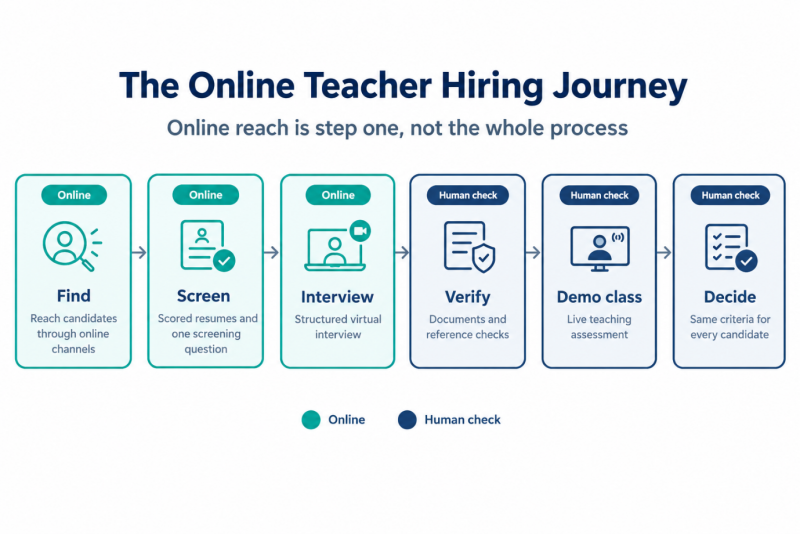
Hiring teachers online can put a school in front of hundreds of candidates within a week. Then the applications start piling up. A school that once sorted twenty walk-in applications can now face a few hundred, arriving through portals, email and WhatsApp forwards. The internet is rarely the culprit. What goes wrong is that nobody has decided how to judge the people it delivers. Online teacher recruitment works when sourcing, screening, interviewing, verification and classroom assessment are treated as separate steps. These seven mistakes show where schools tend to blur them.
Table of Contents
- The Short Answer
1. Choosing a Channel Because It Is Popular, Not Because It Fits
2. Publishing a Vague Job Post
3. Letting Resumes Do All the Screening
4. Treating a Virtual Interview Like a Normal One on a Screen
5. Going Quiet After Applications Arrive
6. Accepting Digital Documents at Face Value
7. Deciding on Digital Impressions Without a Demo Class
- Pair Online Reach with Proper Evaluation
- Getting Support with Hiring
- Conclusion
- FAQs About Online School Hiring Mistakes
- About the Authors
7 Mistakes Schools Make When Hiring Teachers Online (And How to Avoid Them)
How to hire teachers online comes down to a sequence. Use digital channels to find and shortlist candidates, then screen, interview, verify documents, watch a demo class, and only then decide. Most teacher hiring mistakes in the online process come from skipping one of those steps.
1. Choosing a channel because it is popular, not because it fits
A general job portal brings volume, but a PRT vacancy for primary classes and a PGT physics vacancy rarely draw from the same pool. Schools trying to find teachers online often post everywhere and then wonder why the applications feel scattered. Social media groups add reach but very little structure.
Before choosing the right teacher hiring platform, ask a few questions. Which candidates does it attract? Can you filter by subject and level? How is applicant data handled? An education-focused teacher recruitment platform often suits hiring teachers for private schools better than a broad portal.
2. Publishing a vague job post
Online listings get copied, shared and indexed, so a loose teacher job posting for schools invites everyone. A line like "teacher required, good salary" produces a flood of online teacher applications from people who never read it.
A useful post states:
- Class level and subject (PRT, TGT or PGT)
- Board and medium of instruction
- Required qualifications, such as B.Ed and TET or CTET where the role needs them
- Salary band, location and working hours
- One screening question every applicant must answer
That last item tends to weed out irrelevant applicants faster than reading resumes does. What a school asks for will vary: a small school may want one teacher covering several subjects, while a larger one hires strictly by subject.
3. Letting resumes do all the screening
A polished resume is easy to produce and easy to borrow. When applications pile up, teacher resume screening drifts toward whoever has the best formatting, and qualified teacher candidates who write plainly get overlooked.
Good teacher candidate screening is short and repeatable. Schools that follow a structured teacher recruitment strategy fix the criteria before the vacancy goes live: qualification, relevant experience, subject fit and the screening answer, scored on one sheet. For a TGT science role, that screening question might ask which board the candidate has taught and which chapter they find hardest to explain, and why. A ten-minute phone call with the top group then confirms what the paper suggests.
4. Treating a virtual interview like a normal one on a screen
A virtual teacher interview brings problems a staffroom interview never had. Weak connections cut answers short, and a confident on-camera manner is easily mistaken for teaching skill. Panel members also ask different questions, so nobody can compare candidates fairly.
Fix the basics:
- Ask every candidate the same core questions
- Fill a shared scorecard straight after each call
- Send the link, time and duration in advance
- Keep a phone backup for dropped connections
Then add one short task, such as explaining a topic to a Grade 6 class in five minutes. A sound teacher interview process tests how someone explains, not only how they present.
5. Going quiet after applications arrive
Online applications land instantly, so candidates expect quick replies. Some schools stay silent for weeks. Others send updates piecemeal, by email one day and from an unsaved number the next. Candidates holding other offers move on, and the shortlist thins.
Acknowledge applications within a day or two, then lay out the stages and timing, and keep updates on one channel. A two-line rejection is worth sending too, since local teachers tend to know each other. If the HR team lacks time, teacher hiring services can handle scheduling and status updates while the decision stays with the school.
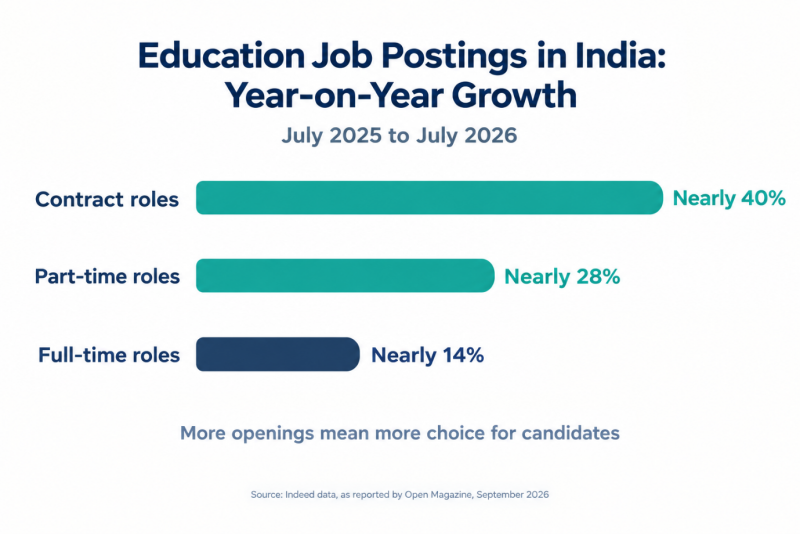
Source: OpentheMagazine
6. Accepting digital documents at face value
Scanned certificates, screenshots and PDF experience letters are convenient. They are also easy to edit. Teacher qualification verification often gets pushed until after the offer, which is too late.
Before an offer, check:
- Degrees and B.Ed certificates, with the issuing university or board where possible
- TET or CTET status, if the post requires it
- Identity and address proof
- Experience letters, against the previous employers
- Two teacher reference checks, ideally former principals or supervisors
Requirements differ by board and state, so verify what applies to your school. Run these checks on the shortlist rather than every applicant, so the effort goes where it counts.
7. Deciding on digital impressions without a demo class
By the final stage, a candidate may have been assessed entirely through forms, chats and video calls. Those are enough to tell you how good a candidate’s communication skills are; however, it says little about how they handle a full classroom.
Consider a hypothetical case. A school shortlists a TGT mathematics candidate with a strong resume and a fluent video interview, but nobody watches the person teach. The first month reveals lessons students struggle to follow.
A teacher demo class, live and scored on subject clarity, pace, student engagement and classroom control, closes that gap. Online sourcing is only the opening stretch of the complete teacher hiring process, which also covers interviews, document checks and references. Weighting varies from school to school, but none should skip assessing actual teaching.
Pair online reach with proper evaluation
Online sourcing can put candidates in front of you but cannot tell you who will teach well. Schools that get this right keep a fixed teacher recruitment process behind it: the same screening, the same questions and a demo class for every candidate. With that in place, the speed of online hiring helps rather than hurts, and finding qualified teachers for schools depends less on luck.
Getting support with hiring
Schools that want help with sourcing, screening and hiring qualified teachers can look at teacher recruitment services for schools and decide how much of the process they want support with. Some need help only at the start, reaching suitable candidates and sorting applications. Others want support through interview scheduling, document checks and reference calls. Who actually joins the staff is still a decision for your principal and academic heads.
SchoolNaukri Insight: Hiring teachers online is easy, but choosing the right teacher takes care. A clear job post, proper interviews and a demo class can help schools avoid common hiring mistakes and find the right fit.
Conclusion:
Online hiring gives schools speed and reach, but neither replaces careful evaluation. The schools that hire well pair digital sourcing with a consistent process: clear job posts, scored screening, structured interviews, verified documents and a demo class before any offer. Get those five right, and online hiring becomes an advantage rather than a risk, bringing in qualified teacher candidates who are assessed properly, not just quickly.
FAQs About Online School Hiring Mistakes
What are the common mistakes schools make when hiring teachers online?
The trouble usually starts with a channel that does not suit the vacancy and a vague job post. Resume-only shortlisting, unstructured video calls, slow replies, unchecked scans and a skipped demo class add to it. Behind most of these sits one assumption, that online sourcing is the whole process when it is only the first stage.
How can schools screen teacher candidates online before an interview?
Score every application against criteria fixed in advance, such as qualification, subject fit and experience. Add one written screening question to the application, then hold a short phone or video call with the top group. This keeps a polished resume from deciding the shortlist and gives you comparable notes on each candidate.
How can schools find qualified teachers online?
For schools that want to hire qualified teachers online, an education-focused portal beats a general job site as a starting point. Name the class, subject, board and qualifications in the listing, and treat referrals and social posts as backups. Every source still needs the same screening, so applicants are compared on one standard.
What should schools check before hiring a teacher online?
Check qualifications with the issuing university or board, TET or CTET status where the post requires it, identity and address proof, past employment and at least two references. Add a demo class before the offer. Requirements differ by board and state, so follow the norms that apply to your school.
How can schools hire teachers online without compromising hiring quality?
Keep the online stage to sourcing and first screening. From there, a sound online teacher hiring process moves on to interviews and document checks, then references and a demo class, and judges every candidate on the same criteria. Getting applications quickly is no reason to decide quickly.
About the Authors:
Atul Kumar (M.Tech, IIT Bombay) and Abhishek Ranjan (MBA) are the founders of SchoolNaukri, a teacher recruitment platform working with over 20,000 schools and 10 lakh+ teachers across India. They specialize in PRT, TGT, PGT and school leadership hiring, and work closely with principals and HR teams on candidate screening, interviews and demo-class evaluation. They are also co-authors of The Ultimate School Hiring Workbook, a practical guide to teacher interview questions, written tests and hiring checklists.