

How to Recruit a Mother Teacher | Mother Teacher Hiring & Recruitment Guide
Introduction
Hiring a Mother Teacher may seem straightforward, but finding the right person for the role requires careful evaluation. A Mother Teacher works closely with young children, so Mother Teacher hiring involves more than checking qualifications and previous teaching experience.
The teacher may be responsible for classroom activities, daily routines, early learning, communication with parents and helping children feel comfortable at school. This makes Mother Teacher recruitment different from hiring for many other teaching positions.
A good Mother Teacher should be patient, caring, confident and comfortable working with young children. The teacher should also be able to communicate clearly, manage a classroom calmly and respond appropriately to different situations.
In this Mother Teacher Hiring & Recruitment Guide, we explain how schools can recruit a Mother Teacher step by step — from defining the role and writing a clear job description to screening resumes, conducting interviews, taking a demo class and selecting the right candidate.
How to Recruit a Mother Teacher?
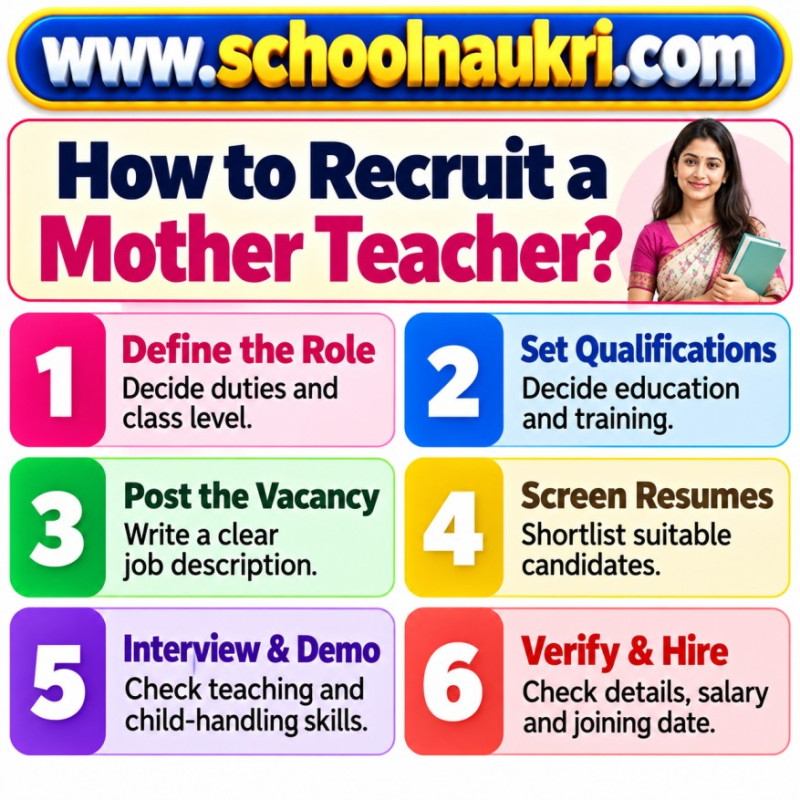
To recruit a Mother Teacher, schools should define the role, decide the required qualifications, post a clear vacancy, screen resumes, conduct an interview and demo class, verify the candidate, discuss salary and confirm the joining date.
A simple Mother Teacher recruitment process is:
Define the role → Decide qualifications → Post the vacancy → Screen resumes → Interview → Demo class → Verify the candidate → Discuss salary → Hire
Table of Contents
- How to Recruit a Mother Teacher?
- What Makes Hiring a Mother Teacher Different?
- What Qualifications Do Schools Look for in Mother Teachers?
- How to Hire a Mother Teacher Step by Step
- Clearly Define the Role
- Decide the Qualifications
- Write a Clear Mother Teacher Job Description
- Find the Right Candidates
- Screen Resumes
- Ask Practical Interview Questions
- Conduct a Mother Teacher Demo Class
- Observe How the Candidate Connects With Children
- Verify the Candidate
- Discuss Salary, Responsibilities and Joining
- Should You Hire a Fresher or an Experienced Mother Teacher?
- What Salary Budget Should a School Keep for a Mother Teacher?
- Common Mistakes Schools Make When Hiring Mother Teachers
- SchoolNaukri Insight: What We See When Schools Hire Mother Teachers
- How SchoolNaukri Helps Schools Hire Mother Teachers
- Frequently Asked Questions About Hiring a Mother Teacher
- Conclusion: Hire for the Child, Classroom and School
- About the Authors
What Makes Hiring a Mother Teacher Different?
Hiring a Mother Teacher is a little different from hiring for many other teaching positions because the teacher works closely with young children every day.
At this age, children need more than lessons and activities. They need patience, encouragement and a teacher who can make them feel comfortable in the classroom. A Mother Teacher may have to settle a child who is nervous on the first day, comfort a crying child or gently encourage a child who is not participating.
That is why schools should look beyond qualifications and experience when hiring a Mother Teacher. The teacher should be able to create a safe, friendly and positive classroom environment.
A good Mother Teacher should have:
- Patience – Young children may need the same instruction explained more than once.
- Caring nature – Children should feel comfortable, valued and cared for in the classroom.
- Kindness and empathy – Every child has a different personality and may need a different approach.
- Good communication skills – The teacher should be able to explain things in a simple and child-friendly way.
- Creativity – Stories, rhymes, games and activities can make everyday learning more enjoyable.
- Classroom management skills – The teacher should be able to keep children engaged and manage the classroom calmly.
- Confidence – A Mother Teacher should feel comfortable leading activities and interacting with children.
- Parent communication – The teacher should be able to share a child's progress or concerns with parents in a clear and respectful manner.
What Qualifications Do Schools Look for in Mother Teachers?
The right qualification for a Mother Teacher depends on the age group, class level, school requirements and responsibilities of the role. There is no single qualification that every school must follow, so schools should define their requirements before starting the hiring process.
Depending on the position, schools may consider candidates with:
- Graduation – A graduate candidate may be suitable for schools that require a general academic qualification.
- B.Ed. – Relevant for schools that prefer candidates with formal teacher-training qualifications.
- D.El.Ed. – Can be considered for teaching roles involving younger learners.
- NTT (Nursery Teacher Training) – Relevant for candidates trained to work with young children.
- PTT (Primary Teacher Training) – May be considered for roles involving primary-level learners.
- ECCE (Early Childhood Care and Education) – Particularly relevant where the role involves early childhood learning and development.
- Montessori Training – Useful for schools following Montessori-based teaching methods.
- Other relevant teacher-training qualifications – Schools can consider other recognized or role-relevant training depending on their requirements.
Verify Mother Teacher Eligibility
Before hiring a Mother Teacher, schools should check whether the candidate meets the qualification and teacher-training requirements applicable to the role.
Because Mother Teacher requirements can vary depending on the school, class level and responsibilities, schools should verify the candidate's qualifications carefully and check the latest applicable guidelines before making a hiring decision.
For official information on teacher qualification requirements, schools can refer to the National Council for Teacher Education (NCTE):
Official NCTE Website:Minimum Qualifications of Teachers – NCTE
How to Hire a Mother Teacher Step by Step
Hiring a Mother Teacher becomes easier when the school follows a clear process. Instead of selecting a candidate only because they have the right qualification or experience, look at the complete picture — their communication, patience, classroom skills and ability to connect with young children.
Here is a practical Mother Teacher hiring process that schools can follow.
1. Clearly Define the Role
Before posting the vacancy, first decide what you expect from the Mother Teacher.
Consider:
- Which class or age group will the teacher handle?
- What will be the teacher's main responsibilities?
- What qualification is required?
- Is previous experience necessary or preferred?
- What will the working hours be?
- What salary range can the school offer?
- When does the teacher need to join?
Also think about whether the teacher will be responsible for activities, classroom routines, parent communication or other school duties.
2. Decide the Qualifications
Once the role is clear, decide which qualifications are required and which are preferred.
Depending on the position, schools may consider:
- Graduation
- B.Ed.
- D.El.Ed.
- NTT or PTT
- ECCE
- Montessori training
- Other relevant teacher-training qualifications
- Relevant experience with young children
Don't reject a fresher automatically. If the candidate has good communication skills, patience, confidence and a genuine interest in working with children, they may be suitable for the role with proper guidance and training.
3. Write a Clear Mother Teacher Job Description
A good job description helps candidates understand the position before they apply.
Avoid a vacancy such as:
“Mother Teacher required. Contact us.”
Instead, clearly explain the role.
For example:
“We are looking for a caring and responsible Mother Teacher to work with young children. The teacher will conduct age-appropriate learning activities, manage daily classroom routines and communicate with parents about children's progress. Good communication and a patient approach to working with children are required.”
Your job description should clearly include:
Position | Location | Qualification | Experience | Responsibilities | Salary | Working Hours | Joining Date | How to Apply
The clearer the vacancy, the easier it is to attract candidates who are genuinely interested in the position.
Read Also-How to Hire Lab Assistants (Physics, Chemistry & Biology) for Schools in India – Complete Recruitment Guide
4. Find the Right Candidates
After preparing the vacancy, share it where relevant candidates are likely to find it.
Schools can use:
- Teacher job portals
- School websites
- Social media
- Teacher networks
- Employee referrals
- Teacher-training institutes
- Recruitment agencies
- School hiring platforms
You can also encourage existing teachers and staff to refer suitable candidates.
The important thing is to reach candidates who are actually interested in working with young children.
Looking to hire a Mother Teacher?
Apply Free on www.schoolnaukri.com
5. Screen Resumes Before the Interview
You don't need to interview every applicant.
Start by checking the resume for the requirements that matter most for your vacancy:
- Educational qualification
- Teacher-training qualification
- Relevant teaching experience
- Experience with young children
- Location
- Communication skills
- Joining availability
Also look at what the candidate has actually done in previous roles. Experience with classroom activities, young learners and parent communication can be particularly relevant.
Create a shortlist of candidates who meet your basic requirements before moving to the interview stage.
6. Ask Practical Interview Questions
The Mother Teacher interview should not be limited to questions about qualifications and previous employment.
Ask questions that help you understand how the candidate would handle real classroom situations.
For example:
- What would you do if a child starts crying in the classroom?
- How would you help a shy child participate in an activity?
- What would you do if two children start fighting?
- How would you keep young children interested during a lesson?
- How would you handle a child who is not listening?
- How would you communicate a child's concern with the parents?
Listen to how the candidate explains their approach.
You want to understand their patience, communication, judgement, confidence and attitude towards children rather than simply looking for a textbook answer.
7. Conduct a Mother Teacher Demo Class
A demo class is one of the most useful parts of the hiring process because it gives the school an opportunity to see the candidate in a teaching situation.
Give the candidate a simple, age-appropriate topic such as:
- Colours
- Numbers
- Shapes
- Animals
- Rhymes
- Storytelling
- Basic concepts
During the demo, observe:
- How clearly the teacher explains
- Whether the language is suitable for young children
- How the teacher uses activities or examples
- Whether children remain engaged
- How confidently the teacher manages the class
- Whether the teacher remains patient
- How naturally the teacher interacts with children
A strong resume can tell you about a candidate's background. The demo class shows you how the candidate actually teaches.
Read Also-How Schools Can Evaluate a Teacher’s Demo Class in India – Complete Guide
8. Observe How the Candidate Connects With Children
For a Mother Teacher, the way a candidate interacts with children is particularly important.
If possible, observe the candidate around children during the demo or another practical activity.
Ask yourself:
- Does the teacher listen to children?
- Does the teacher speak respectfully?
- Are they patient when a child does not respond?
- Can they encourage a shy child?
- How do they react when a child becomes upset?
- Do they remain calm when the classroom becomes noisy?
- Can they make children feel comfortable?
A Mother Teacher should be able to teach, guide and care for young children at the same time.
9. Verify the Candidate Before Making the Offer
Once you have identified a suitable candidate, verify the important information before finalising the appointment.
Check:
- Educational certificates
- Teacher-training certificates
- Previous employment details
- Relevant experience
- References, where required
- Other documents required by the school
If the candidate has provided information about previous employment or qualifications, verify it appropriately.
This step can help the school make a more informed hiring decision and maintain proper recruitment records.
10. Discuss Salary, Responsibilities and Joining Clearly
Before the candidate accepts the offer, make sure there is a clear understanding between the school and the candidate.
Discuss:
- Salary
- Working hours
- Job responsibilities
- Leave policy
- Joining date
- Probation period, if applicable
- Additional duties, if any
Read Also-How to Recruit Teachers for Your School | Complete Teacher Recruitment & Hiring Guide
Should You Hire a Fresher or an Experienced Mother Teacher?
During Mother Teacher hiring, schools often wonder whether to choose a fresher or an experienced teacher. The right choice depends on the school's requirements and how much training and support it can provide.
Fresher Mother Teacher
A fresher may:
- Be eager to learn
- Bring fresh ideas
- Adapt to the school's teaching style
- Need more guidance initially
Experienced Mother Teacher
An experienced teacher may:
- Already know how to handle young children
- Understand classroom routines
- Have experience communicating with parents
- Require less initial training
However, experience should not be the only deciding factor. During the interview and demo class, check the candidate's patience, communication, classroom management and ability to connect with children.
For Mother Teacher recruitment, choose the candidate who best fits your school's children, classroom and teaching needs—not simply the candidate with more experience.
What Salary Budget Should a School Keep for a Mother Teacher?
Mother Teacher salary can vary based on location, qualification, experience, school and job responsibilities.
According to AmbitionBox's 2026 data, the typical Mother Teacher salary in India is around ₹2.5 lakh–₹2.8 lakh per year, with an average of about ₹2.7 lakh per year.
Before posting a vacancy, schools should decide:
- Salary for fresher and experienced candidates
- Working hours and responsibilities
- Required qualifications
- Maximum hiring budget
It is also helpful to mention the salary range in the job description so candidates know what to expect.
For detailed salary information, schools can check AmbitionBox – Mother Teacher Salary.
Read Also-How to Hire a School Principal in India (2026 Guide) – Interview Questions, Salary, Skills, Process & Hiring Tips
Common Mistakes Schools Make When Hiring Mother Teachers
Hiring a Mother Teacher can become difficult when a school is focused only on filling the vacancy quickly. A few simple mistakes can lead to hiring the wrong person or losing a good candidate.
1. Choosing a Teacher Only From the Resume
A resume tells you about a candidate's qualification and experience, but it doesn't show how they behave with children.
During the interview and demo, also look at patience, communication, caring nature and classroom skills.
2. Skipping the Demo Class
Don't make the hiring decision based only on the interview.
A short demo class helps you see how the teacher explains things, handles children and keeps them engaged.
3. Looking Only at Experience
More experience doesn't always mean the teacher will be the right fit for your school.
A fresher may be eager to learn, while an experienced teacher may already understand classroom routines.
Look at the overall suitability of the candidate.
4. Writing an Unclear Job Description
A vague vacancy can bring many irrelevant applications.
Clearly mention the job role, location, qualification, experience, salary, responsibilities and joining date.
5. Not Discussing Salary and Responsibilities Clearly
Before the teacher joins, make sure both sides understand the job.
Discuss the salary, working hours, responsibilities, leave and joining date clearly.
6. Hiring in a Hurry
An urgent vacancy can make schools select the first available candidate.
Even when hiring is urgent, take time to check the resume, conduct an interview and take a demo class.
7. Forgetting About the Teacher After Hiring
Hiring is only the beginning.
Give the new Mother Teacher clear responsibilities, proper guidance and some support during the first few weeks. This can help the teacher settle into the classroom and understand the school's expectations.
SchoolNaukri Insight: What We See When Schools Hire Mother Teachers
After speaking with and helping schools with teacher hiring, we have seen that Mother Teacher recruitment needs special attention. This role involves working closely with young children, so a good resume or interview alone is not enough.
What Should Schools Look For?
Schools should pay attention to:
- Patience – Can the teacher stay calm with restless or crying children?
- Caring nature – Does the teacher interact gently and respectfully?
- Child interaction – Can the teacher make children feel comfortable?
- Activities – Can the teacher use rhymes, stories, games and simple activities effectively?
- Communication – Can the teacher explain things in a simple, child-friendly way?
- Classroom management – Can the teacher manage young children calmly?
Don't Skip the Demo Class
Before making the final decision, conduct a simple activity or demo class. Ask the candidate to conduct a story, rhyme, numbers, colours or shapes activity and observe how they interact with children.
What Should Schools Check Before Hiring?
Conduct a demo class and observe the candidate closely.
Look for:
- Patience with children
- Calm behaviour
- Caring and kind nature
- How they handle a crying child
- How they respond when a child does not listen
- Whether they lose their temper
- How they manage the classroom
- Whether children feel comfortable around them
Keep Observing After the Teacher Joins
The evaluation should not end after the interview or demo class.
A 2–3 month probation period, where appropriate, can help a school understand how a teacher performs in real classroom situations.
During this period, schools can observe:
- Behaviour with children
- Patience and calmness
- Classroom management
- Caring nature
- Communication with parents and staff
- Punctuality and responsibility
- Ability to handle difficult situations
SchoolNaukri Insight: For Mother Teacher recruitment, look beyond communication and experience. Watch the demo class and continue observing classroom behaviour after the teacher joins.
How SchoolNaukri Helps Schools Hire Mother Teachers
Finding the right Mother Teacher can take time when schools have to search through multiple sources. SchoolNaukri helps schools simplify the Mother Teacher hiring process by connecting them with teachers looking for school jobs across India.
Schools can:
- Register their school in 2 minutes with AI
- Post Mother Teacher vacancies
- Access 10 lakh+ teacher resumes
- Find fresher and experienced teachers
- Search candidates by qualification, experience and location
- Shortlist suitable Mother Teacher candidates
- Review profiles and conduct interviews and demo classes
- Choose a recruitment package based on their hiring needs
SchoolNaukri is used by 20,000+ schools across India and supports recruitment for Mother Teachers, Nursery, Pre-Primary, Play School, Montessori and other school roles.
Looking to Hire a Mother Teacher?
Apply Free on www.schoolnaukri.com
Frequently Asked Questions About Hiring a Mother Teacher
1. How can I hire a Mother Teacher for my school?
Start by defining the class, responsibilities, qualification, experience and salary. Post a clear Mother Teacher vacancy, screen resumes, conduct an interview and take a demo or activity class before making the final selection.
2. How can I recruit a Mother Teacher?
Schools can recruit Mother Teachers through teacher job portals, referrals, social media, teacher networks and school recruitment platforms. A clear job description can help attract more relevant candidates.
3. What qualifications should a Mother Teacher have?
The required qualification depends on the school, class level and job responsibilities. Schools may consider candidates with Graduation, B.Ed., D.El.Ed., NTT, PTT, ECCE, Montessori training or other relevant qualifications.
4. What skills should I look for when hiring a Mother Teacher?
Schools should look for patience, caring nature, communication skills, classroom management, creativity and the ability to connect with young children.
5. Should I hire a fresher or experienced Mother Teacher?
Both can be considered. A fresher may be enthusiastic and willing to learn, while an experienced teacher may require less initial training. The interview and demo class can help the school assess the candidate's suitability.
6. What questions should I ask in a Mother Teacher interview?
Ask practical questions about classroom situations, such as how the candidate would handle a crying child, encourage a shy child, manage two children fighting or communicate a child's concern with parents.
7. Should I conduct a demo class before hiring a Mother Teacher?
Yes. A demo class can help schools see how the candidate communicates, conducts activities, manages children and keeps young learners engaged.
8. How can I check if a Mother Teacher is good with children?
Observe the candidate during the interview and demo class. Look at how patiently they communicate, whether they listen to children, how they respond to difficult situations and whether they can create a comfortable classroom environment.
9. What activities can I give in a Mother Teacher demo class?
Schools can ask candidates to conduct simple activities such as storytelling, rhymes, colours, numbers, shapes, drawing, games or basic concept activities suitable for the children's age group.
10. How much salary should I offer a Mother Teacher?
Salary depends on factors such as location, qualification, experience, school and responsibilities. Schools should check the local hiring market and decide a realistic salary range before posting the vacancy.
11. How can I select the right Mother Teacher after the interview?
Consider the candidate's qualification, experience, interview performance, demo class, patience, communication and interaction with children. Avoid making the final decision based only on the resume.
12. Where can I find Mother Teacher candidates for my school?
Schools can find candidates through teacher job portals, referrals, social media, teacher networks and school recruitment platforms. SchoolNaukri helps schools post Mother Teacher vacancies and connect with teachers looking for school jobs.
Conclusion: Hire for the Child, Classroom and School
Hiring a Mother Teacher is about more than checking qualifications or years of experience. Because the teacher works closely with young children every day, patience, caring nature, communication, classroom management and child-friendly behaviour are important parts of the hiring decision.
A practical Mother Teacher hiring process can help schools make better decisions. Clearly define the role, write a detailed job description, screen resumes, ask practical interview questions and conduct a demo or activity class before making the final selection.
After the teacher joins, continue to observe classroom behaviour and provide guidance during the initial period. This helps the school understand how the teacher handles real classroom situations.
The goal of Mother Teacher recruitment is not simply to fill a vacancy. It is to find a teacher who can teach, care for and positively engage with young children while fitting the needs of the classroom and school.
A careful hiring process today can help your school build a happier, safer and more effective learning environment for children.
About the Authors
Atul Kumar and Abhishek Ranjan are the founders of SchoolNaukri, a school-focused recruitment platform helping schools across India hire teachers and school professionals.
Through SchoolNaukri, they have worked with 20,000+ schools and built a network of 10 lakh+ teachers and educators. Their work focuses on making school recruitment more structured, efficient and accessible for school founders, principals and HR teams.
They are also the co-authors of The Ultimate School Hiring Workbook, a practical resource focused on improving school hiring and recruitment processes.
- Atul Kumar (M.Tech, IIT Bombay): Brings an engineering and technology-driven approach to school recruitment, with a focus on building structured hiring processes and technology-enabled recruitment workflows for schools.
- Abhishek Ranjan (MBA): Brings expertise in management and recruitment strategy, with a focus on teacher hiring, interview processes, staffing decisions and building effective school recruitment practices.