
20 Most Asked Sanskrit Teacher Interview Questions and Answers for School Jobs in India
Sanskrit Teacher Interview Questions – What Schools Usually Ask
Most CBSE, ICSE, Gurukul, and private schools in India ask Sanskrit teachers questions related to:
- Sanskrit grammar,
- pronunciation,
- classroom management,
- teaching methods,
- demo class performance,
- and student engagement.
Schools today are not only checking qualifications. They want teachers who can explain Sanskrit clearly, teach grammar in a simple way, conduct interactive demo classes, and help students develop interest in the language.
This practical guide includes:
- commonly asked Sanskrit teacher interview questions,
- Sanskrit grammar questions,
- demo class preparation tips,
- classroom management guidance,
- and practical interview preparation strategies for school teaching jobs in India.
Introduction
Today many schools across India are hiring Sanskrit teachers for CBSE, ICSE, Gurukul, and private schools. But many qualified teachers still struggle during interviews.
The reason is simple.
Schools are not only looking for teachers who know Sanskrit grammar and shlokas. They also want teachers who can:
- explain concepts clearly,
- pronounce Sanskrit properly,
- engage students in classroom,
- conduct interactive demo classes,
- and make Sanskrit easier and more interesting for students.
Many teachers prepare grammar topics but ignore:
- pronunciation confidence,
- communication skills,
- demo class preparation,
- classroom interaction,
- and interview practice.
A common situation in schools – A teacher with strong Sanskrit knowledge attended a school interview but became nervous during demo class. Pronunciation became unclear, student interaction was weak, and the class felt less engaging. Another teacher with simpler explanation style and better classroom confidence got selected.
This is very common in India.
Schools today check:
- pronunciation clarity,
- communication confidence,
- classroom management,
- demo class performance,
- teaching methods,
- and student engagement ability.
Teachers preparing for interviews should also read:
“How to Get a Teaching Job in India (2026 Guide) – Resume, Interview, Demo Class, Salary & Tips”
Table of Contents
- Introduction
- Real Case Study – Why One Sanskrit Teacher Failed Interview
- 20 Most Asked Sanskrit Teacher Interview Questions and Answers
- Sanskrit Grammar and Subject Questions
- 10 Common Mistakes Sanskrit Teachers Make During Interview
- Tips to Clear Sanskrit Teacher Interview and Get Job Faster
- 5 Skills Schools Look for in Sanskrit Teachers
- How to Prepare for Sanskrit Teacher Demo Class
- Practical Interview Preparation Checklist
- FAQ – Sanskrit Teacher Interview Preparation
- Conclusion
- About the Authors
Real Case Study – Why One Sanskrit Teacher Failed Interview
A teacher named Ravi from Varanasi applied for a Sanskrit teacher job in a CBSE school.
His qualifications were good:
- MA in Sanskrit,
- B.Ed,
- and good grammar knowledge.
But during the demo class:
- he became nervous,
- spoke too fast,
- pronunciation became unclear,
- and there was very little student interaction.
The school selected another teacher.
After this experience, Ravi improved his preparation:
- practiced interview questions daily,
- improved pronunciation confidence,
- practiced speaking slowly and clearly,
- and prepared more interactive demo classes.
Within a few weeks, he attended another interview.
This time, he explained concepts clearly, involved students during class, and handled the demo class confidently.
He got selected.
This is very common in India. Many teachers fail interviews not because they lack subject knowledge, but because they do not prepare properly for communication and demo class performance.
20 Most Asked Sanskrit Teacher Interview Questions and Answers
1. Tell us about yourself.
Answer:
“My name is Priya Sharma. I completed my graduation and B.Ed in Sanskrit. I enjoy teaching Sanskrit and helping students understand grammar, shlokas, and basic Sanskrit language in a simple way.”
2. Why do you want to become a Sanskrit teacher?
Answer:
“Sanskrit is an important part of Indian culture and knowledge. I enjoy teaching Sanskrit and helping students connect with our traditional language.”
3. Why should we hire you for this Sanskrit teacher position?
Answer:
“I have good Sanskrit subject knowledge, clear pronunciation, communication skills, and simple teaching methods for students.”
4. How do you handle weak students in Sanskrit class?
Answer:
“I explain concepts slowly, revise grammar regularly, practice pronunciation daily, and encourage students to ask questions freely.”
5. How do you maintain discipline in classroom?
Answer:
“I maintain discipline through student engagement, positive communication, and classroom activities.”
Subject-Specific Sanskrit Questions
6. What is Sandhi in Sanskrit?
Answer:
“Sandhi means joining of letters or words according to grammar rules.”
Example:
राम + इति = रामेति
7. What is Samas?
Answer:
“Samas means combining two or more words into one short word.”
Example:
राजपुत्रः = राजा का पुत्र
8. What is the meaning of ‘विद्या ददाति विनयम्’?
Answer:
“It means ‘Knowledge gives humility.’”
9. Explain a simple Sanskrit sentence.
Answer:
रामः विद्यालयं गच्छति।
Meaning:
“Ram goes to school.”
10. What is Vachan in Sanskrit grammar?
Answer:
“Vachan means number in grammar.”
Types:
- एकवचन
- द्विवचन
- बहुवचन
11. What is Ling in Sanskrit grammar?
Answer:
“Ling means gender.”
Types:
- पुल्लिंग
- स्त्रीलिंग
- नपुंसकलिंग
12. How do you improve students’ Sanskrit pronunciation?
Answer:
“I encourage regular reading practice, shloka recitation, and slow pronunciation exercises.”
13. What is Dhatu in Sanskrit?
Answer:
“Dhatu means root word from which words are formed.”
Example:
गम् = जाना
14. What is Karak in Sanskrit grammar?
Answer:
“Karak shows the relation of noun with action in sentence.”
Example:
कर्ता, कर्म, करण
15. How do you teach shlokas to students?
Answer:
“I first teach pronunciation, then explain meaning in simple language, and finally help students practice slowly.”
Classroom & Teaching Method Questions
16. How do you make Sanskrit classes interesting?
Answer:
“I use storytelling, shloka explanation, games, pronunciation activities, and student participation.”
17. How do you prepare lesson plans for Sanskrit classes?
Answer:
“I prepare lesson plans according to grammar topics, pronunciation practice, activities, and revision.”
18. How do you handle students afraid of Sanskrit language?
Answer:
“I explain concepts in very simple language and create a friendly classroom environment.”
19. What teaching methods do you use in Sanskrit classes?
Answer:
“I use reading practice, storytelling, activity-based learning, pronunciation exercises, and interactive teaching.”
20. What is your biggest strength as a Sanskrit teacher?
Answer:
“My biggest strengths are pronunciation clarity, communication skills, classroom interaction, and simplifying Sanskrit concepts for students.”
10 Common Mistakes Sanskrit Teachers Make During School Interview
1. Becoming nervous during Sanskrit demo class
Many teachers know Sanskrit well but become nervous while teaching in front of interview panel or students.
2. Incorrect Sanskrit pronunciation
Schools carefully check pronunciation during shloka reading and grammar explanation. Weak pronunciation creates a poor impression.
3. Speaking too fast while teaching Sanskrit
Some teachers explain shlokas and grammar very quickly, making it difficult for students to understand.
4. Focusing only on grammar rules
Many teachers only explain Sandhi, Samas, and grammar definitions without making the class interactive.
5. Weak classroom interaction during demo class
Some teachers keep speaking continuously without asking questions or involving students in classroom activities.
6. Poor preparation for Sanskrit demo class
Teachers often prepare theory only and forget:
- student engagement,
- pronunciation practice,
- and classroom activities.
7. Weak explanation of shlokas and meanings
Schools expect teachers to explain shlokas in simple and student-friendly language.
8. Not revising basic Sanskrit grammar properly
Interview panels often ask questions related to:
- Sandhi,
- Samas,
- Vachan,
- Ling,
- and sentence formation.
9. Low communication confidence
Even teachers with good Sanskrit knowledge sometimes struggle to communicate confidently during interview.
10. Poor body language and eye contact
Low confidence, weak eye contact, and nervous body language can negatively affect Sanskrit teacher interview performance.
Tips to Clear Sanskrit Teacher Interview and Get Job Faster
1. Practice pronunciation daily
Clear pronunciation improves speaking confidence.
2. Revise grammar basics regularly
Focus on Sandhi, Samas, sentence formation, and shloka explanation.
3. Prepare demo classes properly
Schools check teaching style and student interaction carefully.
4. Practice common interview questions
Daily practice improves confidence.
5. Improve classroom communication
Speak clearly and confidently during teaching.
6. Use interactive teaching methods
Encourage student participation during class.
7. Practice speaking slowly and clearly
Avoid rushing during demo classes.
8. Improve spoken Sanskrit confidence
Use simple Sanskrit sentences during teaching.
9. Conduct mock interviews
Mock interviews help reduce nervousness.
10. Apply regularly for teaching jobs
Regular interviews improve confidence and presentation skills.
Teachers preparing for interviews should also read:
“Best Free Teacher Resume Maker in India – Create Teaching Resume Online Easily”
5 Important Skills Schools Look for in Sanskrit Teachers
1. Clear Sanskrit Pronunciation
Schools prefer teachers who can pronounce Sanskrit words and shlokas clearly and confidently.
2. Simple Teaching Style
Teachers should explain Sanskrit grammar and meanings in an easy way that students can understand.
3. Good Classroom Management
Schools want teachers who can handle classroom discipline and keep students focused during class.
4. Student Interaction Skills
Good Sanskrit teachers involve students in:
- reading,
- shloka recitation,
- pronunciation practice,
- and classroom activities.
5. Strong Sanskrit Subject Knowledge
Teachers should have good understanding of:
- Sandhi,
- Samas,
- grammar basics,
- shlokas,
- and sentence formation.
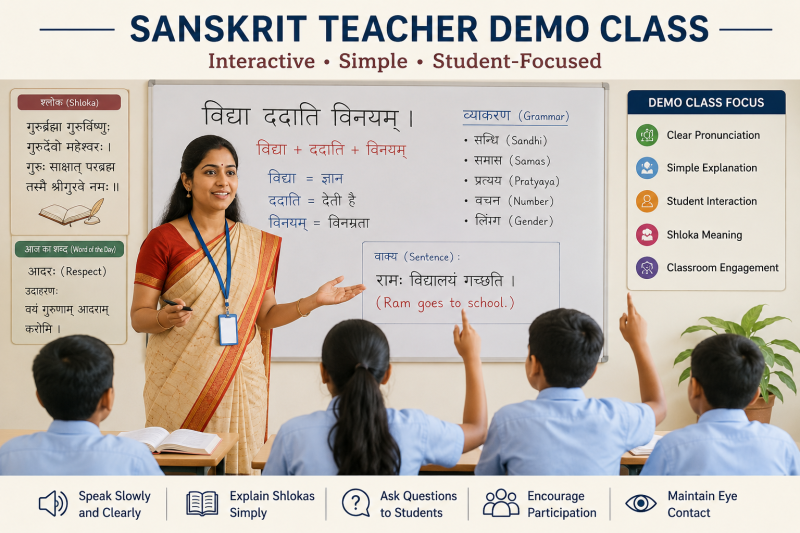
Practical Sanskrit Teacher Interview Preparation Checklist
Before attending Sanskrit teacher interview, make sure you prepare these important things properly:
1. Revise Important Sanskrit Grammar Topics
Revise:
- Sandhi,
- Samas,
- Vachan,
- Ling,
- Dhatu,
- and simple sentence formation.
Schools often ask basic grammar questions during interview.
2. Practice Sanskrit Pronunciation Daily
Read shlokas and Sanskrit sentences loudly to improve pronunciation confidence and speaking clarity.
3. Prepare Your Self-Introduction Properly
Practice introducing yourself confidently in simple and professional language.
4. Prepare One Simple Sanskrit Demo Topic
Keep one demo class topic ready like:
- Sandhi,
- simple shloka explanation,
- or basic Sanskrit sentence teaching.
5. Practice Demo Class at Home
Practice teaching in front of mirror, friends, or family members to improve confidence and classroom interaction.
6. Carry Updated Resume and Certificates
Keep:
- resume,
- qualification certificates,
- experience letters,
- and ID proof properly arranged in one file.
7. Improve Classroom Communication Confidence
Speak slowly, clearly, and confidently during interview and demo class.
8. Dress Professionally for Interview
Simple and professional dressing creates a positive first impression.
9. Maintain Eye Contact and Positive Body Language
Good eye contact and confident body language improve interview performance.
10. Research the School Before Interview
Check:
- school type,
- board (CBSE/ICSE),
- teaching pattern,
- and school environment before attending interview.
FAQ – Sanskrit Teacher Interview Preparation
What questions are usually asked in Sanskrit teacher interview?
Schools usually ask questions related to:
- Sanskrit grammar,
- Sandhi and Samas,
- pronunciation,
- classroom management,
- teaching methods,
- and demo class performance.
Many schools also ask teachers to explain one shloka or teach a small topic during demo class.
How can I prepare for Sanskrit teacher interview?
Practice common interview questions regularly, revise basic Sanskrit grammar, improve pronunciation confidence, and prepare one simple demo class topic properly.
Daily speaking and reading practice also helps improve confidence.
Do schools ask Sanskrit grammar questions in interview?
Yes. Schools often ask grammar questions related to:
- Sandhi,
- Samas,
- Vachan,
- Ling,
- sentence formation,
- and shloka explanation.
Is demo class important for Sanskrit teacher interview?
Yes. In many CBSE, ICSE, Gurukul, and private schools, demo class performance is a very important part of teacher selection.
Schools check:
- pronunciation,
- communication,
- classroom interaction,
- and teaching confidence during demo class.
Can freshers clear Sanskrit teacher interview?
Yes. Freshers can also clear Sanskrit teacher interviews with proper preparation, confidence, pronunciation practice, and good demo class preparation.
Many schools focus more on teaching ability and communication skills than experience alone.
Conclusion
Clearing a Sanskrit teacher interview is not only about remembering grammar rules or shlokas. Schools today want Sanskrit teachers who can:
- explain concepts simply,
- pronounce Sanskrit clearly,
- engage students during class,
- and make Sanskrit interesting and easy to learn.
Many teachers fail interviews because of nervousness, weak demo class preparation, or low communication confidence. But these skills improve with regular practice.
Focus on:
- Sanskrit pronunciation,
- grammar revision,
- demo class practice,
- classroom interaction,
- and confident communication.