

How to Get CBSE Affiliation for School in India – Complete Step-by-Step Guide
Introduction
Getting CBSE affiliation is a very important step for any school in India. It allows the school to follow the CBSE curriculum and send students for Class 10 and Class 12 Board examinations.
Many principals, directors and school owners feel that the CBSE affiliation process is very complicated.
However, if you understand the basic requirements and complete each step properly, getting CBSE affiliation becomes much easier.
In this guide, you will learn the complete CBSE affiliation process in simple language — including eligibility, infrastructure requirements, documents, inspection and final approval. This will help school management teams plan better and avoid common mistakes.
How to Get CBSE Affiliation for School in India – Complete Step-by-Step Guide
Getting CBSE affiliation for a school in India involves meeting the eligibility criteria set by the Central Board of Secondary Education (CBSE), fulfilling infrastructure and staff requirements, obtaining the necessary government approvals, and applying through the official CBSE affiliation process. Schools must comply with CBSE norms related to land, safety, academics, and administration before affiliation is granted.
Why CBSE Affiliation is Important for Schools
Getting CBSE affiliation is a big step for any school in India. It helps the school become more trusted, organised and attractive for parents and students.
1. Builds Trust Among Parents
CBSE is a well-known national board. When a school is CBSE-affiliated, parents feel more confident about taking admission.
2. Students Can Give Board Exams
Only CBSE schools can send students for Class 10 and Class 12 Board exams. This is important for students’ future studies and career.
3. Clear and Standard Curriculum
CBSE schools follow NCERT books and a structured syllabus. This helps students prepare better for competitive exams and also makes school transfers easier.
4. Improves School Reputation and Admissions
Many parents prefer CBSE schools. Affiliation can increase the school’s image in the area and help attract more admissions.
5. Better Teachers and Academic Quality
CBSE schools need qualified teachers and proper academic systems. Platforms like SchoolNaukri.com – India’s fastest-growing teacher hiring website – help schools find subject-wise teachers from a large database of 5 lakh+ resumes.
6. Scope for Future Growth
After getting affiliation, schools can upgrade to Secondary or Senior Secondary level and expand their academic offerings.
What is CBSE Affiliation?
CBSE affiliation is the official approval given by the Central Board of Secondary Education that allows a school to run classes under CBSE curriculum.
After affiliation, the school can:
- Follow NCERT books
- Conduct CBSE pattern exams
- Send students for Class 10 & 12 Board Exams
According to the CBSE Affiliation Bye-Laws, affiliation is granted only when the school fulfils required land, infrastructure, staff and financial conditions.
Step 1 – Create a Proper School Managing Society / Trust
First, the school must be run by a registered body like:
- Society
- Trust
- Section-8 Company
CBSE clearly mentions that the school must be established by a properly registered organization before applying for affiliation.
Without a legal managing body, CBSE affiliation is not possible.
Read Also -How Schools Can Hire Office Staff, Clerks and Receptionists in India – A Practical Guide
Step 2 – Take Recognition from State Education Department
Before applying for CBSE affiliation, the school must first obtain approval from the State Education Department. This includes:
- State Government Recognition Certificate
- NOC (No Objection Certificate) for CBSE Affiliation
CBSE normally considers an affiliation application only after the school has received permission from the concerned State or Union Territory authority.
Schools can refer to the official NOC / Recognition certificate format issued by the District Education Officer, which includes details like school recognition status, land ownership, safety certificates and staff norms.
https://www.cbse.gov.in/cbsenew/documents//Appendix%20II.pdf
Step 3 – Arrange Required Land for School
Land requirement for CBSE affiliation depends on the location of the school such as city area, rural area or hill stations.
Generally:
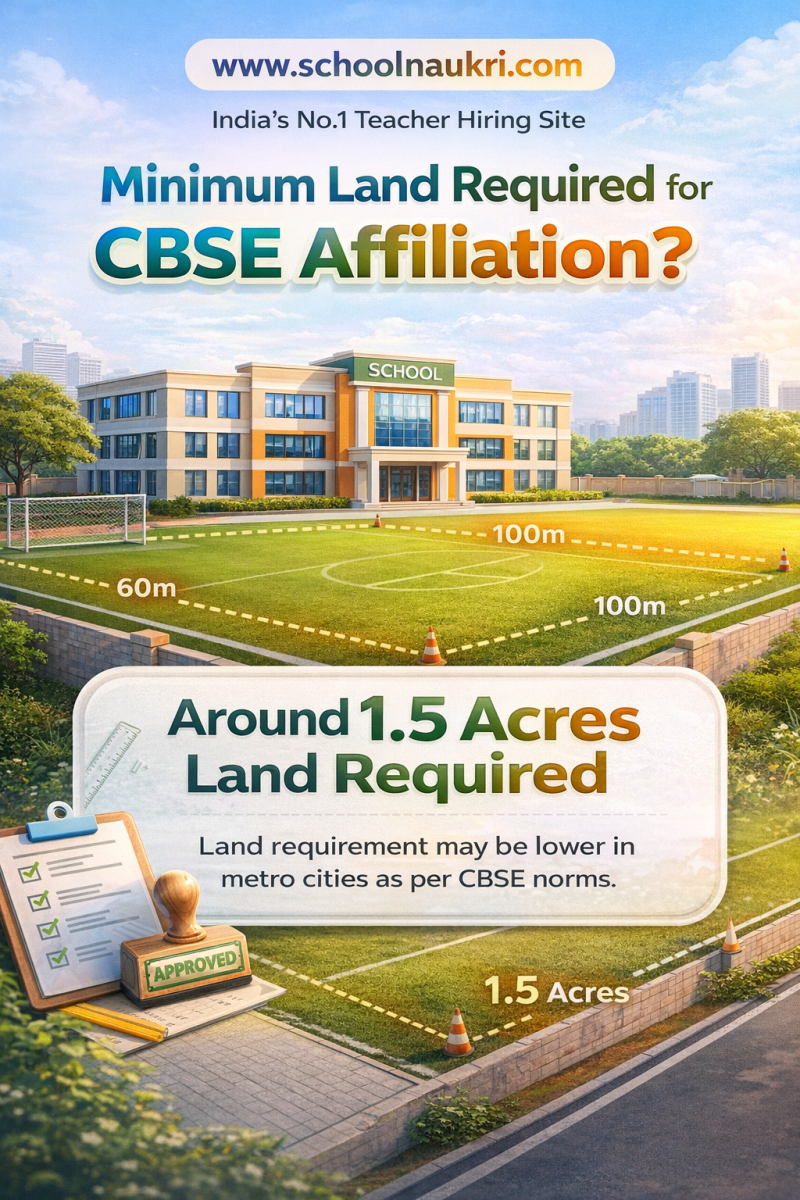
- Big cities / Municipal areas – Around 4000 square meters land is required
- General areas – About 6000 to 8000 square meters land may be required depending on enrolment and section limits
- Metro / special category cities – In some cases, land requirement can be 1600 to 3000 square meters based on level of school (Secondary or Senior Secondary)
CBSE bye-laws clearly state that the school land should be a single contiguous plot with proper boundary wall, playground space and school building.
Schools must also have clear land ownership documents or a properly registered long-term lease (generally minimum 15 years) at the time of applying for affiliation. Temporary or informal rented land is usually not accepted.
You can refer to the detailed CBSE land requirement norms and ownership conditions here-
Step 4 – Build Proper School Infrastructure
CBSE checks the physical infrastructure of the school during inspection. The school must have proper facilities as per CBSE Affiliation Bye-Laws.
School should have:
- Classrooms – Minimum size should be about 8 m × 6 m (around 500 sq. ft.). In smaller rooms, there should be at least 1 square metre space per student.
- Science Laboratories – For Secondary / Senior Secondary schools, labs should be around 9 m × 6 m (about 600 sq. ft.) and fully equipped.
- Library – Minimum size should be 14 m × 8 m, with sufficient books and reading space.
- Computer Lab – Minimum size should be 9 m × 6 m (about 600 sq. ft.), with proper student-computer ratio and internet facility.
- Playground – Adequate open space for outdoor sports and physical activities.
- Clean Toilets and Drinking Water – Separate hygienic toilets for boys, girls and staff, and safe drinking water facility.
- Safety Facilities – Fire safety, building safety, disaster management measures and secure school environment.
These infrastructure norms are clearly mentioned under Physical Infrastructure requirements in the CBSE Affiliation Bye-Laws (see Chapter 4, around page 13–14 of the document).
CBSE also recommends adequate classroom space per student and proper building safety norms.
You can visit the official CBSE website to understand the latest rules, affiliation bye-laws and complete application process.
https://www.cbse.gov.in
Step 5 – Hire Qualified Teachers and Staff
School must appoint:
- Qualified Principal
- Trained Teachers
- Physical Education Teacher
- Special Educator
- Counsellor (for Secondary / Senior Secondary schools)
CBSE bye-laws mention that teacher qualifications must follow CBSE / NCTE norms.
Teacher-student ratio should also be properly maintained.
Want to hire qualified teachers in 7 days? Use www.schoolnaukri.com – India’s No.1 teacher hiring site, trusted by 10,000+ schools with 5 lakh+ teacher database. Starting is free – register in just 2 minutes.
Step 6 – Maintain Strong Financial Resources
CBSE requires the school to show that it has enough funds to run smoothly.
School must:
- Maintain proper accounts
- Not distribute profit to individuals
- Use funds only for school development
Financial transparency is mandatory for affiliation approval.
CBSE Affiliation Fee Structure
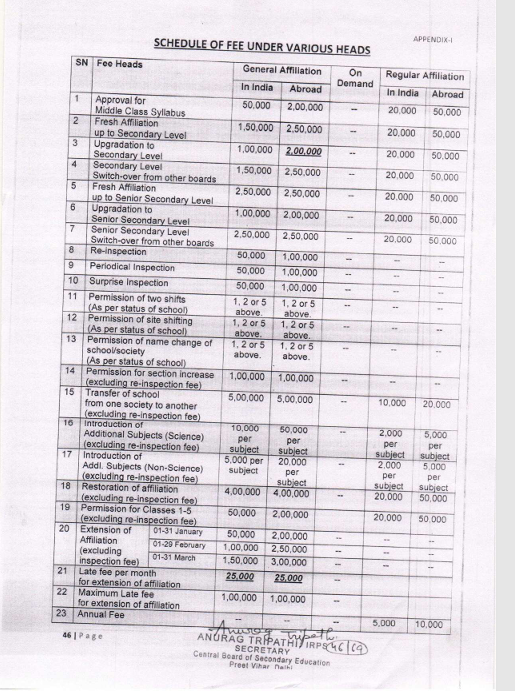
The image down shows the CBSE fee schedule for different types of school affiliation services, including new affiliation, upgradation, additional sections, additional subjects, inspection, and extension of affiliation. The applicable fee depends on the type of application and whether the school is located in India or abroad. School management should always refer to the latest CBSE guidelines and fee structure while planning the affiliation process and budgeting for related expenses.
Step 7 – Apply Online for CBSE Affiliation
After completing all requirements:
- Visit CBSE affiliation portal
- Fill online application form
- Upload documents
- Pay affiliation fee
After submission, CBSE reviews the application.
To understand the CBSE affiliation application process step by step, schools can visit the official CBSE affiliation portal.
This portal provides detailed guidelines, application steps, document requirements and status tracking facility for schools applying for affiliation.Official Portal – https://saras.cbse.gov.in
Step 8 – CBSE Inspection
CBSE sends an inspection committee to check:
- Land documents
- Infrastructure
- Staff records
- Safety certificates
- School functioning
If everything is correct, CBSE issues Letter of Intent (LOI).
Step 9 – Get Final Affiliation Approval
After fulfilling LOI conditions, CBSE grants affiliation for a fixed period.
Schools must continue following CBSE norms even after approval.
FAQs – CBSE Affiliation for Schools in India
1. How long does it take to get CBSE affiliation for a school in India?
The time required for CBSE affiliation depends on the school's readiness and compliance with CBSE norms. If the required infrastructure, documents, and government approvals are in place, the process may take several months. Schools should carefully complete all requirements to avoid delays.
2. Can a new school apply for CBSE affiliation?
Yes. A new school can apply for CBSE affiliation after obtaining the necessary recognition and meeting the eligibility criteria prescribed by CBSE. The school must have suitable infrastructure, qualified staff, safety certificates, and other mandatory approvals.
3. Is a No Objection Certificate (NOC) required for CBSE affiliation?
In many cases, CBSE requires a No Objection Certificate (NOC) or the relevant approval from the State Government or the competent authority, as per the applicable CBSE Affiliation Bye-Laws and regulations.
4. Can a school start CBSE classes without CBSE affiliation?
No. Only schools with valid CBSE affiliation can officially offer CBSE courses and present students for CBSE Board examinations. Schools should complete the affiliation process before advertising or operating as a CBSE-affiliated institution.
5. What are the basic requirements for CBSE affiliation?
Schools generally need to meet CBSE requirements related to land, infrastructure, classrooms, laboratories, library facilities, qualified teachers, safety measures, recognition from the competent authority, and other prescribed standards.
6. What documents are required for CBSE affiliation?
The required documents may vary depending on the type of application, but commonly include recognition certificates, land documents, building safety certificates, fire safety certificates, sanitation certificates, staff details, and other records specified by CBSE.
7. What is the fee for CBSE affiliation?
CBSE charges different fees depending on the type of affiliation or service, such as new affiliation, upgradation, additional sections, and extension of affiliation. Schools should refer to the latest CBSE fee structure before applying.
8. How can schools improve their chances of getting CBSE affiliation?
Schools should carefully study the latest CBSE Affiliation Bye-Laws, ensure all infrastructure and safety requirements are fulfilled, maintain proper documentation, appoint qualified staff, and complete the application process accurately before submission.
Conclusion
Getting CBSE affiliation for a school in India is an important milestone that can enhance a school's credibility and provide students with access to a nationally recognised education system. While the process may seem challenging at first, careful planning and a clear understanding of CBSE requirements can make it much more manageable.
Schools should focus on building a strong foundation by ensuring proper infrastructure, qualified teachers, necessary approvals, safety measures, and accurate documentation. Taking a step-by-step approach and following the latest CBSE Affiliation Bye-Laws can help avoid unnecessary delays and improve the chances of successful affiliation.
For school founders, principals, and management teams, CBSE affiliation is not just about completing a legal process—it is about creating a safe, well-managed, and high-quality learning environment for students. With proper preparation, commitment, and compliance with CBSE standards, schools can successfully achieve affiliation and build a strong reputation for academic excellence.
CBSE Contact Details for Affiliation Help
If schools need guidance related to CBSE affiliation process, application status or official requirements, they can contact CBSE directly through the official contact page.
This page provides important information such as CBSE office addresses, helpline numbers and regional office details.
Visit Official CBSE Contact Page – https://www.cbse.gov.in/cbsenew/contact-us.html
About the Authors
Abhishek Ranjan and Atul Kumar are the founders of SchoolNaukri and actively work with schools across India to improve teacher recruitment and school management practices.
Through their work with school founders, principals, and education leaders, they gain practical insights into the challenges schools face, including staffing, compliance, and institutional growth. They are also the authors of "The Ultimate School Hiring Workbook," a practical resource designed to help schools build effective hiring systems and strengthen their academic teams.
Their goal is to provide simple, practical, and reliable information that helps schools make better decisions and support quality education across India.