

How to Prepare for School Demo Class – Complete Guide for Teachers in India
How to Prepare for School Demo Class for Teacher Interview in India
A school demo class is one of the most important stages of teacher interviews in India. In CBSE, ICSE, international, and private schools, demo class performance often matters more than interview answers. Schools use demo classes to understand how confidently a teacher explains concepts, manages students, communicates inside the classroom, and creates an engaging learning environment. Proper preparation can greatly improve a teacher’s chances of getting selected for school teaching jobs.
Why Demo Class Has Become So Important in School Interviews
Today, almost every school in India asks candidates to take a demo class before final selection. This is because schools no longer hire teachers only based on qualifications or subject knowledge.
A teacher may have:
- strong academic background,
- B.Ed qualification,
- good marks,
- and even teaching experience,
but still fail during demo class.
Why?
Because schools want teachers who can actually handle a classroom confidently.
Interview panels usually observe:
- how teachers speak,
- how students react,
- whether the class feels engaging,
- and how teachers manage classroom attention.
Many teachers prepare interview answers seriously but ignore practical classroom preparation. As a result, they become nervous, speak too fast, avoid eye contact, or teach like a lecture without involving students.
Schools today prefer teachers who can make learning simple, interactive, and student-friendly.
A good demo class is not about showing difficult knowledge. It is about showing schools that students can comfortably understand and connect with your teaching style.
Real Classroom Case Study – Why One Teacher Failed Demo Class
A teacher named Ravi attended a demo class interview in a CBSE school.
He had prepared the topic properly and had good subject knowledge. Before entering the classroom, he felt confident.
But as soon as the demo class started, he became nervous.
His voice became very low. He kept looking only at the board while teaching and explained the topic very fast. Students sitting at the back were struggling to hear and understand him properly.
After a few minutes, some students started talking to each other. Slowly the classroom became noisy.
Ravi became even more nervous and lost classroom control completely.
The interview panel noticed that although he knew the subject well, his classroom confidence and student interaction were weak.
He was not selected.
After this experience, Ravi started practicing demo classes regularly at home. He worked on:
- voice confidence,
- eye contact,
- student interaction,
- and classroom presentation.
He also practiced speaking slowly and asking students small questions during teaching.
A few weeks later, he attended another interview.
This time, students were attentive, classroom interaction was much better, and Ravi handled the class confidently.
He got selected.
This situation is very common in India. Many teachers fail demo classes not because they lack knowledge, but because they do not prepare properly for real classroom teaching.
Read Also-How to Get a Teaching Job in India (2026 Guide) – Resume, Interview, Demo Class, Salary & Tips
Common Demo Class Questions and Answers for Teachers
These are some common questions that schools and interview panels may ask during or after a demo class. Preparing these questions can improve confidence and help teachers handle interviews more comfortably.
1. Why did you choose this topic for demo class?
Answer:
“I selected this topic because it is simple, student-friendly, and helps me explain concepts clearly within limited demo class time.”
2. How do you handle weak students during classroom teaching?
Answer:
“I explain topics in simple language, use examples, and encourage students to ask questions without hesitation.”
3. How do you keep students engaged during class?
Answer:
“I involve students by asking small questions, encouraging participation, and using interactive teaching methods.”
4. What will you do if students become noisy during class?
Answer:
“I will calmly regain students’ attention through classroom interaction and positive communication instead of becoming angry.”
5. Why should we hire you as a teacher?
Answer:
“I can explain concepts clearly, maintain positive classroom environment, and help students learn comfortably.”
6. How do you prepare lesson plans before class?
Answer:
“I prepare lesson flow in advance including introduction, explanation, examples, student interaction, and revision.”
7. How do you make difficult topics easier for students?
Answer:
“I use simple explanations, practical examples, diagrams, and step-by-step teaching methods.”
8. What teaching methods do you use during classroom teaching?
Answer:
“I use interactive teaching methods, student participation, practical examples, and activity-based learning.”
9. How do you improve communication confidence during teaching?
Answer:
“I practice teaching regularly, speak slowly and clearly, and take mock demo classes before interviews.”
10. What is the most important thing during demo class?
Answer:
“In my opinion, clear explanation, student interaction, classroom confidence, and positive teaching environment are most important during demo class.”
Subject-Specific Demo Class Questions
English Teacher Demo Class Question
How do you improve spoken English confidence of students?
Answer:
“I encourage reading practice, classroom speaking activities, vocabulary improvement, and regular communication in English.”
Maths Teacher Demo Class Question
How do you help students who are weak in Maths?
Answer:
“I explain sums step-by-step, clear basic concepts properly, and give regular practice.”
Science Teacher Demo Class Question
How do you make Science classes interesting?
Answer:
“I use diagrams, practical examples, activities, and daily-life connections during teaching.”
Computer Teacher Demo Class Question
How do you explain technical concepts to beginners?
Answer:
“I explain computer topics in simple language and use practical demonstrations during teaching.”
Primary Teacher Demo Class Question
How do you manage small children during class?
Answer:
“I keep students engaged through storytelling, activities, visuals, and positive classroom interaction.”
Read Also-How to Make a Free Teacher Resume for School Jobs – Resume Format & Step-by-Step Guide
Step-by-Step Demo Class Preparation Guide
Choose a Topic You Can Teach Comfortably
Do not choose a difficult topic only to impress the panel.
Choose something:
- you understand properly,
- can explain confidently,
- and students can easily follow.
Simple and confident teaching always works better.
Prepare a Proper Lesson Flow
Before demo class, prepare the structure of your teaching.
Your class should have:
- Introduction
- Topic explanation
- Examples or activities
- Student interaction
- Quick revision
When the lesson flows naturally, teachers appear more organized and professional.
Practice How You Will Start the Class
The first 1–2 minutes are very important.
Start by:
- greeting students,
- introducing yourself,
- and asking one simple topic-related question.
This creates connection with students and reduces nervousness.
Teach in Simple Language
Many teachers try to sound overly academic during demo classes.
This often creates confusion.
Good teachers explain difficult concepts in easy and student-friendly language. Schools notice this very carefully.
Keep Students Involved During Teaching
Do not turn the demo class into a speech.
Ask:
- short questions,
- quick activities,
- or small opinion-based questions.
When students participate, the classroom automatically becomes more engaging.
Write Clearly on the Board
Good board writing improves classroom understanding.
Keep writing:
- neat,
- organized,
- and readable from the last bench.
Messy board work creates poor classroom impression.
End the Class Calmly
Do not suddenly stop teaching.
Before ending:
- revise important points,
- ask one or two quick questions,
- and conclude confidently.
A strong ending leaves positive impression on the interview panel.
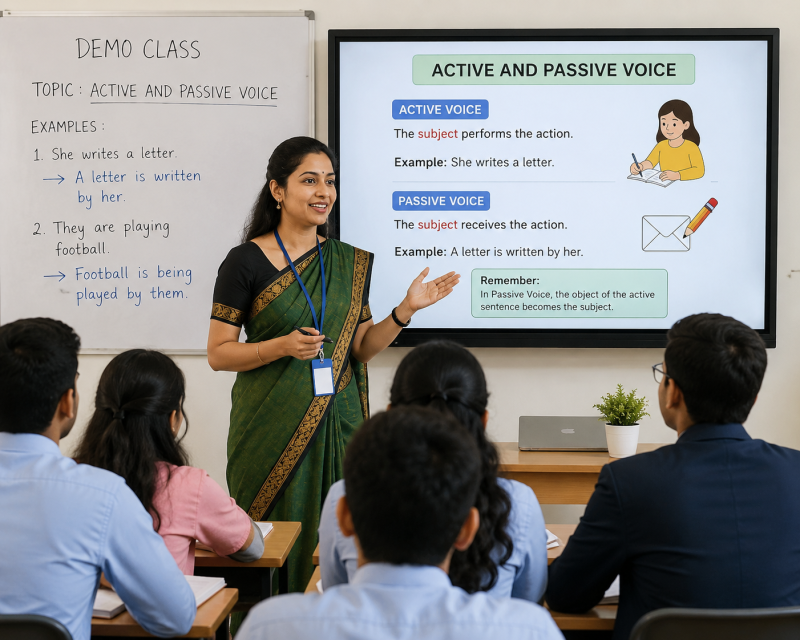
Best Demo Class Tips for Teachers
Speak Slowly and Clearly
Many teachers speak very fast because of nervousness. Students then struggle to understand the explanation.
Slow and clear communication improves classroom understanding immediately.
Maintain Eye Contact
Do not keep looking only at the board or notebook.
Eye contact helps teachers connect better with students and shows classroom confidence.
Use Real-Life Examples
Students understand concepts faster when teachers connect topics with practical situations.
Even simple examples make classes more interesting and easier to follow.
Stay Calm During Classroom Mistakes
Sometimes students may not answer correctly or classroom energy may drop.
Do not panic.
Schools observe how calmly teachers handle classroom situations.
Practice Demo Class Before Interview
Mock practice helps tremendously.
Teachers can:
- practice in front of mirror,
- teach family members,
- or record themselves while teaching.
Regular practice improves confidence, voice clarity, and teaching flow.
Subject-Wise Demo Class Tips for Teachers
English Teachers
English teachers should focus on:
- pronunciation,
- reading interaction,
- spoken confidence,
- and communication clarity.
Students should feel comfortable understanding your language.
Maths Teachers
Maths teachers should explain solutions step-by-step.
Good Maths teaching is not about speed. It is about helping students understand the process clearly.
Science Teachers
Science demo classes become stronger when teachers use:
- diagrams,
- examples,
- and real-life situations.
Practical explanation improves student interest.
Computer Teachers
Computer teachers should focus more on practical explanation than theory-heavy teaching.
Simple explanation of technical concepts creates better classroom connection.
Primary Teachers
Schools usually expect primary teachers to be energetic and interactive.
Storytelling, visuals, classroom activities, and friendly interaction play a big role during primary demo classes.
Language Teachers
Language teachers should focus strongly on:
- pronunciation,
- speaking confidence,
- reading practice,
- and student participation.
Common Demo Class Mistakes Teachers Make
Speaking Too Fast
Many teachers rush while teaching because of nervousness. Students then struggle to follow the explanation.
Teaching Without Student Participation
A classroom should not feel like a one-way lecture.
Interactive teaching creates much stronger impression.
Reading Directly From Notes
Teachers who continuously read from notebook appear less confident.
Weak Classroom Control
If students become noisy and teachers panic, interview panels notice this immediately.
Over-Explaining Theory
Long theoretical explanation often reduces classroom interest.
Simple teaching usually works better.
Poor Lesson Planning
Random teaching without proper flow confuses both students and interview panel.
Lack of Practice
Most demo class problems improve with regular mock practice.
How Freshers Can Crack Demo Class Successfully
Freshers often feel nervous because they have limited classroom experience.
This is completely normal.
Schools usually do not expect perfection from freshers. They mainly check:
- communication confidence,
- teaching style,
- classroom interaction,
- and willingness to learn.
Freshers should focus on:
- practicing demo classes regularly,
- choosing simple topics,
- improving speaking confidence,
- and learning how to interact with students naturally.
Many freshers try to teach difficult topics just to impress schools. This often creates more nervousness.
Simple and confident teaching creates much better impression.
With regular practice, freshers can also perform very well during demo classes.
Practical Demo Class Checklist Before Interview
Before attending school interview, make sure you:
- revise your topic properly,
- prepare lesson flow,
- carry updated resume,
- arrange certificates neatly,
- dress professionally,
- practice voice confidence,
- research school background,
- and sleep properly before interview day.
Small preparation often creates huge difference during demo class performance.
FAQ – School Demo Class Preparation
How can I prepare for a school demo class?
Start practicing your teaching before the interview. Choose one simple topic, prepare proper lesson flow, and practice speaking clearly and confidently. Mock practice in front of a mirror, friends, or family members can improve confidence quickly.
What do schools check during a demo class?
During a demo class, schools usually check:
- teaching style,
- classroom confidence,
- communication skills,
- student interaction,
- board writing,
- and classroom management.
Schools also observe how teachers handle students and explain topics in simple language.
Is demo class important in teacher interviews?
Yes. In many CBSE, ICSE, and private schools, demo class performance is one of the most important parts of teacher selection. Many schools give more importance to demo class than interview answers.
How long is a school demo class?
Most school demo classes are usually:
- 10 minutes,
- 15 minutes,
- or 20 minutes long.
Some schools may also ask teachers to take a full practical classroom session.
Can freshers clear school demo class?
Yes. Freshers can also perform very well in demo classes with proper preparation, confidence, and regular practice. Schools mainly look for teaching ability, communication confidence, and classroom interaction.
Which topic is best for demo class?
Choose a topic:
- you understand properly,
- can explain easily,
- and students can understand comfortably.
Simple and clear teaching usually creates better impression than difficult topics.
What is the biggest mistake teachers make during demo class?
One common mistake is teaching continuously without involving students. Schools prefer teachers who ask questions, interact with students, and make the classroom engaging.
Get Teaching Job in Just 7 Days – सिर्फ 7 दिनों में पाएँ Teaching Job Across India
Looking for teaching jobs in CBSE, ICSE, international, or private schools across India?
SchoolNaukri.com helps teachers connect with trusted schools faster and apply for school jobs easily across India.
What You Can Do on SchoolNaukri
- Apply for teaching jobs for free
- Create professional Teacher Resume/CV in just 2 minutes
- Find teacher, principal, and school office staff vacancies
- Apply to schools across India easily
- Discover CBSE and private school teaching jobs
- Connect directly with schools hiring teachers
Create Your Free Resume (CV)
https://schoolnaukri.com/teacher-resume-maker
Apply for School Jobs
Download SchoolNaukri App
https://play.google.com/store/apps/details?id=com.schoolnaukri.app
Trusted by 10,000+ schools and joined by 5 lakh+ teachers across India.
SchoolNaukri – India’s No.1 Teaching Job Site
Conclusion
A school demo class is not about showing perfect teaching. It is about showing schools that students can comfortably understand and connect with your teaching style.
Many teachers fail demo classes because of nervousness, weak classroom interaction, or lack of preparation. The good thing is that these problems improve with practice.
Teachers who focus on:
- communication confidence,
- classroom interaction,
- simple explanation,
- and student engagement,
usually perform much better during interviews.
With proper preparation and regular practice, both freshers and experienced teachers can successfully clear school demo classes and get good teaching jobs across India.
About the Authors
Abhishek Ranjan and Atul Kumar are the founders of SchoolNaukri and work closely with schools across India to help schools hire better teachers and improve recruitment processes.
Atul Kumar, an IIT Bombay graduate, helps schools solve one of their biggest challenges — finding the right teachers. He focuses on creating simple and practical hiring systems that schools can trust and use easily.
Abhishek Ranjan is an edupreneur actively working in the Indian education sector. He regularly works with school founders and principals to improve teacher hiring, leadership recruitment, and school staffing processes.
They are also the authors of “The Ultimate School Hiring Workbook”, a practical guide designed to help schools improve:
- Teacher Hiring
- Teacher Interviews
- Demo Classes
- School Recruitment Systems