
How to Start a Play School in India: Complete Step-by-Step Guide
How to Start a Play School in India
Starting a play school is more than opening a business. It is an opportunity to create a safe, happy, and caring place where children begin their learning journey.
Many people want to start a play school but are unsure where to begin. Questions about investment, registration, location, teachers, curriculum, and admissions can make the process confusing.
The good news is that with proper planning and the right guidance, starting a play school in India can be much easier than you think. Whether you are a teacher, homemaker, entrepreneur, or someone passionate about early childhood education, you can build a successful play school.
Introduction
Imagine a parent visiting your play school for the first time. They are not just looking for colourful classrooms or expensive toys. They want a place where their child will be safe, happy, and cared for every day.
A successful play school is built on trust, good teachers, a child-friendly environment, and strong relationships with parents. Fancy interiors alone cannot create a great preschool.
This step-by-step guide will help you understand the complete process of starting a play school in India. From planning and choosing a name to setting up classrooms, hiring teachers, getting admissions, and successfully launching your school, you will find practical and easy-to-follow guidance at every stage.
Step 0 – Ask Yourself: Why Do You Want to Start a Play School?
Before thinking about investment, registration, or a building, ask yourself one important question:
Why do I want to start a play school?
Your answer will help you make better decisions and build a successful school.
1. Do You Love Working with Children?
If you enjoy spending time with children and helping them learn, starting a play school can be a rewarding journey.
2. Do You Want to Make a Positive Impact?
A good play school helps shape a child's future. If you want to contribute to your community through education, this can be a meaningful career.
3. Are You Looking for a Long-Term Business?
A play school is not a quick-profit business. It takes time to build trust, reputation, and admissions.
4. Are You Ready to Learn and Improve?
You do not need to know everything on day one. Successful school owners keep learning about child development, teaching methods, and parent expectations.
5. Are You Prepared to Build Parent Trust?
Parents trust you with their children. Safety, care, and good communication are just as important as academics.
Step 1 – Decide Why You Want to Start a Play School
Before investing money or searching for a building, ask yourself one simple question:
Why do I want to start a play school?
Your answer will shape your journey and help you make better decisions.
People start play schools for many reasons:
Love for children and teaching.
Passion for education.
Starting their own business.
Contributing to the community.
Building a stable and rewarding career.
A play school is more than a business. Parents trust you with their children's care and early learning.
Who Can Start a Play School?
Anyone with dedication and proper planning can start a play school, including:
Teachers.
Homemakers.
Entrepreneurs.
Parents.
Retired education professionals.
Educational organisations.
Teaching experience is helpful but not essential. You can always hire qualified teachers and staff.
Independent or Franchise?
You have two options:
Independent Play School
Benefits:
Build your own brand.
Full control over your school.
Lower long-term costs.
Challenges:
Need to create your own reputation.
Handle marketing and planning.
Franchise Play School
Benefits:
Established brand name.
Ready curriculum and support.
Training and guidance.
Challenges:
Franchise and royalty fees.
Less freedom in decision-making.
Choose the option that matches your budget, goals, and long-term vision.
Read Also-How Much Money is Required to Start a CBSE School in India? Land, Building, Furniture, Staff & CBSE Affiliation Cost Guide
Step 2 – Market Research and Planning Your Play School
After deciding to start a play school, the next step is proper planning. A little research before investing can save both time and money.
Understand Your Local Area
Look around your locality and ask:
Are there many young families nearby?
Are new apartments or housing projects coming up?
Are there enough good play schools in the area?
A location with growing families usually offers better opportunities.
Visit Other Play Schools
Spend some time visiting nearby play schools.
Observe:
Fee structure.
Facilities.
Teaching style.
Parent feedback.
Overall environment.
Learn from them, but create your own identity.
Know Your Target Parents
Different parents look for different things.
Some want:
Affordable fees.
Safe environment.
Daycare facilities.
Activity-based learning.
Small class sizes.
Understanding parents' needs helps you plan better.
Plan Your Budget
Prepare a simple budget for:
Building.
Furniture and toys.
Teacher salaries.
Learning materials.
Marketing.
Daily expenses.
A proper budget helps avoid future problems.
Decide Your School's Strength
Ask yourself:
Why should parents choose my play school?
It could be:
Caring teachers.
Safe environment.
Quality education.
Affordable fees.
Strong parent communication.
Talk to Parents
One of the best ways to understand the market is to speak with local parents.
Ask them:
What do they expect from a play school?
What facilities are important?
What fee range is comfortable?
Their feedback can help you make better decisions.
Step 3 – Choose the Right Name and Complete Basic Planning
After deciding to start a play school, the next step is choosing a good name and planning the basics.
A good name and clear planning can help create a positive first impression among parents.
Choose a Good Name
Your school's name should be:
Short and easy to remember.
Child-friendly.
Easy to pronounce and spell.
Positive and meaningful.
Avoid names that are too long or confusing.
Check Online Availability
Many parents search for schools online before visiting.
If possible:
Check if a website domain is available.
Create a Google Business Profile.
Reserve your social media handles.
This will help parents find your school easily.
Create a Simple Logo
You do not need an expensive logo. A simple and colourful design that reflects children and learning is enough to start.
Decide How You Will Run Your School
You can operate your play school in different ways, such as:
Individual ownership.
Partnership.
Educational trust.
Society.
Choose the option that suits your long-term plans and local requirements.
Keep Important Documents Ready
Organise basic documents like:
Identity proof.
Address proof.
Property or rental documents.
PAN and bank details.
Keeping documents ready saves time later.
Make a Simple Business Plan
Write down:
School name.
Location.
Estimated investment.
Fee structure.
Expected number of students.
Monthly expenses.
A simple plan helps you stay organised.
Build Your School's Identity
Think about what parents should remember about your school.
It could be:
Safe environment.
Caring teachers.
Activity-based learning.
Affordable fees.
Personal attention to every child.
Practical Tip
Do not spend too much time trying to create the perfect name or logo. Parents usually remember a play school for its caring teachers, happy children, and safe environment. A good reputation is your biggest strength.
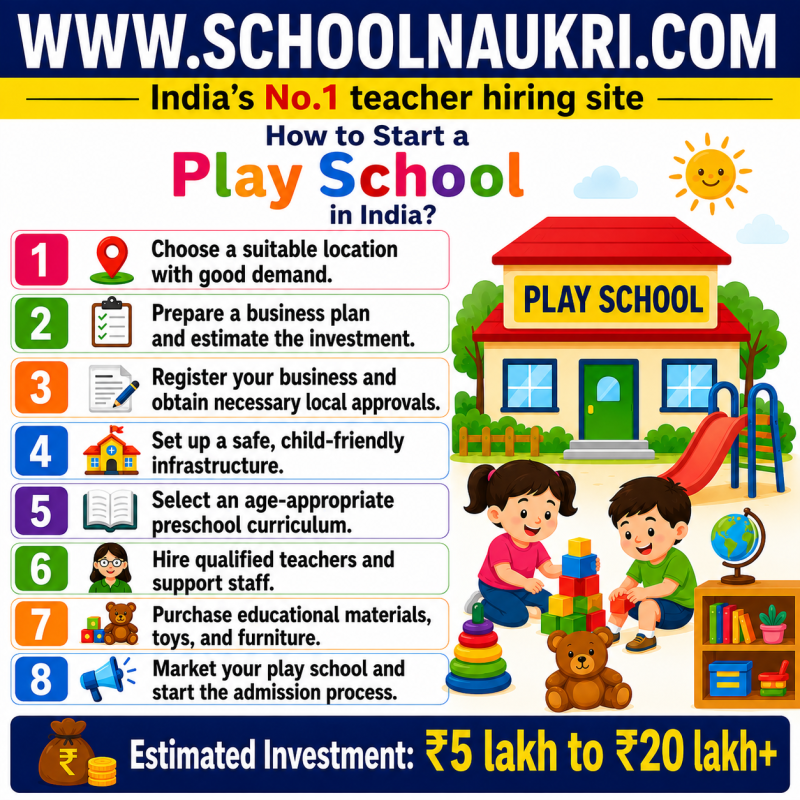
Step 4 – Choose the Right Location and Building for Your Play School
The location of your play school plays a big role in its success. A safe and easily accessible location can help attract more admissions.
Choose the Right Area
Look for places with:
Residential colonies and apartments.
Young families.
Growing neighbourhoods.
Good road connectivity.
These areas usually have a higher demand for play schools.
Pick a Child-Friendly Building
Your building should be:
Safe and clean.
Well ventilated.
Bright and spacious.
Equipped with clean washrooms and safe drinking water.
Comfortable for children and parents.
A ground-floor building is often the best choice for easy access and safety.
Plan Indoor and Outdoor Activities
Children learn through play, so try to include:
Indoor activity space.
Outdoor play area.
Small garden or open space.
Room for games and creative activities.
Even a small play area can be used effectively.
Make Safety a Priority
Parents always check safety before taking admission.
Basic safety measures include:
CCTV cameras.
First aid kit.
Fire extinguisher.
Safe furniture.
Secure gates.
Clean and hygienic surroundings.
A safe environment builds parent trust.
Rent or Buy?
Many new school owners start with a rented building because it requires less investment. If your budget allows and you have long-term plans, buying a property can also be a good option.
Think About Future Growth
Choose a place where you can expand later by adding:
More classrooms.
Daycare facilities.
Activity rooms.
Parent waiting area.
Step 5 – Set Up Your Play School
A good play school does not need expensive interiors. Children and parents prefer a place that is safe, clean, colourful, and fun to learn in.
Create Child-Friendly Classrooms
Your classrooms should be:
Bright and well ventilated.
Clean and spacious.
Colourful and welcoming.
Comfortable for children to move and play.
Buy Safe Furniture
Start with the basics:
Small tables and chairs.
Storage shelves.
Toy cabinets.
Book racks.
Soft floor mats.
Choose furniture with smooth and safe edges.
Add Learning and Play Areas
Children learn through activities, so create simple spaces for:
Reading.
Art and craft.
Building blocks.
Music and dance.
Puzzles and games.
Choose Educational Toys
You do not need many toys. Start with:
Building blocks.
Flash cards.
Story books.
Educational puzzles.
Drawing materials.
Alphabet and number games.
Keep the School Clean and Safe
Parents always notice cleanliness and safety.
Make sure you have:
Clean classrooms and washrooms.
Safe drinking water.
First aid kit.
Fire extinguisher.
CCTV cameras.
Secure entrance and exit.
Create a Welcoming Reception
A simple and organised reception area helps create a good first impression for parents and visitors.
Avoid Unnecessary Expenses
Do not spend too much money on expensive decorations. Focus on good learning materials, child safety, and quality facilities. You can improve the school as admissions grow.
A Common Mistake
Many new play schools look attractive but have limited learning activities. Children need opportunities to play, explore, and interact. A fun learning environment is more important than expensive interiors.
Quick Setup Checklist
Before opening your play school, make sure you have:
✓ Child-friendly classrooms.
✓ Safe furniture.
✓ Educational toys.
✓ Activity areas.
✓ Clean washrooms.
✓ Safe drinking water.
✓ CCTV and first aid.
✓ Comfortable reception area.
Step 6 – Choose the Right Curriculum and Daily Activities
A play school is not just a place where children spend a few hours. It is where they learn, play, make friends, and build confidence.
A good curriculum should be simple, fun, and suitable for the child's age.
Focus on Overall Development
A play school should help children:
Build confidence.
Improve communication.
Learn through play.
Develop social skills.
Become ready for formal schooling.
Use Fun Learning Activities
Young children learn best through activities like:
Storytelling.
Rhymes and songs.
Music and dance.
Art and craft.
Educational games.
Outdoor play.
Learning should always be enjoyable.
Plan Age-Appropriate Classes
Most play schools have:
Playgroup (2–3 years) – Play and social interaction.
Nursery (3–4 years) – Alphabets, numbers, colours, and rhymes.
LKG (4–5 years) – Reading, writing, and creative activities.
UKG (5–6 years) – Language, maths, and school readiness.
Follow a Daily Routine
A simple daily schedule may include:
Welcome time.
Learning activities.
Storytelling.
Snack break.
Art and craft.
Outdoor play.
Music and dance.
Goodbye session.
A routine helps children feel comfortable and secure.
Celebrate Festivals and Involve Parents
Celebrate special days and organise:
Cultural events.
Sports Day.
Children's Day.
Parent-teacher meetings.
Family activity programmes.
This strengthens the bond between the school and parents.
Avoid Too Much Academic Pressure
Play schools should focus on fun learning rather than homework and long written exercises. Children learn better through activities, play, and interaction.
Step 7 – Hire the Right Teachers and Staff for Your Play School
A good play school is built by good teachers and caring staff. Parents may like your building, but they trust the people who take care of their children every day.
Decide What Staff You Need
A small play school usually needs:
Play school teachers.
Mother teachers or helpers.
Receptionist.
Housekeeping staff.
As your school grows, you can hire more staff as needed.
Hire People Who Love Children
Look for teachers who are:
Patient and caring.
Friendly and energetic.
Good communicators.
Comfortable working with parents.
A positive attitude is often more important than years of experience.
Check Qualifications
Teachers with NTT, Early Childhood Education, Graduation, or teaching experience are preferred. However, practical teaching skills and love for children matter the most.
Conduct Simple Interviews and Demo Activities
Ask simple questions and request a short activity session. This helps you understand:
Communication skills.
Creativity.
Confidence.
Child handling ability.
Train Your Team
Regular training can improve:
Child safety.
Classroom activities.
Parent communication.
School policies.
A well-trained team provides better care and learning.
Build a Positive Work Environment
Respect and support your staff. Happy teachers create happy classrooms and help reduce staff turnover.
A Common Mistake
Some new school owners hire staff only to reduce costs. Parents may ignore simple interiors, but they quickly notice poor teaching and lack of care. Good teachers help build a strong reputation for your school.
Read Also-How to Hire Teachers in India – Interview Questions, Salary, Skills & Hiring Tips
Step 8 – Decide Your Fee Structure and Budget
Setting the right fee structure is important for the success of your play school. The goal is to provide quality education while keeping fees affordable for parents.
Understand the Local Market
Visit nearby play schools and check:
Admission fees.
Monthly fees.
Daycare charges.
Transport fees.
Other common charges.
This will help you decide competitive pricing.
Keep Your Fee Structure Simple
A play school may charge:
Admission fee.
Monthly tuition fee.
Annual charges.
Daycare fee.
Transport fee (if available).
Keep everything clear and easy for parents to understand.
Plan Your Monthly Budget
Calculate expenses such as:
Building rent.
Teacher and staff salaries.
Electricity and maintenance.
Learning materials.
Marketing.
Emergency expenses.
A proper budget helps avoid financial problems.
Keep Some Backup Funds
Admissions may take time to grow. Keep enough money to manage daily expenses during the first few months.
Focus on Value, Not Low Fees
Parents usually look for:
Safe environment.
Caring teachers.
Good learning activities.
Clean classrooms.
A quality experience is often more important than the lowest fee.
Avoid Unnecessary Spending
In the beginning, spend wisely. Invest in:
Good teachers.
Child safety.
Learning materials.
Clean facilities.
Luxury interiors can wait until your school grows.
Step 9 – Market Your Play School and Get Your First Admissions
Opening a play school is only the first step. Parents need to know about your school and trust you before they take admission.
Start Promotion Early
Begin marketing 1–2 months before opening.
Share:
School name and location.
Facilities.
Admission updates.
Fun activities for children.
Build Your Online Presence
Create:
Google Business Profile.
Facebook and Instagram pages.
A simple website with admission details and contact information.
Many parents search online before visiting a school.
Connect with Local Parents
Promote your school through:
WhatsApp groups.
Apartment societies.
Parent communities.
Local events.
Word-of-mouth recommendations work very well.
Organise an Open House
Invite parents and children to visit your school.
Show them:
Classrooms.
Play areas.
Teachers.
Learning activities.
A personal visit helps build trust.
Make Admissions Easy
Keep the process simple:
Enquiry.
School visit.
Admission form.
Document submission.
Fee payment.
A smooth process creates a good first impression.
Focus on Quality
Good marketing brings parents to your school, but quality makes them stay.
Focus on:
Caring teachers.
Child safety.
Clean environment.
Fun learning activities.
Good parent communication.
A Common Mistake
Many new play schools spend a lot on advertising but forget to build relationships with parents. Happy families often bring more admissions through referrals.
Step 10 – Launch Your Play School Successfully
Congratulations! After months of planning, your play school is almost ready to welcome its first students. A good opening day can create a lasting impression on both parents and children.
Get Everything Ready
Before opening, check:
Classrooms and furniture.
Toys and learning materials.
Safety equipment.
Admission records.
Teacher and staff arrangements.
Avoid last-minute work.
Train Your Team
Meet with your staff and discuss:
Daily routine.
Child safety.
Parent communication.
Classroom responsibilities.
A prepared team builds confidence.
Make the School Safe and Welcoming
Check that you have:
Clean classrooms.
Safe furniture.
CCTV cameras.
First aid kit.
Safe drinking water.
Clean washrooms.
Parents should feel comfortable from their first visit.
Welcome Parents and Children
Organise a simple orientation and explain:
School timings.
Daily activities.
Safety measures.
Communication process.
On the first day, greet children warmly and keep activities fun and relaxed.
Keep Admission and Records Organised
Maintain:
Admission forms.
Student records.
Parent contact details.
Fee records.
Good organisation makes school management easier.
Keep Learning and Improving
Listen to feedback from:
Parents.
Teachers.
Staff.
Small improvements can make a big difference over time.
A Common Mistake
Many school owners think the work is over after the opening day. In reality, building a successful play school requires continuous care, improvement, and strong relationships with parents.
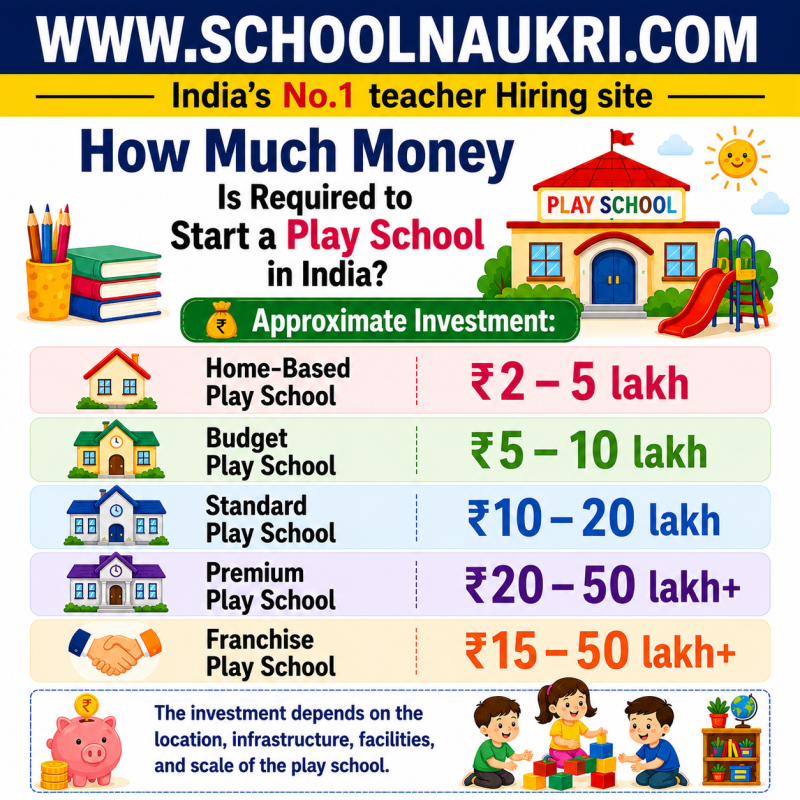
How Much Money Is Required to Start a Play School in India?
The investment required to start a play school depends on the location, building, facilities, and the number of students you plan to admit. Here's a simple estimate:
| Type of Play School | Approximate Investment | Suitable For |
|---|---|---|
| Home-Based Play School | ₹2–5 lakh | Small neighbourhood setup |
| Budget Play School | ₹5–10 lakh | Independent startup in a rented building |
| Standard Play School | ₹10–20 lakh | Well-equipped preschool with quality facilities |
| Premium Play School | ₹20–50 lakh | Large preschool with modern infrastructure |
| Franchise Play School | ₹15–50 lakh+ | Established preschool brands with franchise support |
The investment may include:
- Building rent and interiors.
- Furniture and educational toys.
- Learning materials.
- Teacher and staff salaries.
- Safety equipment.
- Marketing and branding.
- School management and miscellaneous expenses.
Frequently Asked Questions (FAQs)
1. How much money is required to start a play school in India?
The investment depends on the location, building, and facilities. A small play school can start with a modest budget, while larger setups may require higher investment.
2. Can I start a play school without a franchise?
Yes. Many successful play schools in India operate independently. You can create your own brand, curriculum, and fee structure.
3. What qualifications are required to start a play school?
There is no fixed educational qualification. Teachers, homemakers, entrepreneurs, parents, and education enthusiasts can start a play school with proper planning.
4. Is a licence required to open a play school in India?
Requirements may vary depending on the state and local authorities. It is advisable to check local regulations before starting your play school.
5. What documents are required to open a play school?
Basic documents may include identity proof, address proof, property or rental documents, PAN, bank account details, and any local registrations required in your area.
6. What are the requirements to open a play school in India?
A suitable location, child-friendly infrastructure, qualified teachers, learning materials, safety arrangements, and proper planning are some of the basic requirements.
7. How much space is needed for a play school?
The required space depends on the number of children and facilities you plan to provide. Safe classrooms and activity areas are important.
8. Can I start a play school at home?
Yes. If you have enough safe and child-friendly space and follow local regulations, you can start a home-based play school.
9. How can I start a preschool with little investment?
You can start with a small setup, focus on essential facilities, rent a suitable space, and gradually expand as admissions grow.
10. What is the setup cost for a play school in India?
The setup cost depends on the location and type of school. Home-based and small independent play schools usually require less investment than premium setups.
11. Is opening a play school a profitable business?
A well-managed play school with good teachers, quality education, and strong parent trust can become a sustainable and rewarding business.
12. How can I get admissions for a new play school?
You can attract admissions through quality education, parent referrals, local marketing, social media, Google Business Profile, and community engagement.
13. How many teachers are required for a play school?
The number depends on student strength. Most play schools start with a small team and add more teachers and support staff as they grow.
14. Which curriculum is best for a play school?
A child-friendly, activity-based curriculum that encourages learning through play, creativity, and social interaction works best.
15. What is the best location for a play school?
Areas with young families, residential colonies, apartment complexes, and good road connectivity are often ideal for a play school.
16. Can I start a play school without teaching experience?
Yes. Teaching experience is helpful but not compulsory. You can hire qualified teachers and focus on managing the school.
17. How long does it take to start a play school?
The time depends on planning, infrastructure, staffing, and local requirements. With proper preparation, many play schools can be set up within a few months.
18. How can I market my new play school?
You can promote your play school through social media, Google Business Profile, local communities, parent referrals, WhatsApp, and open house events.
19. Is starting a play school a good business opportunity in India?
Yes. With increasing awareness of early childhood education, a well-planned and professionally managed play school can be both socially rewarding and financially sustainable.
How SchoolNaukri Can Help
- Hire Play School Teachers in as little as 7 Days
- Find Nursery, Pre-Primary & Kindergarten Teachers
- Recruit Coordinators, Principals & Support Staff
- Post Unlimited School Job Vacancies
- Access Thousands of Education Professionals Across India
- Build Your Complete Play School Team Before Launch
🔗 Visit: www.schoolnaukri.com
Conclusion
Starting a play school in India is more than opening a business—it is an opportunity to make a positive difference in the lives of young children and their families.
With proper planning, the right location, caring teachers, a child-friendly environment, and good communication with parents, you can build a play school that children love and parents trust.
You do not need to start with a huge investment or expensive infrastructure. Focus on safety, quality education, and creating a happy learning experience for every child. As your reputation grows, your admissions and school will grow naturally.
Take one step at a time, keep learning, and always put children's well-being first. With patience, dedication, and the right approach, you can build a successful and rewarding play school in India.
Final Recommendation: Read These Resources Before Starting a Play School
Ministry of Education (Government of India)
The Ministry of Education provides policies, guidelines, and updates related to school education in India. Understanding these regulations can help you build a strong foundation for your play school.
🔗 https://www.education.gov.in
National Education Policy (NEP) 2020
NEP 2020 emphasizes the importance of Early Childhood Care and Education (ECCE). It offers valuable insights into curriculum planning and child-centered learning.
🔗 https://www.education.gov.in/en/nep-new
Ministry of Women and Child Development (MWCD)
MWCD focuses on child welfare and early childhood development. Its resources can help play school founders understand best practices for nurturing young learners.