
How to Start an IB School in India: Affiliation, Requirements, Cost & Complete Setup Guide
Introduction
The demand for International Baccalaureate (IB) schools in India has grown significantly over the past decade. With parents increasingly looking for globally recognized education, critical thinking, inquiry-based learning, and international university pathways, many education entrepreneurs are considering starting an IB school.
However, opening an IB school is very different from opening a traditional school. It requires careful planning, substantial investment, qualified teachers, modern infrastructure, and a successful authorization process with the International Baccalaureate Organization (IBO).
If you're planning to establish an IB school in India, this guide will help you understand everything you need to know—from eligibility and infrastructure requirements to authorization, costs, staffing, and timelines.
Whether you're an education entrepreneur, school management trust, existing school owner, or investor, this guide will help you make informed decisions before starting your journey.
Table of Contents
- What Is an IB School?
- Why Start an IB School in India?
- IB Programmes Offered by the International Baccalaureate
- Can Anyone Start an IB School in India?
- Why IB Authorization Matters
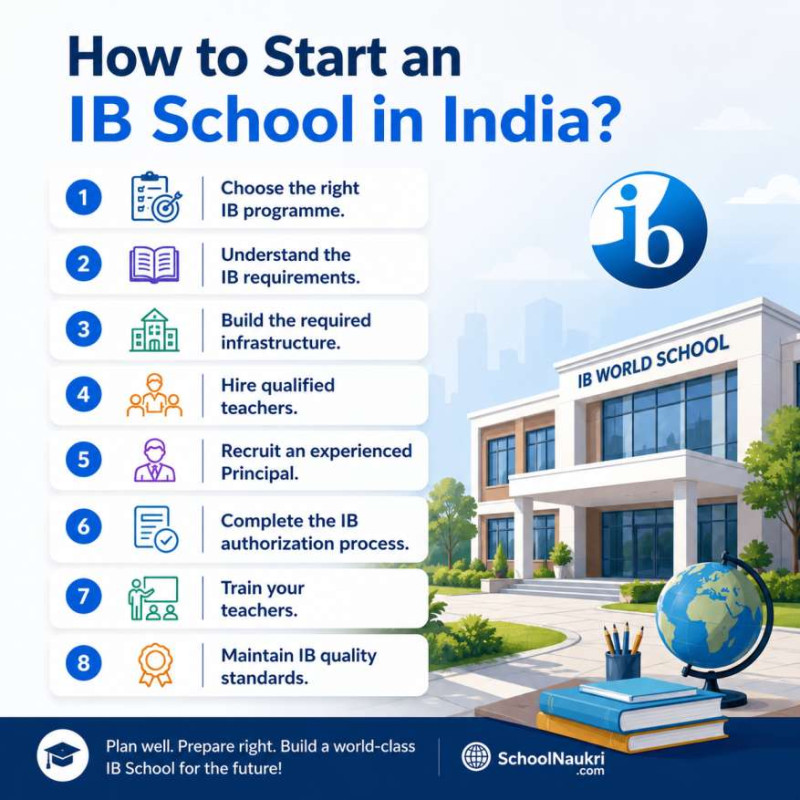
- IB School Authorization Process in India
- Step 1: Evaluate Your School's Readiness
- Step 2: Submit an Application
- Step 3: Become a Candidate School
- Step 4: Teacher Professional Development
- Step 5: Verification Visit
- Step 6: Authorization
- Infrastructure Requirements for an IB School
- Teacher Qualification Requirements
- Principal and School Leadership Requirements
- How Much Does It Cost to Start an IB School in India?
- Documents Required to Start an IB School
- How Long Does It Take to Start an IB School?
- Common Mistakes Schools Should Avoid
- Before You Start an IB School
- Frequently Asked Questions
- How SchoolNaukri Can Help IB Schools
- Conclusion
What is an IB School?
An IB (International Baccalaureate) School is an educational institution authorized by the International Baccalaureate Organization (IBO) to offer one or more IB programmes. The IB curriculum is recognized in over 150 countries and is designed to develop students who are knowledgeable, curious, responsible, and globally minded.
Unlike traditional education systems that mainly focus on examinations and memorization, the IB framework emphasizes:
- Critical thinking
- Inquiry-based learning
- Research skills
- Creativity
- Communication
- International-mindedness
- Real-world problem solving
The curriculum encourages students to ask questions, explore ideas, and become lifelong learners rather than simply preparing for examinations.
Today, thousands of schools worldwide offer IB programmes, and the number of IB schools in India continues to grow as demand for international education increases.
Why Start an IB School in India?
India has witnessed a steady rise in demand for international education, especially in metropolitan cities and rapidly developing urban centers.
Parents today are looking for schools that provide:
- Globally recognized education
- Strong English communication skills
- Holistic personality development
- International university opportunities
- Modern teaching methods
- Future-ready skills
As a result, IB schools often attract families seeking an internationally benchmarked education for their children.
Starting an IB school also offers several advantages for school owners:
- Strong brand recognition worldwide
- Premium positioning in the education market
- Opportunity to attract international and expatriate families
- Modern curriculum focused on innovation
- Better teacher development opportunities
- High-quality academic standards
- Strong alumni outcomes
Although establishing an IB school requires considerable planning and investment, it can become a highly respected educational institution with the right vision and leadership.
IB Programmes Offered by the International Baccalaureate
The International Baccalaureate (IB) offers four internationally recognized educational programmes designed for different age groups. Each programme focuses on developing students' academic knowledge, critical thinking, creativity, and lifelong learning skills.
| IB Programme | Age Group | Overview |
|---|---|---|
| Primary Years Programme (PYP) | 3–12 Years | Designed for young learners, the PYP focuses on inquiry-based learning, creativity, communication, and conceptual understanding. Students learn by exploring real-world situations rather than memorizing facts. |
| Middle Years Programme (MYP) | 11–16 Years | The MYP encourages critical thinking, interdisciplinary learning, research skills, collaboration, and problem-solving while preparing students for higher education and future careers. |
| Diploma Programme (DP) | 16–19 Years | A globally recognized pre-university programme that prepares students for admission to leading universities. It combines rigorous academics with research, creativity, community service, and personal development. |
| Career-related Programme (CP) | 16–19 Years | The CP combines IB academic learning with career-focused education. It is ideal for students who want to develop professional skills while benefiting from the IB's international education philosophy. |
Can Anyone Start an IB School in India?
Yes, but only schools that successfully complete the IB authorization process are permitted to offer IB programmes. The International Baccalaureate Organization evaluates whether a school meets its programme standards before granting authorization. The process includes stages such as consideration, candidacy, authorization, and a verification visit, ensuring that schools are prepared to deliver the programme effectively.
Before applying, school owners should have:
- A clear educational vision aligned with IB philosophy
- Suitable land and school infrastructure
- Financial resources for setup and operations
- Qualified school leadership
- Well-trained teachers
- Long-term commitment to maintaining IB standards
- Appropriate governance and management systems
Many schools begin by offering a national curriculum alongside IB programmes before expanding their international offerings.
Why IB Authorization Matters
Receiving authorization from the International Baccalaureate demonstrates that a school meets internationally recognized standards for teaching, learning, leadership, and continuous improvement.
For parents, it builds confidence in the quality of education.
For teachers, it offers opportunities for professional growth through IB training and collaboration.
For students, it provides access to a globally respected curriculum that supports admission to universities around the world.
For school owners, authorization strengthens credibility and positions the school among leading international institutions.
IB School Authorization Process in India
One of the most important steps in starting an IB school is obtaining authorization from the International Baccalaureate Organization (IBO). Unlike some education boards, schools cannot simply submit an application and begin teaching the IB curriculum. The authorization process is comprehensive and is designed to ensure that schools can successfully deliver the IB philosophy and programmes.
The official process generally includes several stages, beginning with a school's initial interest, followed by candidacy, preparation, a verification visit, and finally the authorization decision. Throughout this journey, schools work closely with IB representatives to meet the required programme standards.
Below is a simplified overview of the process.
Step 1: Evaluate Your School's Readiness
Before applying, assess whether your school is ready to adopt the IB philosophy. Consider the following questions:
- Does your school have a long-term vision for international education?
- Do you have qualified leadership and experienced teachers?
- Can you invest in teacher training and professional development?
- Is your infrastructure suitable for inquiry-based learning?
- Do you have sufficient financial resources?
Answering these questions honestly will help determine whether your school is prepared for the authorization journey.
Step 2: Submit an Application
Once your school is ready, you can begin the authorization process by expressing your interest and completing the required application procedures with the International Baccalaureate Organization.
At this stage, you'll provide information about your school, its leadership, facilities, educational vision, and the IB programme you wish to offer.
Step 3: Become a Candidate School
After your application is accepted, your school enters the candidacy stage.
During this period, schools work toward implementing IB standards by:
- Developing curriculum plans
- Strengthening school policies
- Training teachers
- Preparing learning resources
- Building leadership capacity
- Improving teaching practices
This stage allows schools to gradually align themselves with IB expectations before authorization.
Step 4: Teacher Professional Development
Teacher training is one of the most important aspects of becoming an IB World School.
IB teachers are expected to understand:
- Inquiry-based learning
- Concept-driven teaching
- Student-centred classrooms
- International-mindedness
- Assessment strategies
- Collaborative planning
Schools should allocate sufficient time and budget for continuous professional development, as well-trained teachers are essential for successfully delivering the IB curriculum.
Step 5: Verification Visit
Once the school believes it has met the required standards, the International Baccalaureate arranges a verification visit.
During this visit, reviewers evaluate several areas, including:
- Leadership and governance
- Teaching quality
- School policies
- Infrastructure
- Learning resources
- Teacher readiness
- Student support systems
- Curriculum implementation
The objective is to ensure that the school can effectively deliver the chosen IB programme.
Step 6: Authorization
If the school successfully meets the programme standards, it receives authorization and becomes an IB World School.
Only after authorization can a school officially offer the approved IB programme.
Authorization also brings ongoing responsibilities. Schools are expected to maintain quality standards, participate in continuous improvement, and support regular professional development for teachers and leaders.
Infrastructure Requirements for an IB School
Modern infrastructure plays a significant role in delivering a high-quality IB education. While there is no single standard building design, schools should provide learning spaces that encourage collaboration, creativity, research, and inquiry.
A well-planned IB campus generally includes:
Classrooms
Classrooms should be spacious, flexible, and designed to support interactive learning rather than traditional lecture-based teaching.
Furniture should be movable to encourage group discussions, projects, and collaborative activities.
Science Laboratories
Schools offering middle and senior programmes should provide well-equipped science laboratories for Physics, Chemistry, and Biology practical work.
Laboratories should meet safety standards and support hands-on learning experiences.
Computer and Technology Facilities
Technology is an essential part of IB education.
Schools should provide:
- Computer laboratories
- High-speed internet
- Digital learning resources
- Interactive teaching technology
- Student research facilities
Library
A modern library should include:
- Academic books
- Fiction and non-fiction collections
- Digital resources
- Journals
- Research materials
- Comfortable reading areas
The library should encourage independent learning and research.
Sports Facilities
IB education emphasizes holistic development.
Schools should provide opportunities for:
- Indoor sports
- Outdoor sports
- Physical education
- Fitness activities
- Team games
Arts and Creative Spaces
Creativity is one of the core elements of the IB philosophy.
Schools should include facilities for:
- Music
- Dance
- Theatre
- Visual arts
- Design and innovation
Dedicated creative spaces help students develop confidence and artistic expression.
Teacher Qualification Requirements
Teachers are the foundation of every successful IB school.
While specific recruitment criteria may vary depending on the programme and subject, schools generally look for educators who combine strong academic qualifications with a learner-centred approach.
A competitive IB teacher typically has:
- A bachelor's or master's degree in the relevant subject
- A B.Ed. or equivalent teaching qualification (where applicable)
- Excellent English communication skills
- Strong classroom management abilities
- Experience with project-based and inquiry-based learning
- A willingness to participate in continuous professional development
Schools also value teachers who are collaborative, reflective, and committed to lifelong learning.
Principal and School Leadership Requirements
Strong leadership is essential for building and sustaining an IB World School.
An IB school principal should possess:
- Relevant academic qualifications
- Leadership and administrative experience
- Excellent communication skills
- Experience in curriculum planning
- Knowledge of international education
- Strategic decision-making ability
- Commitment to teacher development
- Focus on student well-being and academic excellence
The leadership team plays a key role in guiding teachers, maintaining quality standards, and ensuring that the school's vision aligns with the IB philosophy.
How Much Does It Cost to Start an IB School in India?
The cost of starting an IB school in India depends on several factors, including the city, land prices, campus size, student capacity, infrastructure, technology, and the IB programme you plan to offer.
For a new school, the investment is generally much higher than for an existing school that is upgrading to an IB curriculum.
The major expenses include:
Land and Building
Land is usually the largest investment. The cost varies significantly depending on whether the school is located in a metropolitan city, Tier-2 city, or rural area.
In addition to purchasing land, you'll need to budget for:
- Academic blocks
- Administrative offices
- Library
- Science laboratories
- Computer labs
- Sports facilities
- Auditorium or multipurpose hall
- Cafeteria
- Parking
- Security systems
Furniture and Classroom Equipment
Every classroom should be equipped with:
- Student desks and chairs
- Teacher workstation
- Smart board or projector
- Whiteboards
- Storage cabinets
- Classroom learning materials
IB classrooms are typically designed to encourage collaborative learning rather than traditional lecture-based teaching.
Technology
Modern technology is an important part of IB education.
Your budget should include:
- High-speed internet
- Wi-Fi across campus
- Student computer labs
- Teacher laptops
- Learning Management System (LMS)
- School ERP
- Digital library
- Audio-visual equipment
- CCTV and security systems
Teacher Recruitment
Hiring experienced teachers is one of the most important investments for an IB school.
You'll need to recruit:
- Principal
- Programme Coordinator
- PYP Teachers
- MYP Teachers
- DP Teachers
- Subject Specialists
- Librarian
- School Counsellor
- Sports Teachers
- Art & Music Teachers
- Administrative Staff
A strong recruitment process helps build the school's reputation from the very beginning.
Teacher Training
Unlike many traditional schools, IB places significant emphasis on professional development.
Schools should budget for:
- IB professional development workshops
- Teacher certification
- Leadership training
- Curriculum planning workshops
- Continuous learning programmes
Teacher development should be viewed as an ongoing investment rather than a one-time expense.
Documents Required to Start an IB School
Although the exact documentation depends on your school's legal structure and programme, schools generally need:
- Trust, Society, or Company Registration
- Land Ownership or Lease Documents
- Building Safety Certificate
- Fire Safety Certificate
- Occupancy Certificate
- Health and Sanitation Certificate
- School Management Committee Details
- Principal Appointment Letter
- Teacher Qualification Documents
- School Policies
- Financial Statements
- Budget Plans
- Curriculum Planning Documents
Maintaining organized documentation can make the authorization process smoother.
How Long Does It Take to Start an IB School?
There is no fixed timeline for authorization.
The duration depends on:
- School readiness
- Infrastructure completion
- Teacher recruitment
- Leadership preparation
- Professional development
- Documentation quality
- Implementation progress
The IB works with schools throughout the authorization journey, and each school progresses based on its readiness rather than a fixed deadline.
For many schools, planning should begin well before the intended launch date.
Common Mistakes Schools Should Avoid
Many schools underestimate the work involved in becoming an IB World School.
Some common mistakes include:
Hiring Teachers Too Late
Teacher recruitment should begin early so that educators have enough time to complete professional development and become familiar with the IB philosophy.
Ignoring Teacher Training
Excellent infrastructure alone does not guarantee a successful IB school.
Well-trained teachers are equally important.
Focusing Only on Buildings
Many school owners invest heavily in infrastructure but overlook curriculum planning, leadership development, and student support systems.
An IB school succeeds because of its educational quality—not just its campus.
Underestimating the Budget
Schools should prepare a realistic financial plan that includes:
- Infrastructure
- Teacher salaries
- Technology
- Professional development
- Marketing
- Operational expenses
- Contingency funds
Lack of Long-Term Vision
Starting an IB school is a long-term commitment.
School leaders should focus on building a sustainable institution rather than seeking short-term returns.
Before You Start an IB School
Before you start an IB school, it's a good idea to read the official IB Guide to School Authorization and Programme Standards and Practices. These guides explain how the IB system works, what your school needs to prepare, and what to expect during the authorization process. Reading them before you begin will help you understand the requirements, plan your school better, and avoid common mistakes.
Official IB Guide: https://ibo.org/globalassets/new-structure/become-an-ib-school/pdfs/programme-standards-and-practices-2020-en.pdf
Frequently Asked Questions
1. How can I start an IB school in India?
To start an IB school in India, you need a legally established school, suitable infrastructure, qualified teachers, strong school leadership, and sufficient financial resources. After meeting the basic requirements, you can apply for authorization from the International Baccalaureate Organization (IBO) to offer IB programmes.
2. What are the requirements to open an IB school in India?
The main requirements include adequate land and infrastructure, modern classrooms, laboratories, library facilities, qualified teachers, experienced school leadership, financial stability, and compliance with the International Baccalaureate's programme standards and authorization process.
3. How much does it cost to start an IB school in India?
The total cost depends on factors such as land prices, school size, infrastructure, technology, teacher recruitment, and training. The investment varies from one project to another, so schools should prepare a detailed financial plan before starting.
4. How long does it take to get IB school authorization?
There is no fixed timeline for IB authorization. The duration depends on how quickly a school meets the required standards, completes teacher training, prepares documentation, and successfully progresses through the authorization process.
5. Can an existing CBSE or ICSE school become an IB school?
Yes. Many CBSE, ICSE, and State Board schools expand their academic offerings by obtaining authorization to become an IB World School while continuing to operate their existing programmes where applicable.
6. What qualifications do IB school teachers need?
IB schools generally prefer teachers with relevant academic qualifications, teaching experience, excellent English communication skills, and a willingness to participate in IB professional development. Strong critical thinking and inquiry-based teaching skills are also highly valued.
7. Is an IB school recognized in India?
Yes. IB schools are recognized internationally, and many universities in India and abroad accept IB qualifications for higher education admissions, subject to their individual admission policies.
8. What is the difference between an IB school and a CBSE school?
An IB school focuses on inquiry-based, student-centred, and internationally oriented education, while CBSE follows a nationally structured curriculum. Both have different teaching methods, assessment approaches, and learning objectives.
9. Can a new school directly apply for IB authorization?
Yes. A newly established school can apply for IB authorization if it meets the required standards, has appropriate infrastructure, qualified staff, effective leadership, and successfully completes the authorization process.
10. Where can I hire qualified teachers for an IB school?
Schools can hire qualified IB, CBSE, ICSE, Cambridge, and other experienced teachers through SchoolNaukri, India's No.1 School Hiring Portal. Schools can post teaching vacancies, search teacher resumes, and recruit principals, coordinators, and school staff from a large database of qualified candidates.
How SchoolNaukri Can Help IB Schools
Build a world-class IB team with SchoolNaukri – India’s No.1 School Hiring Portal. Find and hire qualified PYP, MYP, DP and CP teachers, Principals, Coordinators, Department Heads and school staff from across India.
Post vacancies, search teacher resumes and connect with the right educators—all on one dedicated school hiring platform.
Start hiring today at www.schoolnaukri.com
Conclusion
Starting an IB school in India is a long-term investment in quality education. While the journey requires careful planning, the right infrastructure, qualified teachers, and strong leadership, it also offers the opportunity to build a school that prepares students for success in a global environment.
Before beginning the authorization process, take time to understand the IB philosophy, assess your school's readiness, prepare a realistic budget, and build a dedicated team of educators. Good planning in the early stages can save time, reduce challenges, and help your school grow successfully.
One of the most important factors in building a successful IB school is hiring the right people. Experienced teachers, principals, coordinators, and school staff play a key role in delivering high-quality education and creating a positive learning environment.