
16 Most Asked School Principal Interview Questions and Answers to Crack Leadership Interviews
Introduction
Becoming a school principal is a big responsibility. A principal does much more than manage teachers and students. The principal leads the school, supports teachers, handles parents, improves academic results, maintains discipline, and creates a positive learning environment.
A School Principal interview is different from a normal teaching interview. The interview panel wants to know how you lead people, solve problems, make decisions, handle pressure, and improve the school.
If you are preparing for a Principal interview in a CBSE, ICSE, international, or private school, these 16 common questions and simple sample answers can help you prepare.
Important: Do not memorize the answers word for word. Understand the ideas and answer according to your own experience.
16 Most Asked School Principal Interview Questions and Answers
School Principal interviews commonly include questions about leadership style, teacher management, academic improvement, student discipline, parent complaints, staff conflicts, school safety, and decision-making. Candidates should prepare real examples from their experience and give short, clear, and practical answers.
1. Tell us about yourself.
Answer:
I am an experienced educator with ______ years of experience in teaching and school administration. During my career, I have worked as a ________ and handled responsibilities such as academic planning, teacher management, student discipline, parent communication, and school activities.
I believe a good school leader should support teachers, listen to students and parents, and always work towards better learning outcomes. I am now looking for an opportunity where I can use my experience to lead a school and help it grow.
Interview Tip: Keep your introduction focused on education and leadership. Do not spend too much time talking about personal details.
2. Why do you want to become a School Principal?
Answer:
I want to become a School Principal because I want to make a positive difference at the whole-school level.
As a teacher and school leader, I have seen that good leadership can improve teaching quality, student discipline, staff motivation, and parent satisfaction.
I want to create a school environment where teachers feel supported, students enjoy learning, and parents trust the school.
3. What is your leadership style?
Answer:
My leadership style is supportive and practical. I believe in listening to people before making important decisions.
I give clear responsibilities to team members and trust them to do their work. At the same time, I regularly review progress and provide support when needed.
I believe a Principal should be approachable, but also firm when it comes to school rules, student safety, discipline, and academic standards.
4. How will you improve the academic performance of the school?
Answer:
First, I will study the current academic results and identify where students need improvement.
I will work with teachers to make simple improvement plans. This may include:
- Regular assessment of students.
- Extra support for weak students.
- Better lesson planning.
- Teacher training and classroom observation.
- Regular discussion of student progress.
- Communication with parents.
- Special support for board classes.
I believe academic improvement does not happen through pressure alone. Teachers and students need clear goals, proper support, and regular follow-up.
“A great principal does not simply manage a school, they build a place where teachers love to teach and students love to learn.”
— SchoolNaukri
5. How do you handle an underperforming teacher?
Answer:
First, I will try to understand the reason behind the poor performance. I may observe the teacher's class, check lesson plans, and discuss the problem privately.
I will clearly explain where improvement is needed and provide support such as training, mentoring, or guidance from a senior teacher.
After giving enough support and time, I will review the teacher's progress. If there is still no improvement, I will take further action according to the school's rules and policies.
My first approach is improvement, but student learning cannot be ignored.
6. How will you handle an angry parent?
Answer:
I will first listen to the parent calmly without interrupting. Many problems become worse when people feel that nobody is listening to them.
After understanding the issue, I will check the facts by speaking with the concerned teacher or staff member. I will not make a decision after hearing only one side.
Then I will explain the situation clearly and try to find a fair solution that is good for the student and follows school rules.
Even if a parent is angry, I will remain calm and professional.
Read Also-How to Become a School Principal in India: Qualification, Experience, Skills, Salary & Career Path
7. How do you maintain discipline in a school?
Answer:
I believe discipline should be based on clear rules, fairness, and consistency.
Students should know what behaviour is expected from them and what happens when rules are broken. Teachers should also follow the same discipline system.
For minor problems, counselling and guidance may be enough. For repeated or serious problems, the school should involve parents and follow its discipline policy.
Discipline should help students improve their behaviour, not simply create fear.
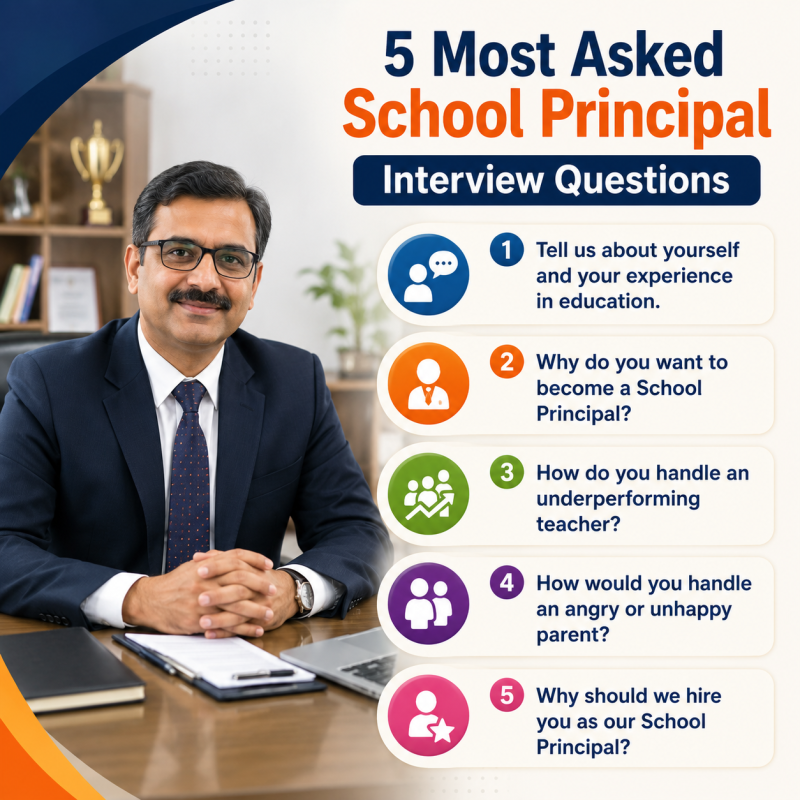
8. How do you motivate teachers?
Answer:
Teachers work better when they feel respected and supported.
I motivate teachers by appreciating good work, listening to their problems, giving useful feedback, and providing opportunities to learn new skills.
I also believe in giving responsibilities according to a teacher's strengths. For example, a teacher who is good at cultural activities can be given a suitable leadership role.
Small appreciation and regular communication can make a big difference in teacher motivation.
9. How will you handle conflict between two teachers?
Answer:
I will speak with both teachers and understand the issue without taking sides.
If needed, I will first speak to them separately and then arrange a discussion together. I will keep the conversation focused on the actual problem and not allow personal attacks.
My goal will be to find a practical solution and maintain a professional working environment.
If the conflict affects students or school work, I will take timely action instead of allowing the problem to continue.
10. How do you communicate with parents?
Answer:
I believe parents are important partners in a child's education.
The school should communicate with parents regularly, not only when there is a problem. Communication can happen through parent-teacher meetings, school apps, circulars, emails, phone calls, and individual meetings.
Communication should be simple, respectful, and clear.
For serious student matters, I prefer proper discussion and documentation so that everyone understands the issue and the next steps.
11. How will you manage pressure from school management?
Answer:
A Principal has to balance the expectations of management with the needs of teachers, students, and parents.
I will communicate openly with management, share facts and progress clearly, and explain challenges honestly.
If I receive a difficult target, I will break it into smaller goals and work with my team to create a practical plan.
I believe a Principal should not pass unnecessary pressure directly to teachers. The leader should help the team understand priorities and find solutions.
12. What will you do in your first 90 days as Principal?
Answer:
In the first 90 days, I will focus on understanding the school before making major changes.
I will:
- Meet teachers and key staff members.
- Understand the school's academic performance.
- Observe classrooms.
- Review discipline and attendance records.
- Understand parent concerns.
- Check important school processes.
- Identify urgent problems.
- Make a practical improvement plan.
I will not try to change everything immediately. First, I will understand what is working well and what needs improvement.
13. How do you use technology in school management and teaching?
Answer:
Technology should make teaching and school work easier, not more complicated.
It can help schools manage attendance, examination results, parent communication, fee records, lesson resources, and teacher training.
Teachers can also use smart boards, videos, presentations, and digital learning materials where they improve student understanding.
However, technology should support good teaching. It cannot replace a good teacher.
Read Also-How to Create a Professional School Principal Resume for Free: Step-by-Step Guide
14. How will you improve teacher retention?
Answer:
Teachers often leave schools because of poor communication, too much unnecessary pressure, lack of support, or no recognition for their work.
I will focus on creating a professional and respectful work environment.
I will listen to genuine staff concerns, appreciate good work, provide clear responsibilities, avoid unnecessary last-minute work, and support teacher development.
Salary is important, but the working environment and quality of leadership also affect whether good teachers stay in a school.
15. How will you handle a serious student safety issue?
Answer:
Student safety must always be taken seriously.
First, I will make sure the student is safe and follow the school's emergency and child-safety procedures. I will inform the required school authorities and properly document the incident.
I will avoid making quick assumptions and will make sure the matter is handled carefully, confidentially, and according to school policy and applicable rules.
After the immediate matter is handled, I will review what happened and take steps to prevent a similar problem in the future.
16. Why should we hire you as our School Principal?
Answer:
You should consider me for this position because I understand both academics and school administration.
I believe in supporting teachers, maintaining discipline, communicating clearly with parents, and keeping student learning and safety at the centre of school decisions.
I am willing to understand the school's existing culture and work with the management and staff to improve it step by step.
If selected, I will lead with responsibility, fairness, and a clear focus on the school's goals.
A Simple Case Study: Why an Experienced Teacher Was Not Selected for a Principal Job
Mr. Sharma had 18 years of teaching experience. He applied for a Principal position in a private school and felt confident that his experience would help him get the job.
During the interview, the panel asked:
"How would you handle an underperforming teacher?"
Mr. Sharma replied,
"I will give the teacher a warning and take strict action."
The interviewers then asked more questions about:
- Improving teachers' performance
- Handling parent complaints
- Improving academic results
- His first 90 days as Principal
Most of his answers focused only on warnings and strict action. He did not explain how he would guide teachers, work with parents, solve problems, or improve the school as a team.
In the end, he was not selected.
What Can We Learn?
- Experience alone does not guarantee success.
- Give practical examples from your work.
- Show that you can support and motivate teachers.
- Explain how you solve problems calmly.
- Talk about teamwork, communication, and school improvement.
Key Lesson
A school does not only want a strict Principal. It wants a good leader who can support teachers, work with parents, solve problems, and help the school grow.
Common Mistakes to Avoid in a School Principal Interview
- Do not give very long and confusing answers.
- Do not criticize your present or previous school.
- Do not blame teachers for every school problem.
- Do not say that strict punishment can solve every discipline issue.
- Do not give fake examples of achievements.
- Do not interrupt the interview panel.
- Do not answer every question with theory.
- Do not focus only on board exam results.
- Do not ignore teacher motivation and retention.
- Do not ignore parent communication.
- Do not speak badly about school management.
- Do not claim that you will change everything immediately.
- Listen to the full question before answering.
- Use real examples from your experience whenever possible.
How to Prepare for a School Principal Interview
A Principal interview needs more preparation than simply reading questions and answers.
Before attending the interview, learn about the school. Understand its curriculum, classes, academic approach, activities, and general background.
Prepare real examples from your own career. Think about situations where you:
- Improved student performance.
- Helped a weak teacher improve.
- Resolved a conflict.
- Handled a parent complaint.
- Managed a school event.
- Introduced a new academic idea.
- Solved a discipline problem.
- Led a team during a difficult situation.
Use simple numbers when you genuinely have them. For example, instead of saying, “I improved results,” you can explain what you changed and what improvement followed.
Never invent numbers or achievements.
Read Also-How to Get a School Principal Job in 7 Days: Step-by-Step Job Search & Interview Guide
Frequently Asked Questions (FAQs)
1. What questions are commonly asked in a School Principal interview?
School Principal interview questions usually focus on leadership, academic planning, teacher management, student discipline, parent communication, conflict resolution, school safety, technology in education, and school improvement. Interviewers may also ask situation-based questions to understand how you solve problems and lead a school effectively.
2. How should I introduce myself in a School Principal interview?
Start with a brief introduction about your education, teaching experience, and leadership roles. Mention your experience as a Coordinator, Vice Principal, Head of Department, or Principal, if applicable. Highlight your achievements in improving academics, managing teachers, handling parents, or leading school initiatives. Keep your introduction professional, confident, and within one to two minutes.
3. What qualities do schools look for in a Principal?
Schools look for a Principal who can provide strong leadership, improve academic performance, support teachers, communicate effectively with parents, and maintain a positive school environment. Good decision-making, problem-solving, team management, honesty, patience, and the ability to motivate staff are some of the most important qualities schools expect.
4. How long should my answers be in a Principal interview?
Your answers should be clear, relevant, and easy to understand. Simple questions can usually be answered in 30–60 seconds. For leadership or situation-based questions, explain the situation, describe the action you took, and share the outcome. Avoid giving very short or unnecessarily long answers.
5. Should I memorise Principal interview answers?
No. Memorising answers word for word can make you sound unnatural. Instead, understand the main idea behind each question and answer in your own words. Support your answers with real examples from your teaching or leadership experience whenever possible.
6. Can a senior teacher apply for a Principal position?
Yes. Many schools consider experienced senior teachers for Principal positions if they meet the required qualifications and experience. Candidates should also be able to demonstrate leadership skills such as managing teachers, planning academics, coordinating teams, handling parents, and supporting overall school administration.
7. What is the most important skill for a School Principal?
A successful Principal needs a combination of leadership, communication, decision-making, academic knowledge, teacher development, parent relationship management, conflict resolution, and school administration skills. Schools look for leaders who can inspire teachers and improve student learning.
8. What should I do if I do not know the answer to an interview question?
Stay calm and be honest. Do not guess or provide incorrect information. Explain how you would approach the situation, follow the school's policies, consult senior colleagues if needed, and make the best decision for the students and the school. Honest and thoughtful answers create a better impression than incorrect ones.
How SchoolNaukri Can Help Principal
Create Your Free Principal Resume
Build a professional Principal resume in minutes.
Create Free ResumeExplore Principal Jobs
Find Principal, Vice Principal, and school leadership vacancies across India.
Find School JobsDownload the SchoolNaukri App
Find and apply for the latest school leadership jobs easily.
Download the App
Conclusion
Preparing for a School Principal interview is not just about answering questions. It is about showing that you can lead a school, support teachers, work with parents, and create a positive learning environment for students.
Before your interview, take time to understand the school's vision, revise common leadership questions, and think of real examples from your teaching or administrative experience. Speak confidently, answer honestly, and focus on practical solutions instead of memorised responses.
Remember, schools are looking for a Principal who can inspire teachers, solve problems, improve academic standards, and build a strong school community. With the right preparation and a positive attitude, you can perform well in your interview and move one step closer to your leadership career.
We wish you all the best for your School Principal interview!