
CBSE Affiliation Process in India – Step-by-Step Application, Inspection & Approval Guide
Introduction
Schools that want to grow, attract more admissions and build trust among parents often plan to get CBSE affiliation.
But many school owners, principals and trustees do not fully understand the CBSE affiliation process. Some schools start building infrastructure before checking land rules. Some apply online without arranging recognition certificates, NOC, teacher records or fire safety documents. As a result, their application gets delayed or rejected.
If you are planning to get CBSE affiliation for your school, this guide will help you understand the complete process in simple language.
CBSE Affiliation Process in India – Step-by-Step Application, Inspection & Approval Guide
Getting CBSE affiliation is an important milestone for any school in India. The process involves meeting infrastructure, safety, academic, and administrative requirements set by CBSE. Schools must first obtain State Government recognition, complete all required documentation, and ensure compliance with CBSE norms. Once ready, the school can submit its application through the CBSE SARAS Portal. After document verification, CBSE may conduct an inspection to assess infrastructure, teacher qualifications, safety measures, and overall compliance. If all requirements are successfully met, CBSE grants affiliation approval, allowing the school to operate under the CBSE curriculum. Proper planning, accurate documentation, and timely compliance can make the affiliation process smoother and help avoid unnecessary delays.
What is CBSE Affiliation?
CBSE affiliation is the official approval given by the Central Board of Secondary Education that allows a school to teach the CBSE curriculum and send students for CBSE board examinations.
Without CBSE affiliation, a school cannot officially run classes under the CBSE pattern for board classes.
CBSE affiliation is important because it gives schools-
- National recognition
- Better trust among parents
- Standard curriculum and academic system
- Permission to conduct CBSE classes
- Better chances of student admissions
- Stronger school reputation
According to the CBSE Affiliation Bye-Laws, schools must fulfil conditions related to land, infrastructure, staff, finances, safety and documents before affiliation is granted.
Real School Problem & Practical Solution
A private school had good classrooms, smart boards, computer lab and enough student admissions. The management thought they were fully ready for CBSE affiliation.
However, during document verification, the school realised that the fire safety certificate had expired and the land documents were not updated properly.
As a result, the school had to delay its CBSE affiliation application and wait for the next cycle.
This is a common problem in many schools across India.
Practical solution--
Before applying for CBSE affiliation, schools should create a complete checklist for--
- Land papers
- Recognition certificate
- NOC
- Fire safety certificate
- Building safety certificate
- Sanitation certificate
- Teacher records
- Infrastructure readiness
This can save a lot of time, money and stress later.
Who Can Apply for CBSE Affiliation?
According to CBSE rules, the following types of schools can apply for affiliation:
- Society-run schools
- Trust-run schools
- Section 8 company schools
- Government schools
- Government-aided schools
- Schools run by public sector undertakings
- Schools run by local bodies or autonomous bodies
The school should be properly registered and should not be run for private profit.
Different Types of CBSE Affiliation
CBSE offers different types of affiliation depending on the class level and school situation.
| Type of Affiliation | Meaning |
|---|---|
| Approval for Middle Class Syllabus | For schools running middle-level classes |
| General Affiliation | For Secondary or Senior Secondary schools |
| Upgradation | For schools moving from Secondary to Senior Secondary |
| Switch Over | For schools shifting from another board to CBSE |
| Extension of Affiliation | For schools renewing existing affiliation |
These categories are mentioned in the CBSE Affiliation Bye-Laws.
Step-by-Step CBSE Affiliation Process
| Step | What School Needs to Do |
|---|---|
| Step 1 | Get school recognition from State Government |
| Step 2 | Arrange land and infrastructure |
| Step 3 | Collect required documents |
| Step 4 | Apply online on CBSE portal |
| Step 5 | Upload documents and pay fees |
| Step 6 | Prepare for CBSE inspection |
| Step 7 | Receive affiliation approval |
Step 1 – Get Recognition from State Government
Before applying for CBSE affiliation, the school must first get recognition from the State Government or concerned education department.
CBSE clearly states that recognition is compulsory.
Without recognition, the school cannot move ahead with the affiliation process.
Schools usually need recognition for the classes they are already running.
For example:
- Recognition up to Class 8 for applying up to middle level
- Recognition up to Class 10 for applying for secondary level
- Recognition up to Class 12 for senior secondary level
Read Also - Common Mistakes Schools Make While Applying for CBSE Affiliation (And How to Avoid Them)
Step 2 – Get NOC from State Government
Most private schools also need a No Objection Certificate (NOC) from the State Government.
- The NOC confirms that the state has no objection if the school wants to get CBSE affiliation.
- The NOC is usually issued by the State Education Department.
Schools should check the latest state rules because the NOC process may vary from one state to another.
Step 3 – Arrange Land and Infrastructure
Land and infrastructure are among the most important parts of CBSE affiliation.
CBSE requires schools to have land in lawful possession.
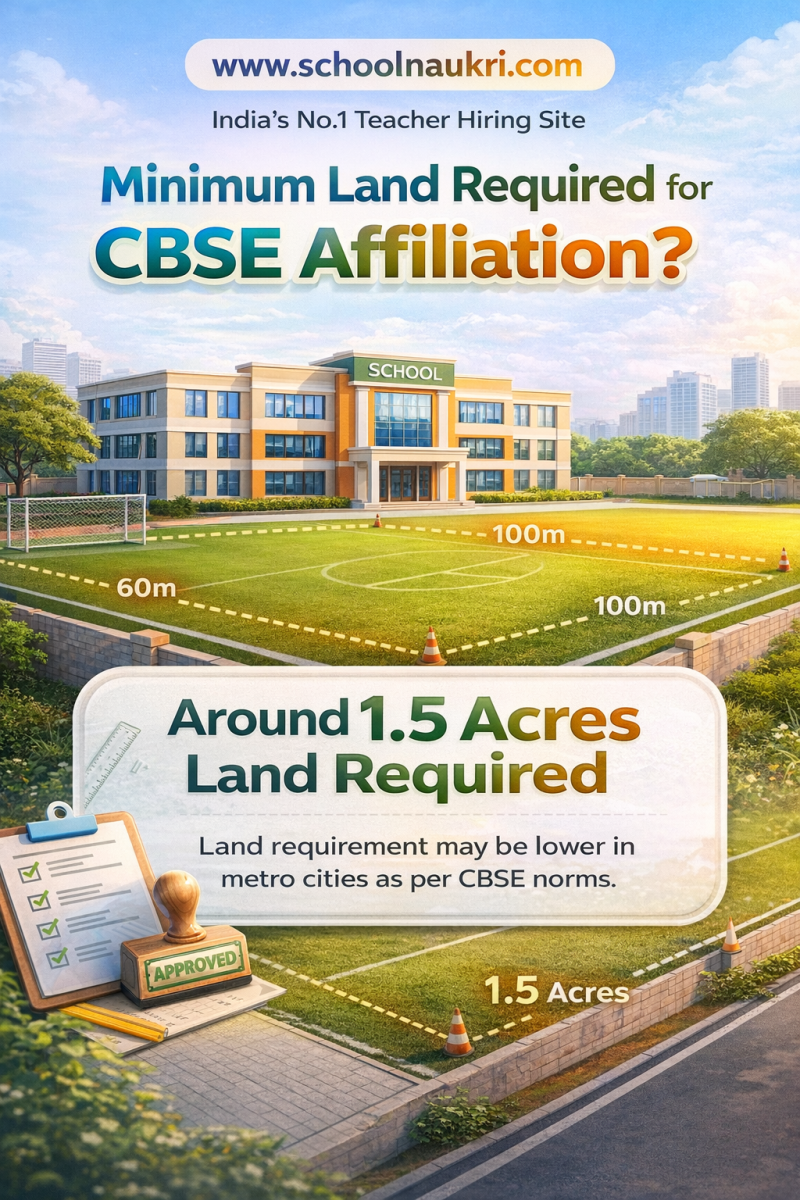
For most schools, the minimum land requirement is usually 6,000 square metres, but this can change depending on the city, location and class level. In some municipal areas and hill stations, lower land requirements are allowed.
CBSE also allows some schools to operate on leased land if the lease is long enough and legally valid. In many cases, the lease should generally be for at least 15 years.
Schools should also have--
- Proper classrooms
- Library
- Computer lab
- Science labs
- Toilets for boys and girls
- Drinking water facility
- Playground
- CCTV and safety systems
- Ramp for disabled students
- Separate rooms for indoor and outdoor activities
CBSE mentions that classroom size should generally be around 8 m x 6 m and science labs should usually be around 9 m x 6 m. Computer labs should usually be around 9 m x 6 m with proper computers and internet connectivity.
Step 4 – Keep All Important Documents Ready
Schools should keep all major documents ready before starting the online application.
Important documents usually include---
- Society or trust registration certificate
- School recognition certificate
- NOC from State Government
- Land ownership documents
- Lease deed if land is leased
- Building safety certificate
- Fire safety certificate
- Water and sanitation certificate
- Staff details
- Teacher qualification records
- Salary payment proof
- EPF and ESI compliance records
- School Management Committee details
- Photographs of infrastructure
- UDISE details
- Affidavit and declarations
The CBSE Bye-Laws also mention that the school should maintain complete records for students, teachers, non-teaching staff, salary details, accounts and school documents.
Step 5 – Teacher Qualification Requirement
Schools must appoint qualified teachers according to CBSE and NCTE norms.
Teacher qualification is important because CBSE checks whether the school has enough trained teachers for all classes.
Schools generally need--
- PRT teachers with D.El.Ed., B.El.Ed. or B.Ed.
- TGT teachers with graduation plus B.Ed.
- PGT teachers with post graduation plus B.Ed.
- Physical education teachers
- Counsellors
- Special educators
- Librarian
CBSE also mentions that the pupil-teacher ratio should not normally exceed 30:1 in the school.
Read Also - How to Get CBSE Affiliation for School in India – Complete Step-by-Step Guide
Step 6 – Apply Online on the CBSE Portal
The CBSE affiliation process is fully online.
Schools need to--
- Visit the CBSE affiliation portal
- Create login details
- Fill school information
- Upload documents
- Enter land and infrastructure details
- Enter teacher and salary details
- Pay the required fee
- Submit the application
According to CBSE rules, schools generally apply between March and the following year depending on the type of application and affiliation cycle.
Schools should double-check every document before submission because incorrect information can delay the process.
Step 7 – CBSE Inspection Process
After the application is submitted, CBSE may send an inspection committee to the school.
The inspection team checks--
- Infrastructure
- Teacher qualifications
- Classroom teaching
- Student records
- Safety measures
- Labs and library
- School management system
- Salary payment records
- Accounts and compliance
The inspection committee may also talk to teachers, students and parents.
The school should keep all original documents ready during inspection.
CBSE also says that the school must provide full support during the inspection process and allow physical verification of documents and facilities.
Common Mistakes Schools Make
Many schools make avoidable mistakes during the affiliation process.
Common mistakes include--
- Incomplete land documents
- Expired fire safety certificate
- Missing recognition certificate
- Weak teacher records
- Poor salary documentation
- Incomplete staff details
- Non-functional labs
- Inadequate library books
- Improper building safety certificate
- Wrong student-teacher ratio
- Poor website information
These mistakes can delay approval or create problems during inspection.
Approximate Fees and Expenses Involved
CBSE affiliation involves different types of expenses.
These may include--
- Application fee
- Inspection fee
- Affiliation fee
- Land and building expenses
- Lab setup cost
- Library cost
- Fire safety system cost
- CCTV installation
- Website and software cost
- Teacher salary expenses
According to the fee schedule in the CBSE Bye-Laws, fresh affiliation fees for schools in India may range from around Rs. 2.5 lakh and can increase depending on the category, level and type of affiliation.
Timeline for CBSE Affiliation Approval
The total timeline can vary depending on:
- Document readiness
- State recognition process
- NOC approval
- Inspection schedule
- Correction of errors
In many cases, the process may take several months.
Schools that prepare all documents properly in advance usually complete the process faster.
Important Checklist Before Applying
Before applying for CBSE affiliation, schools should check-
- Recognition certificate available
- NOC available
- Land papers complete
- Building ready
- Classrooms ready
- Library ready
- Labs ready
- Teacher records complete
- Salary proof available
- Fire safety certificate valid
- Water and sanitation certificate valid
- School website updated
- School Management Committee formed
- CCTV and safety measures installed
Want to hire qualified teachers in 7 days? Use www.schoolnaukri.com – India’s No.1 teacher hiring site, trusted by 10,000+ schools with 5 lakh+ teacher database. Starting is free – register in just 2 minutes.
Conclusion
Getting CBSE affiliation is not just about filling out an online application. Schools need to prepare important legal, land, infrastructure, safety, and staff-related documents well in advance. Proper planning can help schools avoid delays and make the affiliation process much smoother.
Before applying, schools should ensure that land papers, recognition certificates, NOC, classrooms, laboratories, teacher records, fire safety certificates, and other required documents are complete and up to date. Small gaps in documentation or infrastructure can lead to unnecessary delays and additional expenses.
A practical approach is to create a separate CBSE Affiliation Checklist and organise all important documents in both digital and hard-copy formats. Regularly reviewing these records can help schools stay prepared for inspection and future compliance requirements.
The best advice for school founders and management teams is simple: prepare early, keep your documents organised, and verify every requirement before applying for CBSE affiliation. Good planning can save time, reduce stress, and improve the chances of a smooth and successful affiliation process.

CBSE Contact Details for Affiliation Help
If schools need guidance related to CBSE affiliation process, application status or official requirements, they can contact CBSE directly through the official contact page.
This page provides important information such as CBSE office addresses, helpline numbers and regional office details.
Visit Official CBSE Contact Page – https://www.cbse.gov.in/cbsenew/contact-us.html