
Documents Required for CBSE Affiliation in India (2026) – Complete School Requirement Checklist
Introduction
Getting CBSE affiliation is one of the biggest steps for any school in India. Many school owners, principals and school management teams spend lakhs of rupees and several months because they are not fully prepared with the right documents before applying.
The biggest mistake most schools make is starting the CBSE process without first preparing a complete document file. Later, when CBSE asks for missing papers, safety certificates or land records, the school has to rush, pay extra money and sometimes even delay the application by 6–12 months.
If you prepare all important documents in advance, you can save time, money and avoid unnecessary stress.
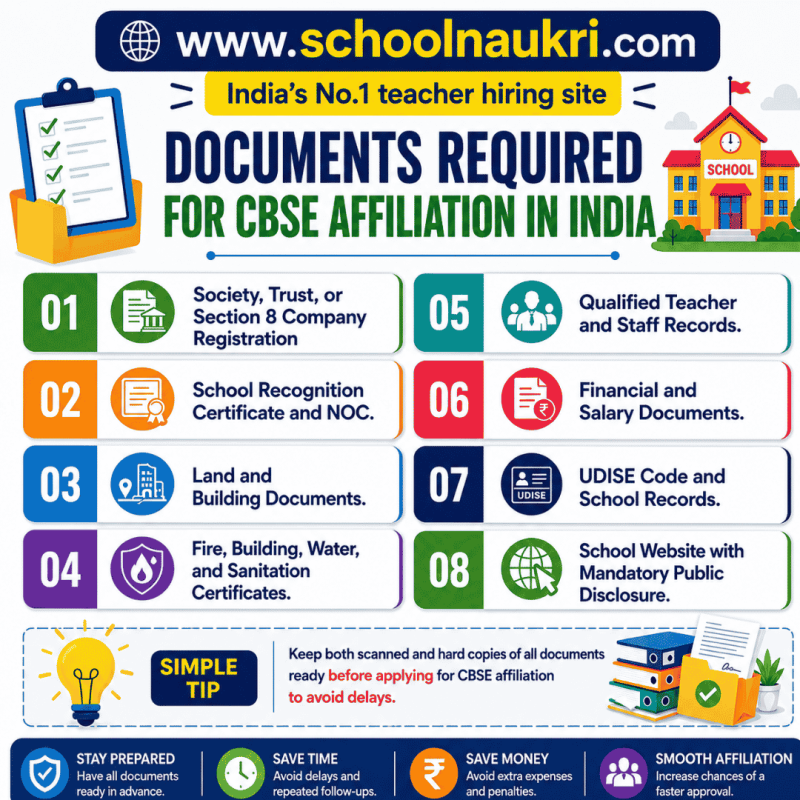
Schools applying for CBSE affiliation in 2026 usually need documents related to-
- School ownership and registration
- Land and building papers
- Recognition and NOC
- Fire and building safety
- Staff and salary records
- School website and public disclosure
- Financial documents
- Infrastructure proof
- Water, sanitation and health certificates
CBSE mainly checks whether the school is legally valid, safe for children, financially stable and properly managed.
What Documents Are Required for CBSE Affiliation in India?
To get CBSE affiliation, a school needs important documents like society or trust registration papers, school recognition certificate, NOC from the state government, land papers, building safety certificate, fire safety certificate, water and sanitation certificate, teacher documents, salary records, financial papers, UDISE code and school website details. Schools also need to follow CBSE rules related to land, safety, teacher-student ratio and public disclosure.
Table of Contents
Introduction
What Documents Are Required for CBSE Affiliation in India?
Real School Problem & Practical Solution
Registration Certificate of Society, Trust or Company
School Recognition Certificate
No Objection Certificate (NOC)
Land Certificate
Building Safety Certificate
Fire Safety Certificate
Water and Sanitation Certificates
Building Plan and Infrastructure Documents
Staff and Teacher Documents
Financial Documents
UDISE Code and School Records
School Website and Mandatory Public Disclosure
Important CBSE Rules and Laws Schools Must Know
Important Checklist Before Uploading Documents
Common Mistakes Schools Make
FAQs – CBSE Affiliation Requirements for Schools in India
Conclusion
About the Authors
CBSE Contact Details for Affiliation Help
Real School Problem & Practical Solution
A common situation in Madhya Pradesh schools – A school founder purchased land and started constructing the school building without carefully studying the CBSE Affiliation Bye-Laws. The classrooms, laboratories, and other facilities were built based on local advice instead of CBSE requirements.
When the school later applied for CBSE affiliation, it found that some parts of the infrastructure did not meet the required standards. The management had to redesign classrooms, modify parts of the building, and reconstruct certain facilities. This resulted in additional expenses and delayed the CBSE affiliation process by nearly two years.
The practical solution is simple: before purchasing land or starting construction, carefully study the latest CBSE Affiliation Bye-Laws and prepare a detailed school infrastructure plan. Consulting the official CBSE requirements at the planning stage can help schools avoid costly changes, save time, and make the affiliation process much smoother.
Documents required for CBSE affiliation
1. Registration Certificate of Society, Trust or Company
CBSE only allows schools that are run by a non-profit organization. Your school must be run by-
- A registered society
- A public trust
- A Section 8 company
You must keep these documents ready-
- Society registration certificate
- Trust deed
- Section 8 company incorporation certificate
- PAN card of the organization
- Memorandum of Association
- List of members or trustees
- Affidavit showing non-proprietary character of the school
CBSE does not allow a school to run as a personal business or sole proprietorship. The school must be owned and managed by a proper educational organization.
2. School Recognition Certificate
Before applying to CBSE, the school must already have recognition from the state education department.
This recognition certificate is usually issued by-
- District Education Officer (DEO)
- State Education Department
- Local education authority
Without recognition, CBSE generally does not accept the application.
For example, in Karnataka , schools usually first get recognition from the state education department and then move towards CBSE affiliation.
The recognition certificate should clearly mention-
- Name of the school
- School address
- Classes approved
- Validity period
- Issuing authority details
If the certificate is in Hindi or any regional language, keep an English translation also ready.
CBSE has fixed formats for many important documents. Schools should try to prepare documents in the same format to avoid objections.
Important CBSE document formats include:
- Land Certificate Format
- Building Safety Certificate Format
- Fire Safety Certificate Format
- Safe Drinking Water Certificate Format
- Sanitary Condition Certificate Format
- No Objection Certificate (NOC) Format
- Recognition Certificate Format
- Society Registration Certificate Format
- DEO Certificate Format
- Public Disclosure Format for School Website
- School Infrastructure Details Format
- Teacher Details and Teacher-Student Ratio Format
- School Management Committee (SMC) Format
- PTA Member List Format
- Fee Structure and Academic Calendar Format
Using these proper formats can make the CBSE affiliation process smoother and faster.
find pdf - https://saras.cbse.gov.in/SARAS/Manuals/CHAPTER_11_REVISED_APPENDIX_PROFORMA.pdf
3. No Objection Certificate (NOC)
The NOC is issued by the state government stating that it has no objection if the school gets CBSE affiliation.
For 2026, there is an important update. CBSE has relaxed the NOC requirement in some categories, and if the state government does not respond within a fixed period, it may be treated as deemed approval in some cases. However, it is still strongly recommended to obtain the NOC because many applications get delayed without it.
Your NOC should include-
- School name
- Address
- Name of society or trust
- State government approval wording
- Official signature and stamp
In many states, getting the NOC takes time. So schools should apply for it early.
4. Land Certificate
The land certificate is one of the most important documents for CBSE affiliation.
The land certificate proves-
The school owns the land, or
The school has leased the land legally
The land certificate must generally be issued by:
- DM
- ADM
- SDM
- Tehsildar
- Sub-Registrar
Other competent government authority
You should keep these documents ready-
- Sale deed
- Lease deed
- Gift deed
- Mutation papers
- Jamabandi or khasra details
- Registered land certificate
- Site map
- Boundary details
If the land is leased, the lease period is generally expected to be at least 15 years.
5. Building Safety Certificate
This certificate confirms that the school building is safe for students and staff.
The certificate is usually issued by-
- Government engineer
- Assistant Engineer
- PWD engineer
- Municipal engineer
- Structural engineer approved by the government
The building safety certificate should mention-
- Total number of floors
- School blocks
- Structural condition
- Safety status of the building
- Validity period
Schools often forget to renew this certificate. CBSE expects it to be valid on the date of application submission.
6. Fire Safety Certificate
This is another mandatory document.
The fire safety certificate is issued by-
- Fire department
- Municipal authority
- Fire officer
- Local government body
- Your school should have:
- Fire extinguishers
- Emergency exit plan
- Fire alarm system
- Safety signage
- Fire water tank if required
- Emergency evacuation process
A simple letter saying that fire extinguishers are installed is not enough. CBSE wants a proper fire safety certificate issued by the competent authority.
7. Water and Sanitation Certificates
Schools must show that they provide safe drinking water and a clean environment for students.
Important certificates include-
- Safe drinking water certificate
- Water testing report
- Sanitary certificate
- Hygiene certificate
- Health and sanitation certificate
- These documents are generally issued by:
- Municipal body
- Health department
- Water testing laboratory
- Public health engineering department
This is especially important for schools in rural areas where water quality can become a concern.
8. Building Plan and Infrastructure Documents
Your school should also keep building and infrastructure-related documents ready.
Important documents include-
- Approved building plan
- Architect certificate
- Floor-wise building map
- Classroom details
- Lab details
- Library details
- Playground details
- Transport details
- CCTV details
- Toilet details
- Ramp and accessibility details
CBSE expects schools to have proper classrooms, labs, library, sports area and student safety arrangements.
Read Also -How to Hire (Recruit) Math Teachers in India – Complete School Guide
9. Staff and Teacher Documents
Many schools focus only on infrastructure and forget teacher-related paperwork.
You should keep ready-
- Teacher appointment letters
- Qualification certificates
- Experience certificates
- Aadhaar card copies
- Salary records
- Bank transfer proof
- EPF details
- Staff attendance records
- Staff salary certificate
- Principal qualification documents
CBSE also expects salary to be paid through bank transfer or ECS instead of cash. Teacher details must also be uploaded on the school website as part of mandatory public disclosure.
10. Financial Documents
CBSE wants to see whether the school is financially stable.
Important financial documents include-
- Audited balance sheet
- Income and expenditure statement
- Bank statement
- Audit report
- Fee structure
- Financial status certificate
- Reserve fund details
- Salary payment proof
Usually, schools are asked to keep at least the last 3 years of financial records ready.
11. UDISE Code and School Records
Your school should also have-
- UDISE code
- Student strength records
- Class-wise enrollment details
- Admission register
- Attendance register
- School leaving certificate format
- School prospectus
- Timetable
- Internal assessment records
These documents help show that the school is functioning properly and already has students and academic records.
12. School Website and Mandatory Public Disclosure
One of the most ignored areas in CBSE affiliation is the school website.
CBSE expects the school website to show-
- Recognition certificate
- NOC
- Building safety certificate
- Fire safety certificate
- Water and sanitation certificate
- Teacher details
- Fee structure
- School managing committee
- PTA details
- Academic calendar
- Transfer certificate format
- Annual report
- Infrastructure details
Schools that do not update their websites regularly can face problems during inspection and renewal.
Read Also - How to Get CBSE Affiliation for School in India – Complete Step-by-Step Guide
Important CBSE Rules and Laws Schools Must Know
Many schools focus only on documents but ignore the actual CBSE rules behind those documents. Knowing these rules makes the process more authentic and also helps schools understand why CBSE asks for certain papers.
School Must Be Run by a Non-Profit Body
CBSE only gives affiliation to schools run by a registered society, registered trust or Section 8 company. A private individual or proprietorship cannot normally get CBSE affiliation. The school must have a proper managing committee and non-proprietary character. This rule is mentioned in the CBSE Affiliation Bye-Laws 2018.
Recognition from State Government Is Mandatory
Before applying for CBSE affiliation, the school must first get recognition from the State Education Department or competent authority. Without state recognition, the CBSE application is generally not accepted.
NOC Requirement from State Government
CBSE rules state that schools should obtain a No Objection Certificate from the State Government confirming that the state has no objection to the school getting CBSE affiliation.
Want to hire qualified teachers in 7 days? Use www.schoolnaukri.com – India’s No.1 teacher hiring site, trusted by 10,000+ schools with 5 lakh+ teacher database. Starting is free – register in just 2 minutes.
Minimum Land Requirement Rule
CBSE has fixed minimum land requirements depending on the city and location of the school.
In normal areas, schools usually need at least 4000 square metres of land
In municipal limits of large cities, schools may be allowed with 2000 square metres
Hill stations and North Eastern states may have lower land requirements
Existing schools in some metro cities may also get relaxation
These land norms are mentioned in Chapter 3 of the CBSE Affiliation Bye-Laws.
Land Must Be in the Name of School Society or Trust
The land should be legally owned or leased in the name of the Society, Trust or Section 8 Company running the school. If it is on lease, the lease should generally be for at least 15 years.
Maximum Students Per Section
CBSE clearly states that normally one section should not have more than 40 students. This rule is important for classroom space, teacher-student ratio and safety.
Teacher-Student Ratio Rule
CBSE expects schools to maintain a proper teacher-student ratio. Normally, the pupil-teacher ratio should not exceed 30:1 in the school. Schools must also appoint subject teachers, physical education teachers, counsellors and special educators where required.
Teacher Salaries Must Be Paid Through Bank
CBSE rules clearly mention that salary should be paid through ECS, bank transfer or cheque. Cash salary payment can create problems during inspection.
NCERT Books Rule
Schools affiliated with CBSE are expected to use NCERT books in classes and subjects where NCERT books are available. Schools should avoid books containing objectionable content against any religion, caste, gender or community.
School Website and Public Disclosure Is Mandatory
Every CBSE school must maintain a website and upload important public documents such as--
- Recognition certificate
- NOC
- Fire safety certificate
- Building safety certificate
- Water and sanitation certificate
- Teacher details
- Fee structure
- Managing committee details
Many schools ignore this rule and face problems during inspection.
RTE Act Compliance
CBSE rules define the Right to Education Act, 2009 as an important part of affiliation compliance. Schools should follow RTE-related rules for admission, infrastructure, safety and reservation wherever applicable.
For detailed rules, schools can also read the official CBSE Affiliation Bye-Laws PDF published by the Central Board of Secondary Education – https://www.cbse.gov.in/cbsenew/documents/affiliation-Bye-Laws.pdf
Safety Rules Are Mandatory
CBSE expects schools to follow important student safety rules under:
- National Building Code
- Fire Safety Rules
- Disaster Management Guidelines
- Supreme Court School Safety Guidelines
- Child Protection and POCSO-related safety measures
This is why schools need valid building safety, fire safety, water safety and sanitation certificates. The CBSE bye-laws also mention the importance of National Disaster Management Authority guidelines and school safety norms.
Important Checklist Before Uploading Documents
Before submitting documents on the SARAS portal, check these points carefully:
- All certificates should be valid
- Names should match in every document
- School address should be same everywhere
- Land area should match building plan
- Documents should be signed and stamped
- Scanned copies should be clear
- File names should be proper
- PDF size should match portal requirement
- Expired certificates should be renewed first
- Hindi documents should also have English translation if needed
Even one mismatch in school name, address or land details can create unnecessary objections.
Common Mistakes Schools Make
Many schools lose time and money because of small mistakes such as:
- Uploading expired fire certificate
- Missing land certificate format
- Incorrect school website details
- No teacher salary proof
- Wrong building plan
- No recognition certificate
- Missing NOC
- Unclear scanned copies
- Mismatch in address or school name
- Not uploading public disclosure documents
Avoiding these mistakes can save a school from rejection or repeated inspection.
FAQs – CBSE Affiliation Requirements for Schools in India
1. What documents are required for CBSE affiliation in India?
Schools applying for CBSE affiliation generally need several important documents, including the Society or Trust registration certificate, school recognition certificate, No Objection Certificate (NOC), land ownership or lease papers, building and fire safety certificates, health and sanitation certificates, staff details, salary records, and other documents required under the CBSE Affiliation Bye-Laws. Keeping these documents ready can make the application process smoother.
2. Is a No Objection Certificate (NOC) required for CBSE affiliation?
Yes. In many cases, schools need a No Objection Certificate (NOC) or the required approval from the State Government before applying for CBSE affiliation. Schools should check the latest CBSE guidelines and state-specific rules before starting the application process.
3. How much land is required for CBSE affiliation?
The land requirement depends on the location of the school and the type of affiliation. In many normal areas, CBSE generally expects around 4000 square metres of land, while different norms may apply for metro cities, hilly regions, and North Eastern states. Schools should always verify the latest CBSE land requirements before purchasing land or starting construction.
4. Can a school get CBSE affiliation on leased land?
Yes. A school can apply for CBSE affiliation on leased land if the lease agreement meets the conditions prescribed by CBSE. In many cases, a long-term lease of at least 15 years is generally expected, along with proper legal documentation.
5. Is a fire safety certificate mandatory for CBSE affiliation?
Yes. A valid fire safety certificate is one of the important documents required for CBSE affiliation. Schools should ensure that the certificate is issued by the competent authority and remains valid throughout the affiliation process.
6. Can a school apply for CBSE affiliation without State Government recognition?
No. State recognition is an important requirement for CBSE affiliation. Schools should obtain the necessary recognition and approvals from the competent authority before applying to CBSE.
7. What is the most common mistake schools make before applying for CBSE affiliation?
A common mistake is starting construction or investing heavily in infrastructure without checking the CBSE Affiliation Bye-Laws. This can lead to costly modifications, delays, and additional expenses during the affiliation process.
8. How can schools improve their chances of getting CBSE affiliation?
Schools should plan carefully, create the correct legal structure, maintain proper documents, appoint qualified teachers, follow CBSE infrastructure and safety norms, and regularly check the latest CBSE Affiliation Bye-Laws before applying.
Conclusion
If your school is planning to apply for CBSE affiliation, start preparing well in advance instead of waiting for the application window to open. Good planning can save time, money, and unnecessary stress.
A simple way to stay organised is to create separate files for important documents such as:
Legal and registration documents
Land and building papers
Fire, safety, and health certificates
Teacher and staff records
Financial documents
School website details
Infrastructure photographs
Many schools face delays because they collect documents at the last minute or discover that important papers are missing. Keeping both hard copies and scanned copies of all records can make the CBSE affiliation process much smoother.

About the Authors
Abhishek Ranjan and Atul Kumar are the founders of SchoolNaukri and actively work with schools across India to support teacher recruitment, school management, and educational growth.
By interacting with school founders, principals, and management teams, they understand the practical challenges schools face while planning expansion, meeting compliance requirements, and building strong academic institutions. Their aim is to simplify complex school-related topics and provide practical guidance for school leaders.
They are also the authors of "The Ultimate School Hiring Workbook," a practical resource that helps schools strengthen their recruitment systems and build effective teaching teams.
CBSE Contact Details for Affiliation Help
If schools need guidance related to CBSE affiliation process, application status or official requirements, they can contact CBSE directly through the official contact page.
This page provides important information such as CBSE office addresses, helpline numbers and regional office details.
Visit Official CBSE Contact Page – https://www.cbse.gov.in/cbsenew/contact-us.html