
CBSE vs ICSE vs IB: Which School Board Is Best for Your School? Complete Comparison Guide
Introduction
Choosing the right school board is one of the most important decisions for any school owner, trustee, principal, or education entrepreneur. The board you choose affects your curriculum, teaching methods, teacher recruitment, infrastructure, student admissions, school reputation, and long-term growth.
In India, CBSE (Central Board of Secondary Education), ICSE (Indian Certificate of Secondary Education), and IB (International Baccalaureate) are among the most popular school boards. Each board has its own curriculum, teaching approach, assessment system, and eligibility requirements.
Many school management teams often ask questions like:
- Which school board is best for starting a new school?
- Should I choose CBSE, ICSE, or IB?
- Which board attracts more admissions?
- Which board is better for international education?
- What are the differences between CBSE, ICSE, and IB?
- Which board requires more investment?
If you're planning to start a new school or upgrade your existing school, this guide will help you understand the differences between CBSE, ICSE, and IB so you can make an informed decision.
CBSE vs ICSE vs IB: Which School Board Is Best for Your School?
Choosing the right school board depends on your school's vision, budget, target students, and long-term goals. CBSE is ideal for schools that want to prepare students for competitive exams and follow the Indian curriculum. ICSE is a good choice for schools focusing on balanced education, strong English, and practical learning. IB is best for schools offering international education with inquiry-based learning and global recognition. There is no single best board for every school—the right choice depends on what your school wants to achieve.
What is CBSE?
CBSE (Central Board of Secondary Education) is one of the largest and most recognized school boards in India. It is managed by the Government of India and is followed by thousands of schools across the country and abroad.
CBSE follows a structured and standardized curriculum designed to build strong academic knowledge while preparing students for competitive examinations such as JEE, NEET, CUET, and other national entrance exams.
The board focuses on conceptual understanding, practical learning, and skill development while maintaining a balance between academics and extracurricular activities.
CBSE is suitable for schools that want to:
- Follow a nationally recognized curriculum
- Prepare students for competitive exams
- Maintain standardized academic practices
- Offer affordable quality education
- Attract a wide range of students
Key Features of CBSE
- Government-recognized national board
- NCERT-based curriculum
- Competency-based learning
- Continuous curriculum updates
- Widely accepted across India
- Suitable for students preparing for competitive exams
- Large network of affiliated schools
Learn More About CBSE
Schools planning to adopt the CBSE curriculum can refer to the official CBSE website for affiliation, curriculum, examinations, and academic guidelines.
Official Website:
https://www.cbse.gov.in/
What is ICSE?
ICSE (Indian Certificate of Secondary Education) is conducted by the Council for the Indian School Certificate Examinations (CISCE).
ICSE is known for its detailed curriculum and balanced approach to academics, languages, arts, and extracurricular learning. Compared to CBSE, the syllabus is generally more comprehensive and places greater emphasis on English language skills, analytical thinking, project work, and practical learning.
Many parents prefer ICSE schools because they focus on the overall development of students rather than only examination preparation.
Key Features of ICSE
- Strong English language curriculum
- Detailed subject coverage
- Project-based learning
- Practical and analytical approach
- Equal importance to academics and co-curricular activities
- Well-recognized across India
Learn More About ICSE
Schools interested in the ICSE curriculum can visit the official CISCE website for curriculum details, examination information, and school regulations.
Official Website:
https://cisce.org/
What is IB?
IB (International Baccalaureate) is an internationally recognized education board headquartered in Switzerland. It is followed by thousands of schools worldwide and is known for its inquiry-based and student-centred learning approach.
Unlike traditional education systems, IB encourages students to ask questions, think critically, solve real-world problems, conduct research, and become independent learners.
IB schools are popular among parents looking for an internationally focused education and students planning to study abroad.
The IB offers four programmes:
- Primary Years Programme (PYP)
- Middle Years Programme (MYP)
- Diploma Programme (DP)
- Career-related Programme (CP)
Key Features of IB
- Internationally recognized curriculum
- Inquiry-based learning
- Student-centred classrooms
- Research-focused education
- Strong communication and leadership development
- Global university recognition
- Emphasis on critical thinking and creativity
Learn More About the IB Programme
Schools planning to introduce the International Baccalaureate (IB) curriculum can explore the official IB website to understand its programmes, teaching approach, and authorization process.
Official Website:
https://www.ibo.org
Why Choosing the Right Board Matters
Selecting the right school board is not just about academics. It influences almost every aspect of running a successful school.
The board you choose affects:
- Student admissions
- Teacher recruitment
- Infrastructure requirements
- School branding
- Annual operating costs
- Curriculum planning
- Parent expectations
- National and international recognition
- Long-term growth of the school
For example, an IB school usually requires greater investment, specialized teacher training, and international teaching practices, while a CBSE school follows a more standardized Indian curriculum with broader accessibility.
Understanding these differences before applying for affiliation can save both time and money.
In This Guide, You'll Learn
In the next sections, we'll compare CBSE, ICSE, and IB in detail based on:
- Curriculum
- Teaching Method
- Assessment System
- Examination Pattern
- Teacher Qualifications
- Student Skills
- Global Recognition
- Infrastructure Requirements
- Affiliation Process
- School Investment
- Advantages & Disadvantages
- Which Board Is Best for Your School?
By the end of this guide, you'll have a clear understanding of which school board best matches your school's vision, budget, and long-term goals.
Read Also-How Schools Can Find and Hire Sanskrit Teachers in India – Complete Recruitment Guide
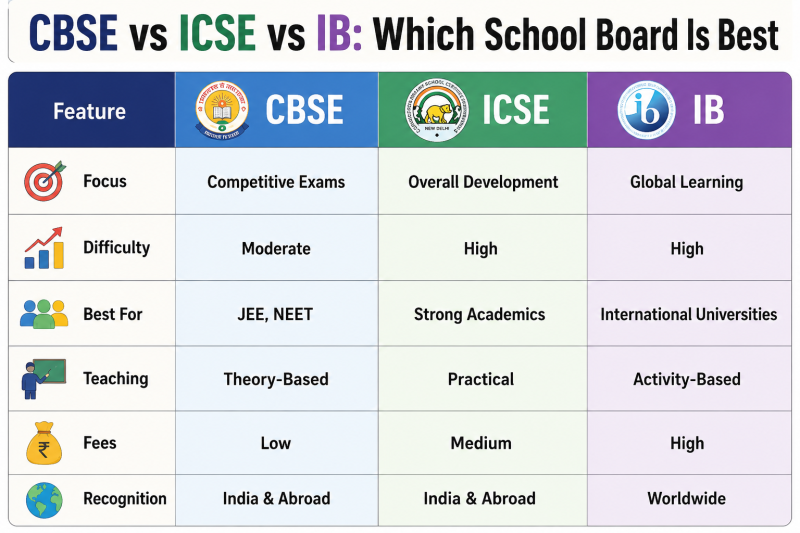
CBSE vs ICSE vs IB: Quick Comparison Table
The table below provides a quick overview of the key differences between CBSE, ICSE, and IB. If you're planning to start a new school or change your school board, this comparison will help you understand which board best matches your school's goals.
| Feature | CBSE | ICSE | IB |
|---|---|---|---|
| Full Form | Central Board of Secondary Education | Indian Certificate of Secondary Education | International Baccalaureate |
| Managed By | Government of India | CISCE | International Baccalaureate Organization (IBO) |
| Recognition | India & Abroad | India & Abroad | Worldwide |
| Curriculum | National | National | International |
| Teaching Style | Concept-based | Detailed & Practical | Inquiry-based & Student-centred |
| Difficulty Level | Moderate | Moderate to High | High |
| Focus | Academics & Competitive Exams | Overall Development | Critical Thinking & Global Learning |
| Assessment | Exams + Internal Assessment | Exams + Projects | Continuous Assessment & Projects |
| Competitive Exam Preparation | Excellent | Good | Moderate |
| International Recognition | Good | Good | Excellent |
| Best For | Schools targeting Indian curriculum | Schools focusing on balanced education | International schools & global education |
| Teacher Training | Standard | Standard | Specialized IB Training |
| Infrastructure Requirement | Moderate | Moderate | High |
| Cost to Operate | Moderate | Moderate to High | High |
| Affiliation Process | CBSE | CISCE | IB Authorization |
| Parent Demand | Very High | High | Growing |
| Suitable For | Most Indian schools | Premium Indian schools | International schools |
Which School Board Is Best?
There is no single "best" school board for every school. The right choice depends on your school's vision, target audience, budget, location, and long-term goals.
- Choose CBSE if you want a widely recognized curriculum, affordable operations, and strong preparation for competitive exams.
- Choose ICSE if your school wants to provide a balanced education with greater emphasis on English, projects, and overall student development.
- Choose IB if you're building an international school focused on global education, inquiry-based learning, and students planning to study abroad.
Detailed Comparison: CBSE vs ICSE vs IB
Choosing the right school board involves more than comparing names. Each board follows a different approach to teaching, learning, assessment, and student development. Understanding these differences will help you choose the board that best fits your school's vision.
1. Curriculum
The curriculum is the foundation of every school. It determines what students learn and how subjects are taught.
CBSE
CBSE follows the NCERT curriculum, which is designed according to national education standards. The syllabus is structured, easy to follow, and regularly updated by the board.
It is especially suitable for students preparing for JEE, NEET, CUET, and other competitive examinations.
ICSE
ICSE offers a more detailed curriculum with greater emphasis on languages, arts, humanities, science, and practical learning. Students study subjects in greater depth and complete project work throughout the academic year.
IB
IB follows an international curriculum focused on inquiry, research, collaboration, and real-world learning. Instead of memorizing information, students learn by asking questions, solving problems, and exploring concepts.
Best Choice
- CBSE: Structured national curriculum
- ICSE: Detailed and balanced curriculum
- IB: International and inquiry-based curriculum
Read Also-How to Get CBSE Affiliation for School in India – Complete Step-by-Step Guide
2. Teaching Method
Each board follows a different teaching philosophy.
CBSE
Teachers explain concepts using textbooks, classroom discussions, practical activities, and assignments. The focus is on building strong subject knowledge while preparing students for higher education.
ICSE
ICSE encourages project work, practical learning, presentations, and classroom participation. Students are expected to think analytically and improve their communication skills.
IB
IB classrooms are highly interactive. Teachers act as facilitators, encouraging students to investigate, research, collaborate, and solve real-life problems instead of simply listening to lectures.
Best Choice
- CBSE: Concept-based learning
- ICSE: Practical and activity-based learning
- IB: Inquiry-based and student-centred learning
3. Assessment & Examination System
The way students are assessed also differs across boards.
CBSE
Assessment includes periodic tests, practical examinations, internal assessments, and final board examinations. Recent reforms also focus on competency-based questions.
ICSE
Students are evaluated through written examinations, project work, practical assessments, and internal evaluations throughout the academic year.
IB
IB follows continuous assessment rather than relying only on final examinations. Students complete projects, presentations, research assignments, essays, and internal assessments along with external evaluations.
Best Choice
- CBSE: Balanced exams and internal assessments
- ICSE: Exams combined with extensive project work
- IB: Continuous assessment and research-based evaluation
4. Student Skills Developed
Every school board develops different skills in students.
CBSE
CBSE builds strong academic knowledge and logical thinking while helping students prepare for national competitive examinations.
ICSE
ICSE focuses on communication skills, analytical thinking, creativity, language proficiency, and overall personality development.
IB
IB develops critical thinking, research skills, leadership, communication, teamwork, creativity, and global awareness.
Best Choice
- CBSE: Academic excellence
- ICSE: Balanced overall development
- IB: Global skills and independent learning
5. Which Board Is Easier for Teachers?
Schools should also consider teacher recruitment and training requirements.
CBSE
Qualified teachers with relevant degrees and B.Ed. qualifications can easily adapt to the CBSE curriculum. Finding experienced CBSE teachers is generally easier because CBSE schools are widespread across India.
ICSE
ICSE schools usually prefer teachers with strong subject knowledge, excellent English communication skills, and experience in project-based learning.
IB
IB schools require teachers who understand inquiry-based teaching methods. Many IB schools also encourage or require teachers to complete IB professional development programmes.
Best Choice
- CBSE: Easier teacher recruitment
- ICSE: Moderate recruitment requirements
- IB: Specialized teacher recruitment and training
Read Also-How Schools Can Find and Hire English Teachers in India – Step-by-Step Recruitment Guide
6. Infrastructure Requirements
The infrastructure required for your school depends on the board you choose. While all three boards expect schools to provide a safe and student-friendly learning environment, the level of facilities and resources varies.
CBSE
CBSE has clear infrastructure guidelines covering classrooms, laboratories, library, sports facilities, safety measures, and other essential amenities. Most schools can meet these requirements with proper planning.
ICSE
ICSE schools also require good infrastructure, including well-equipped laboratories, libraries, computer labs, sports facilities, and activity rooms. Schools are encouraged to provide facilities that support practical and project-based learning.
IB
IB schools generally require a more advanced learning environment. Flexible classrooms, modern libraries, digital learning resources, science laboratories, creative learning spaces, and strong teacher support systems are important parts of an IB school.
Best Choice
- CBSE: Moderate infrastructure requirements
- ICSE: Moderate to good infrastructure
- IB: Premium infrastructure with modern learning facilities
7. School Setup Cost
The investment required to start a school depends on factors such as land, building, location, staff salaries, infrastructure, and the board you choose.
CBSE
CBSE schools generally require moderate investment, making them one of the most popular choices for new schools in India.
ICSE
ICSE schools may require slightly higher investment because of additional facilities, practical learning resources, and subject-specific infrastructure.
IB
IB schools usually require the highest investment due to international standards, specialized teacher training, modern infrastructure, technology integration, and the IB authorization process.
Best Choice
| Board | Investment Level |
|---|---|
| CBSE | Moderate |
| ICSE | Moderate to High |
| IB | High |
8. International Recognition
If your school plans to attract expatriate families or students who may pursue higher education abroad, international recognition is an important factor.
CBSE
CBSE is recognized by universities across India and many institutions worldwide. It is particularly suitable for students planning to study in India.
ICSE
ICSE is also widely accepted by universities in India and abroad. Its strong English curriculum is often appreciated during higher education.
IB
IB is one of the most internationally recognized school programmes. Many universities around the world value the IB Diploma because it emphasizes research, independent learning, and critical thinking.
Best Choice
- CBSE: Good international recognition
- ICSE: Good international recognition
- IB: Excellent international recognition
9. Affiliation Process
Each board has its own affiliation or authorization process.
CBSE
Schools must meet the infrastructure, land, safety, financial, and academic requirements prescribed by CBSE before applying for affiliation.
ICSE
Schools seeking ICSE affiliation must follow the eligibility criteria and standards laid down by CISCE, including infrastructure, staffing, and academic readiness.
IB
IB schools must complete the official authorization process. This includes planning, teacher training, implementation, and evaluation before becoming an authorized IB World School.
Best Choice
| Board | Affiliation Process |
|---|---|
| CBSE | Structured and standardized |
| ICSE | Detailed and systematic |
| IB | Comprehensive authorization process |
10. Which Board Is Best for Starting a New School?
There is no single answer because every school has different goals, budget, and target audience.
Choose CBSE if:
- You want to start a school with moderate investment.
- Your focus is on the Indian education system.
- You want to prepare students for competitive exams.
- You want a widely accepted national curriculum.
- You want easier teacher recruitment.
Choose ICSE if:
- You want to provide a balanced and detailed curriculum.
- Your school focuses on strong English communication.
- You value project-based and practical learning.
- You are targeting parents looking for holistic education.
Choose IB if:
- You want to establish an international school.
- You are targeting global education.
- Your students may pursue higher education abroad.
- You are ready to invest in premium infrastructure and teacher training.
- You want to offer inquiry-based learning and internationally recognized programmes.
Advantages and Disadvantages of CBSE, ICSE & IB
Every school board has its own strengths and limitations. The best choice depends on your school's vision, target audience, budget, and long-term goals.
CBSE: Advantages & Disadvantages
Advantages
- Government-recognized and widely accepted across India.
- NCERT-based curriculum supports JEE, NEET, CUET, and other competitive exams.
- Easier to recruit qualified teachers due to the large number of CBSE schools.
- Moderate infrastructure and operational costs.
- Standardized curriculum suitable for schools in both urban and rural areas.
- Simple and well-defined affiliation process.
Disadvantages
- Less flexibility compared to IB.
- Limited emphasis on research and inquiry-based learning.
- Fewer project-based activities than ICSE and IB.
ICSE: Advantages & Disadvantages
Advantages
- Strong focus on English language and communication skills.
- Balanced curriculum covering academics, arts, sports, and practical learning.
- Encourages project work, creativity, and analytical thinking.
- Suitable for students seeking overall personality development.
- Well-recognized by universities in India and abroad.
Disadvantages
- More detailed syllabus than CBSE.
- Higher workload due to projects and assignments.
- Teacher recruitment may require stronger subject expertise and English proficiency.
IB: Advantages & Disadvantages
Advantages
- Internationally recognized curriculum.
- Focus on critical thinking, creativity, research, and leadership.
- Student-centred and inquiry-based learning approach.
- Excellent preparation for international universities.
- Develops communication, collaboration, and global perspectives.
Disadvantages
- High setup and operating costs.
- Requires specialized teacher training.
- IB authorization takes time and careful planning.
- Premium fee structure may limit admissions in some markets.
Common Mistakes Schools Make While Choosing a School Board
Choosing the wrong board can increase costs, create operational challenges, and affect admissions. Many schools make avoidable mistakes during the decision-making process.
Choosing a Board Based Only on Popularity
A board may be popular nationally, but it should also match your school's vision, target audience, and long-term plans.
Ignoring Local Parent Demand
Before selecting a board, understand what parents in your city or region are looking for. Demand varies from one location to another.
Underestimating Infrastructure Requirements
Every board has different expectations for classrooms, laboratories, libraries, sports facilities, and learning resources. Plan your infrastructure carefully before applying.
Not Planning Teacher Recruitment
Your teachers should have the qualifications and teaching skills required by the board you choose. Recruitment and training should be part of your planning from the beginning.
Ignoring Long-Term Costs
Look beyond the initial setup cost. Consider teacher salaries, staff training, annual operational expenses, technology upgrades, and future expansion.
Applying Without Understanding the Affiliation Process
Many schools begin the affiliation process without fully understanding the documentation, infrastructure standards, and compliance requirements. This can delay approval and increase costs.
Which School Board Should You Choose?
There is no single board that is best for every school.
Choose the board that matches your school's mission, budget, student profile, and future goals.
- Choose CBSE if you want a nationally recognized curriculum, moderate investment, and strong preparation for competitive examinations.
- Choose ICSE if you want a balanced curriculum with greater emphasis on English, projects, creativity, and overall student development.
- Choose IB if you want to build an international school offering inquiry-based learning and globally recognized education.
The right decision is the one that supports your school's long-term growth while meeting the expectations of your students and parents.
How SchoolNaukri Can Help Schools
Finding the right teachers is one of the biggest challenges for any school, regardless of the board you choose. Whether your school follows CBSE, ICSE, or IB, building a qualified and experienced teaching team is essential for delivering quality education.
SchoolNaukri can help your school by:
- Hire qualified teachers across India.
- Find Principals, Vice Principals, Academic Coordinators, and school staff.
- Access 10 Lakh+ teacher resumes.
- Post school job vacancies quickly.
- Receive applications from active job seekers.
- Shortlist candidates based on qualification and experience.
- Recruit subject-wise teachers for Primary, PRT, TGT, PGT, IB, and ICSE schools.
- Simplify your school hiring process through one trusted platform.
Frequently Asked Questions (FAQs)
Is CBSE better than ICSE and IB?
There is no single board that is best for every school. CBSE is ideal for schools focusing on the Indian curriculum and competitive exams. ICSE offers a balanced education with strong English and project-based learning, while IB is best for schools providing international education and inquiry-based learning.
Which school board is best for starting a new school in India?
The best board depends on your school's vision, budget, location, and target audience. Most new schools choose CBSE because it is widely recognized and easier to manage. Schools aiming for international education may consider IB, while ICSE is a good choice for balanced academic development.
Which board requires the highest investment?
Among the three, IB schools generally require the highest investment due to international standards, teacher training, infrastructure, and the authorization process. CBSE usually requires moderate investment, while ICSE falls between CBSE and IB.
Which board is better for competitive exams like JEE and NEET?
CBSE is generally considered the best option for students preparing for competitive exams because its curriculum closely follows NCERT, which is widely used for national entrance examinations.
Which board has the best international recognition?
IB has the strongest international recognition and is accepted by universities around the world. CBSE and ICSE are also recognized internationally but primarily serve students pursuing education in India.
Is it difficult to get CBSE, ICSE, or IB affiliation?
Each board has its own eligibility criteria and approval process. Schools must meet infrastructure, safety, academic, and administrative requirements before receiving affiliation or authorization.
Which board is better for overall student development?
ICSE and IB place greater emphasis on communication, creativity, practical learning, and critical thinking. CBSE focuses on strong academic foundations while also supporting overall student development.
Can schools change their board later?
Yes. Schools can change their board if they meet the eligibility requirements of the new board and complete the required affiliation or authorization process. Proper planning is important before making such a decision.
Which teachers are required for CBSE, ICSE, and IB schools?
All schools require qualified and experienced teachers. IB schools may also require teachers to undergo specialized IB professional development programmes, while CBSE and ICSE generally recruit teachers based on educational qualifications and teaching experience.
How can SchoolNaukri help schools recruit teachers?
SchoolNaukri helps schools hire qualified teachers, principals, vice principals, academic coordinators, and school staff from across India. Schools can post vacancies, access 10 Lakh+ teacher resumes, shortlist candidates, and simplify their recruitment process through one platform.
SchoolNaukri Insight
At SchoolNaukri, we regularly interact with school owners, principals, and education leaders across India. One piece of advice we often share is don't choose a school board simply because other schools are doing it.
Before starting a CBSE, ICSE, or IB school, take time to understand your local market. Talk to parents, study the demand in your area, evaluate the competition, and choose the board that best matches your school's vision, budget, faculty, and long-term goals.
Schools that make this decision after proper research are usually better positioned to attract admissions, hire the right teachers, and grow successfully over time.
Conclusion
Choosing between CBSE, ICSE, and IB is an important decision for every school. Each board has its own strengths, curriculum, teaching style, and long-term benefits.
Before making a decision, understand your school's vision, budget, infrastructure, parent expectations, and future growth plans. Selecting the right board at the beginning can help you build a strong academic foundation and create better learning opportunities for students.
No matter which board you choose, one thing remains the same—great schools are built by great teachers. Hiring qualified teachers, school leaders, and support staff plays a key role in delivering quality education and achieving long-term success.
If you're planning to recruit teachers for your CBSE, ICSE, or IB school, SchoolNaukri can help you connect with qualified education professionals across India and make your school hiring process faster and easier.
About the Authors
Abhishek Ranjan and Atul Kumar are the founders of SchoolNaukri, India's No.1 School Hiring & Teacher Recruitment Platform. They regularly work with school owners, principals, directors, and HR teams across India, helping schools strengthen their recruitment processes and build high-performing teaching teams.
Through their experience in the education sector, they also interact with schools following CBSE, ICSE, IB, Cambridge, and State Board curricula. These interactions have given them practical insights into how different school boards approach academics, teacher recruitment, curriculum delivery, and overall school management.
They are also the authors of "The Ultimate School Hiring Workbook," a practical resource that helps schools improve recruitment through structured interview questions, teacher evaluation tools, hiring checklists, and proven hiring systems. Their mission is to help schools make informed decisions that improve both teaching quality and student outcomes.